Greek Mythology
Nike: Greek Goddess of Victory — Family, Symbols & Myths
Meet Nike, Greek goddess of victory: her parents, siblings, symbols, myths, and Roman name Victoria — explained clearly with facts…
 KnowMastery
 Chiron is the wisest and most civilized of all centaurs in Greek mythology. He symbolizes healing that comes from personal suffering, the link between animal instinct and higher knowledge, and the patient mentor who shapes heroes. Unlike the wild, drunken centaurs born from Ixion's union with a cloud, Chiron was the son of the Titan Cronus and the sea nymph Philyra, which made him immortal, gentle and highly educated. He is the original wounded healer, the idea that pain and mortality can become a source of wisdom instead of despair.
There is something unforgettable about an immortal being who suffers a wound that will never close. Chiron lived with pain he could not escape, yet he spent his long life teaching others how to fight, heal, play music and read the stars. He never asked for pity. He just kept teaching.
That contradiction, a healer who cannot heal himself, is why his story still lands thousands of years later. Parents, teachers, therapists and anyone who has turned their own scars into something useful tend to feel a quiet kinship with him.
Most centaurs in Greek myth came from Ixion, a mortal king punished for lusting after Hera and tricked into mating with a cloud shaped like her. Their offspring became the rowdy, violent centaurs who show up drunk at weddings and start fights. Chiron's origin was entirely different.
According to Hesiod and later writers, Cronus took the form of a horse to seduce Philyra, a daughter of Oceanus. Ashamed of the strange child that resulted, half man and half horse, Philyra begged the gods to change her shape and became a linden tree, leaving the infant Chiron to be raised by Apollo and Artemis on Mount Pelion in Thessaly. From them he learned medicine, music, archery, prophecy and the arts of hunting.
Because his father was a Titan, Chiron was immortal, a detail that becomes the center of his entire myth later on.
Chiron's most famous story is also his most painful one. During a visit from Heracles, a fight broke out between the hero and a group of centaurs. In the chaos, an arrow tipped with the blood of the Lernaean Hydra struck Chiron by accident. Hydra venom was lethal to anyone, god or mortal, and the wound caused agony that nothing could cure.
Because Chiron was immortal, he could not die from the poison. He could only suffer, with no end in sight. He lived in this state for years, still teaching, still helping others, while carrying a wound he could not close.
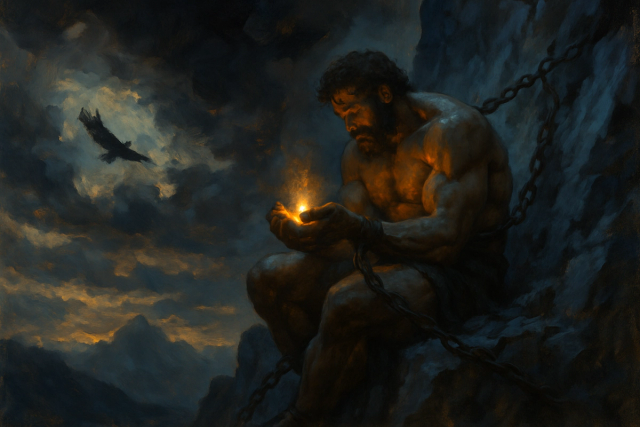
His release finally came through Prometheus, the Titan punished by Zeus for giving fire to humanity. Prometheus was chained to a rock, his liver eaten daily by an eagle and regrown each night. Chiron offered to give up his own immortality in exchange for Prometheus's freedom. Zeus accepted the trade, Chiron finally died and was freed from pain, and in honor of his sacrifice Zeus placed him among the stars as the constellation Centaurus, or in some versions, Sagittarius.
Long before his wound, Chiron had already earned a reputation as the greatest teacher in Greek myth. His cave on Mount Pelion became something like a school for future legends. His students included:
What set Chiron apart from other teachers of myth, including the tutoring role sometimes credited to Athena, was his range. He did not just train warriors. He taught medicine, ethics, astronomy and music with equal seriousness, treating the body and the mind as part of the same education.
In Greek thought, centaurs usually stood for the uncivilized, animal side of human nature, impulsive and violent, especially in myths like the battle between the Lapiths and centaurs carved on the Parthenon. Chiron was the deliberate exception built into the same tradition, proof that the same hybrid form could also hold restraint, intellect and compassion. Writers like Homer and Pindar singled him out specifically as the most righteous of the centaurs.
Roman poets, especially Ovid in the Metamorphoses and the Fasti, leaned into the astronomical side of the story, focusing on Chiron's placement among the stars as a reward for virtue rather than the tragedy of his wound. Roman astrology absorbed this, treating the constellation Sagittarius as a symbol of justice, teaching and higher learning, a direct inheritance of Chiron's role as mentor.
| Figure | Origin | Nature | Symbolic Role |
|---|---|---|---|
| Chiron | Son of Cronus and Philyra | Wise, gentle, immortal until his death | Healer, teacher, wounded healer archetype |
| Nessus | Born from Ixion's line | Violent, deceitful | Treachery, uncontrolled desire |
| Pholus | Son of Silenus and a nymph | Hospitable but accident prone | Hospitality mixed with chaos |
| General Centaurs | Children of Ixion and the cloud Nephele | Wild, drunken, aggressive | Barbarism, loss of self control |
Chiron's story is the basis for the term wounded healer, an idea that psychologists, including those working in Jungian analysis, use to describe therapists and caregivers who draw on their own unresolved pain to help others heal. The logic is simple: someone who has personally lived through a specific wound often understands that pain in others more clearly than someone who never has.
In 1977, astronomers discovered a small icy body orbiting between Saturn and Uranus and named it Chiron. In modern astrology, Chiron is read as a marker of a person's deepest psychological wound, the place in a birth chart tied to shame, rejection or early pain that never fully closes, but which, worked through honestly, can become a source of empathy and even a gift to others.
Dreaming of a centaur, or specifically of a wise, wounded figure like Chiron, often points to a conflict between instinct and reason playing out inside you. Depending on the tone of the dream, it can suggest different things:
These interpretations lean on archetypal psychology rather than fixed dream dictionaries, so the feeling in the dream matters more than any single symbol.
Chiron's myth is not just a story to read once and forget. It offers a working model for anyone dealing with a wound that will not fully disappear.
For readers interested in the wider pantheon that surrounds figures like Chiron, the Greek Gods overview is a useful next stop, alongside the myth of Zeus, who ultimately decided Chiron's fate among the stars.
Chiron was neither a traditional god nor a monster in the way other centaurs were portrayed. He was a Titan's son with a half-horse body, but his wisdom, teaching and eventual sacrifice placed him closer to the heroic and divine figures of Greek myth than to the beastly centaurs he was born alongside.
The arrow that struck Chiron was poisoned with the blood of the Lernaean Hydra, a toxin so powerful it had no known cure, even for an immortal being with deep medical knowledge. His immortality meant the poison could not kill him, so he suffered indefinitely until he traded that immortality away to free Prometheus.
Chiron is most commonly linked to the constellation Centaurus, though some ancient sources connect him instead to Sagittarius, the archer. Zeus placed him among the stars after his death as a reward for his sacrifice on behalf of Prometheus.
In modern astrology, Chiron refers to a small celestial body discovered in 1977 and named after the mythological centaur. Its placement in a birth chart is read as showing a person's core emotional wound, an area of life marked by early pain that, once worked through, can become a source of strength and empathy for others.
Meet Nike, Greek goddess of victory: her parents, siblings, symbols, myths, and Roman name Victoria — explained clearly with facts…
The full myth of Orpheus and Eurydice, its ancient sources, ending, and what the tragic backward glance symbolizes about grief and…
Who was Prometheus? Explore the Titan's myth, punishment, fire symbolism, tattoo meaning, and what he teaches us about progress an…