
Greek Mythology
The Minotaur: Myth of the Labyrinth Explained
Discover the true story of the Minotaur, Crete's bull-headed monster, its Labyrinth, Theseus's quest, and what the myth symbolizes…
 KnowMastery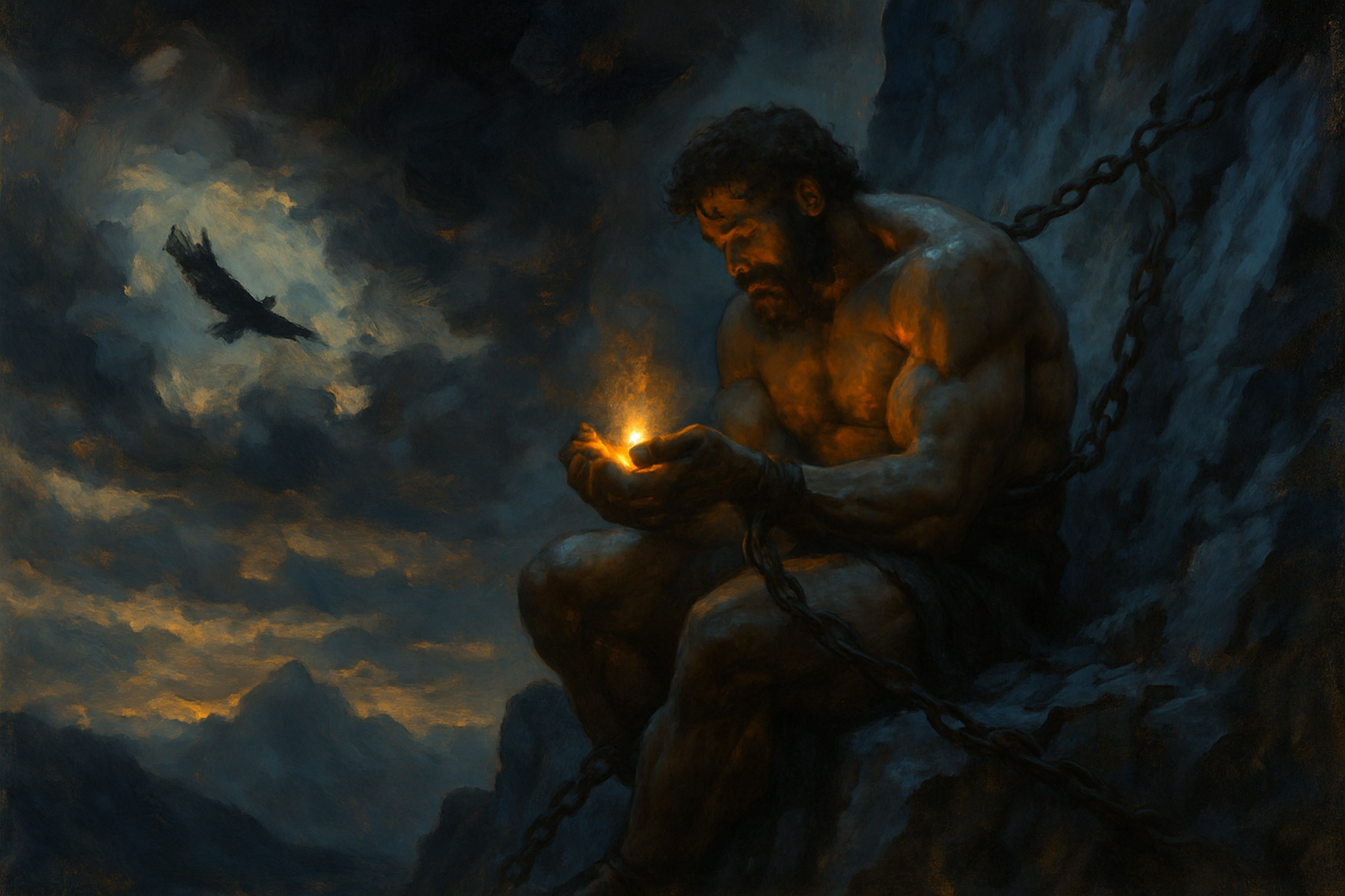
Prometheus is the Titan of Greek mythology best known for stealing fire from the gods and gifting it to humanity — an act of rebellion that gave people warmth, craft, and civilization but earned him eternal punishment from Zeus. His name means "forethought," and his myth has endured for nearly 3,000 years as a symbol of intelligence, sacrifice, and the price of progress. The fullest ancient accounts appear in Hesiod's Theogony and Works and Days (c. 700 BCE) and Aeschylus's tragedy Prometheus Bound (5th century BCE).
Picture a world without hearths, without forges, without a single spark to hold back the dark. That was humanity before Prometheus, according to the old poets — shivering, defenseless, barely distinguishable from the beasts. Then a Titan looked at these fragile creatures and felt something the gods rarely allowed themselves: pity.
He climbed to Olympus, hid a smoldering coal inside a hollow fennel stalk, and carried it down to earth. In that single act of theft, he changed the fate of an entire species — and sealed his own. Few myths carry so much tenderness and so much cost in the same breath.
Prometheus was a second-generation Titan, son of Iapetus and the Oceanid Clymene (or Themis, in some tellings), making him cousin to Zeus rather than his sibling. Unlike most Titans who fought alongside Cronus during the Titanomachy, Prometheus sided with the Olympians, using his gift of foresight to back the winning side. This choice initially spared him from being cast into Tartarus with the other Titans.
He is most famous for two acts: shaping mankind out of clay (in some versions) and stealing fire from Olympus after Zeus withheld it from humans as punishment for a trick Prometheus played during a sacrifice dispute at Mecone — tricking Zeus into choosing bones wrapped in fat over meat hidden in an ox's stomach. That slight is often overlooked, but it's the real spark that ignites Zeus's fury and sets the fire myth in motion. Prometheus also had a brother, Epimetheus ("afterthought"), whose slower-witted nature is frequently read as a deliberate contrast to Prometheus's foresight — a pairing later philosophers used to discuss the cost of acting before thinking.
According to Hesiod, Zeus punished humanity twice: first by hiding fire, and again, after Prometheus stole it back, by sending Pandora — the first woman — bearing a jar of miseries into the world. Prometheus himself received a far crueler sentence. Zeus had him chained to a rock in the Caucasus Mountains, where an eagle devoured his liver each day, only for it to regenerate overnight so the torment could begin again.
This punishment lasted for generations until Heracles, son of Zeus, killed the eagle and freed Prometheus — a moment often read as reconciliation between divine order and human progress.
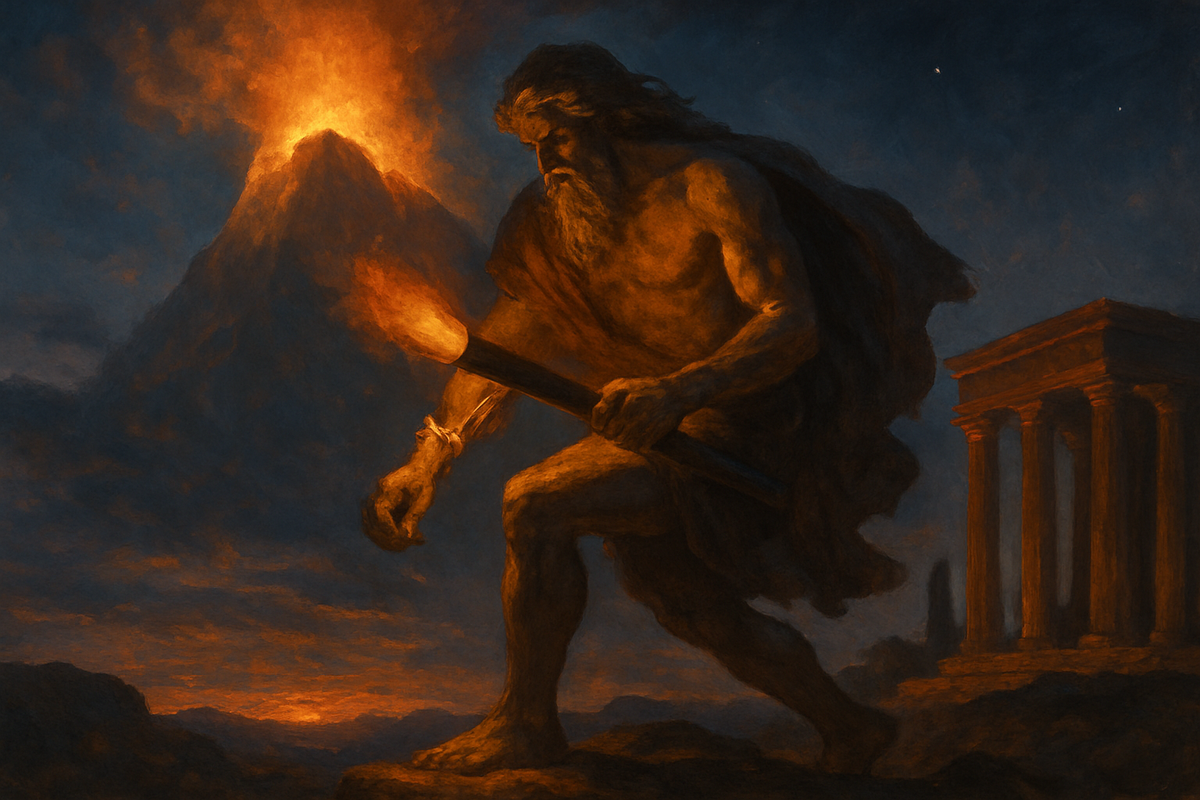
Prometheus has come to represent far more than a single myth. Across literature, philosophy, and art, his story is used as shorthand for specific human experiences:
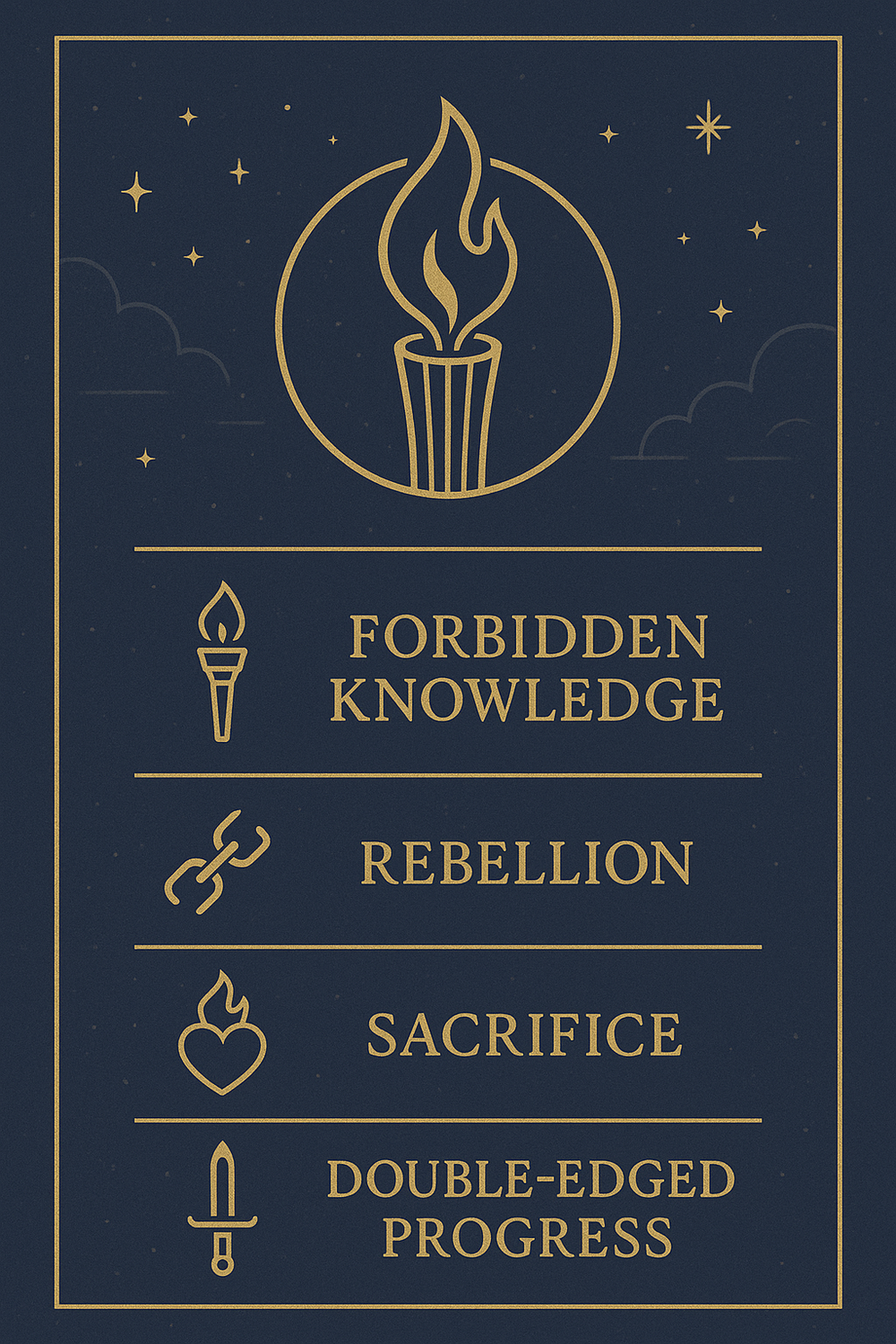
In esoteric and spiritual readings, Prometheus's fire is often treated as a metaphor for the spark of consciousness or the soul's awakening. Some mystics associate him with the inner flame of willpower — the part of a person that dares to act despite consequence. His chained suffering is sometimes interpreted as the pain that accompanies growth: the liver, which regenerates nightly, symbolizes resilience and the body's capacity to heal even under relentless pressure.
In Gnostic-influenced readings, Prometheus's fire has even been likened to the spark of divine knowledge, or gnosis, hidden within matter — a spiritual spark comparable to the one that determines a soul's fate in systems like Valentinian Gnosticism. Jungian psychologists similarly use Prometheus as an archetype of the "culture hero" — a figure who bridges the gap between instinct and civilization, much like Athena represents structured wisdom born fully formed from divine will.
Prometheus's story shifts meaning depending on who is telling it, and comparing these versions reveals how differently ancient cultures viewed defiance and progress.
In Aeschylus's play Prometheus Bound (5th century BCE), the Titan is a tragic hero who openly mocks Zeus's tyranny, calling him unjust and cruel. This version frames Prometheus as a proto-revolutionary, suffering nobly for a righteous cause. Athenian audiences, living under a democracy proud of its intellectual achievements, likely saw him as a champion of human ingenuity against arbitrary divine power.
Roman writers like Ovid and Hyginus retold the myth with less focus on rebellion and more on Prometheus as the craftsman who literally molded humans from clay, aligning him with creation rather than defiance. Centuries later, Romantic-era writers like Percy Bysshe Shelley (Prometheus Unbound, 1820) and Mary Shelley, who subtitled Frankenstein "The Modern Prometheus," revived the rebellious Greek reading. The philosopher Karl Marx, in his 1841 doctoral dissertation, went even further, calling Prometheus "the most eminent saint and martyr in the philosophical calendar" — proof that the defiant Greek reading never fully disappeared, even during the Roman era's gentler retellings.
The myth has never stopped being retold in new forms. Paul Manship's gilded bronze statue of Prometheus (1934) still overlooks the skating rink at Rockefeller Center in New York, chosen specifically to symbolize human progress and industry during the Depression era. In cinema, Ridley Scott borrowed the Titan's name directly for his 2012 film Prometheus, using themes of forbidden knowledge and creation to frame a story about humanity's origins and the dangers of seeking answers better left alone. Even the periodic table nods to him: the radioactive element promethium, discovered in 1945, was named for the Titan because, like fire, it was extracted from something dangerous and difficult to control.

Prometheus is not the only mythological figure who delivers fire or forbidden knowledge to humans. Comparing him to similar figures from other traditions highlights what makes the Greek version distinct.
| Figure | Culture | Role | Consequence |
|---|---|---|---|
| Prometheus | Greek | Steals fire from Olympus for humans | Chained to a rock, liver eaten daily by an eagle |
| Loki | Norse | Trickster who aids and sabotages gods and men | Bound with a serpent dripping venom |
| Maui | Polynesian (Māori) | Wrests fire secrets from the goddess Mahuika | Nearly killed, forced to flee her wrath |
| Raven | Pacific Northwest Native American | Steals daylight/fire and releases it to the world | Transforms and outsmarts his captors, largely unpunished |
What sets Prometheus apart is the severity and permanence of his punishment — a reflection of how seriously Greek religion treated the boundary between divine and mortal knowledge, a theme echoed in the myths of Apollo punishing mortals who overstepped their place.

Dream dictionaries and Jungian-influenced analysts tend to treat mythological figures as archetypal messengers rather than literal predictions, and Prometheus is a favorite for dreams involving breakthrough or exposure. Common interpretations include:
You don't need to believe in Titans to find practical value in this myth. People invoke Prometheus's story when they need courage to act despite uncertain consequences. Some ways to apply it:
The myth also pairs naturally with other Greek figures tied to knowledge, order, and consequence — from Ares's association with the destructive side of power to the broader Greek gods pantheon that gives Prometheus's punishment its full weight and meaning.
Zeus had deliberately withheld fire from mankind as punishment after Prometheus tricked him at a sacrifice, so stealing it back was a direct act of defiance against the king of the gods. Zeus punished Prometheus severely to reassert his authority and discourage further rebellion among Titans or mortals.
Prometheus is classified as a Titan, part of the generation of deities that preceded the Olympians, though he sided with Zeus during the Titanomachy. He is sometimes loosely called a "god" in modern retellings because of his ongoing role in myths involving the Olympian pantheon.
After Heracles killed the eagle and broke his chains, Prometheus was granted a form of reconciliation with Zeus, and in some versions he was allowed to live among the gods again, sometimes offering prophecy in return for his freedom. Ancient sources differ on the exact terms, but most agree his suffering formally ended at this point.
The myth explores the tension between progress and authority, suggesting that knowledge and technology bring enormous benefit but also real risk and cost. It's frequently read as a warning about hubris, while simultaneously celebrating human ingenuity and the courage required to pursue it.
Discover the true story of the Minotaur, Crete's bull-headed monster, its Labyrinth, Theseus's quest, and what the myth symbolizes…

Discover who the Sirens really were in Greek mythology, why their song was so deadly, and what these creatures symbolize in spirit…
Meet Eros, the Greek god of desire and romantic love: his myths, symbols, Roman twin Cupid, and what his story reveals about passi…