Greek Mythology
Why Did Persephone Eat Pomegranate Seeds? Myth & Meaning
Why did Persephone eat the pomegranate seeds? Explore the myth, family ties, and spiritual symbolism behind this famous underworld…
 KnowMastery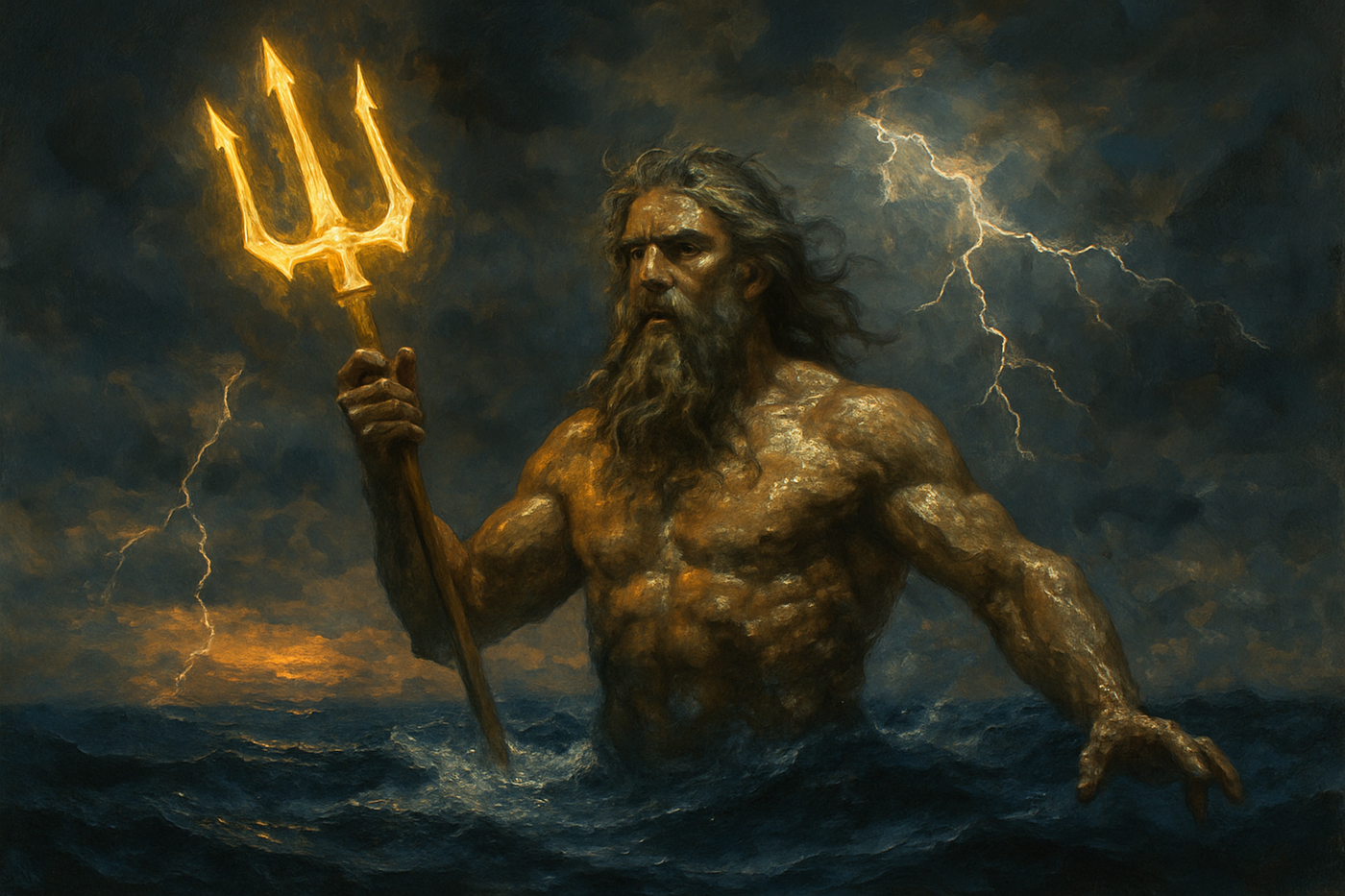
Poseidon is the Greek god of the sea, earthquakes, and horses, one of the twelve Olympians and a brother of Zeus and Hades. He ruled every ocean, river mouth, and storm at sea, and sailors, fishermen, and horse breeders in ancient Greece prayed to him before any major undertaking. His main symbols are the trident, the horse, the bull, and the dolphin, and he was known for a temper as changeable as the waves he commanded. Romans later worshipped him as Neptune.
Picture a fisherman standing on a rocky shore near Sounion, watching storm clouds pile up over black water. He does not see wind or pressure systems. He sees a god deciding whether his family eats tonight or whether his boat comes back at all.
That fear and respect shaped Poseidon into one of the most feared figures in the Greek pantheon. He was not a distant, abstract force. He was the reason the sea could be calm one hour and deadly the next, and the Greeks built an entire religious life around trying to stay on his good side.
Poseidon was born to the Titans Cronus and Rhea, making him a sibling of Zeus, Hades, Hera, Demeter, and Hestia. Like his brothers and sisters, he was swallowed at birth by Cronus, who feared being overthrown by his own children, and later freed when Zeus forced Cronus to disgorge them.
After the Titans were defeated in the war known as the Titanomachy, the three brothers divided the cosmos by lot. Zeus took the sky, Hades took the underworld, and Poseidon took the sea. Earth and Olympus remained common ground, which is why Poseidon still shows up in stories set on land, especially ones involving horses and earthquakes.
He married Amphitrite, a sea nymph and one of the Nereids, and their son Triton became a minor sea god often shown blowing a conch shell. Poseidon fathered many children, including Pegasus, born (with his brother Chrysaor) from Medusa's blood after Perseus beheaded her — in Ovid's version, the encounter that led to this took place in Aphrodite's rival, Athena's, temple — while his Cyclops son Polyphemus was born not to Medusa but to the sea-nymph Thoosa.
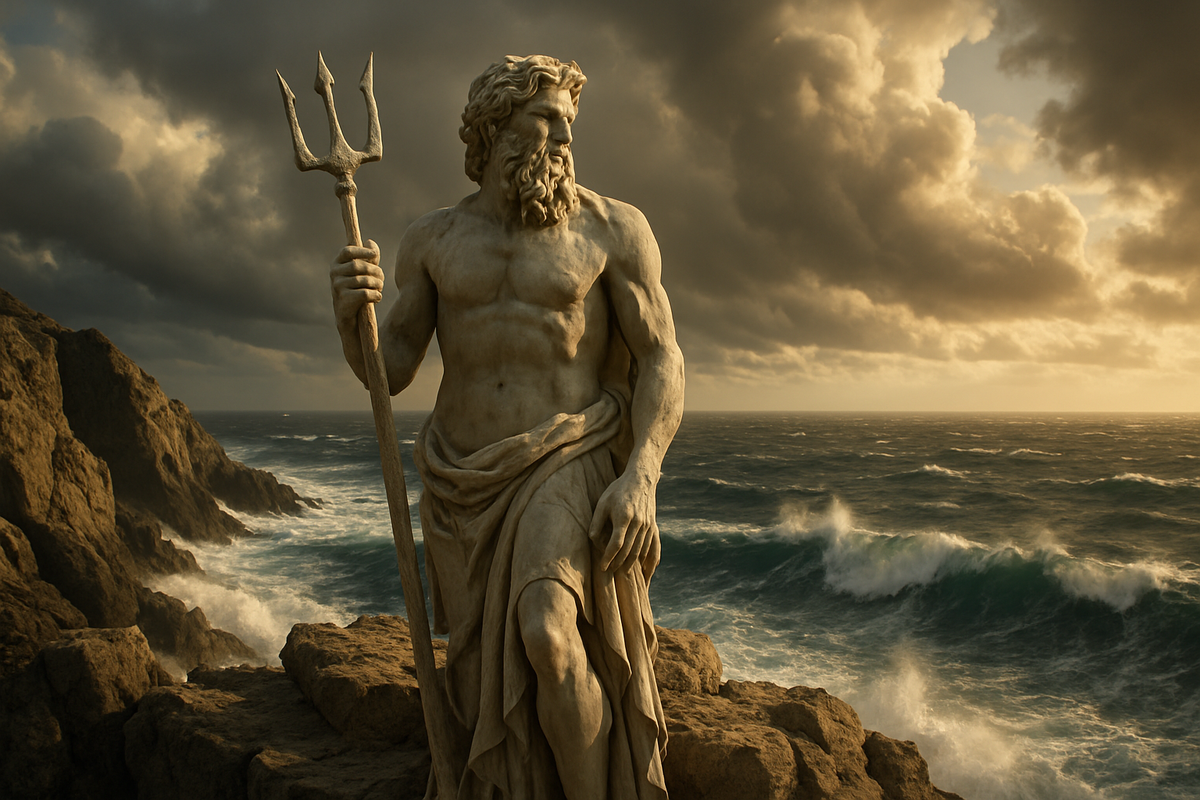
Poseidon controlled far more than open water. His powers extended into several connected domains that shaped daily life for coastal Greek communities.
His trident was not just decorative. In myth he used it to strike rocks, split the earth, summon or calm storms, and create springs. It functioned as both weapon and scepter, a visible sign that he ranked alongside Zeus and Hades as one of the three great sons of Cronus.
Because the three brothers split the cosmos between them, comparing their domains, symbols, and temperaments is one of the clearest ways to understand where Poseidon fits in the Greek pantheon.
| God | Domain | Main Symbols | Personality |
|---|---|---|---|
| Poseidon | Sea, earthquakes, horses | Trident, horse, dolphin, bull | Volatile, proud, quick to anger when disrespected |
| Zeus | Sky, thunder, kingship of the gods | Thunderbolt, eagle, oak tree | Authoritative, strategic, occasionally impulsive |
| Hades | Underworld, the dead, hidden wealth | Helm of darkness, bident, Cerberus | Stern, fair, withdrawn from Olympian politics |
All three brothers share the same raw Titan-born power, but where Zeus rules through command and Hades through quiet finality, Poseidon rules through sheer unpredictability. That difference is exactly why ancient sailors treated him with a mix of devotion and dread rather than simple obedience.
Poseidon's symbols were painted on pottery, carved into temple friezes, and stamped on coins across the Greek world, especially in port cities that depended on him for survival.
| Symbol | Meaning |
|---|---|
| Trident | Divine authority over the sea, power to cause or calm storms and earthquakes |
| Horse | Speed, raw power, and Poseidon's role as creator of the horse |
| Bull | Untamed strength and fertility, often sacrificed to him at coastal shrines |
| Dolphin | Guidance and goodwill toward sailors, a friendlier face of his power |
| Sea green or dark blue color | The changing moods of the ocean, from calm to violent |
Poseidonia/Paestum's oldest coins, from the 6th century BC, famously depict Poseidon wielding his trident, while Corinth's classic silver staters instead carried Pegasus and Athena as their emblem, with a trident-bearing Poseidon appearing mainly on later, Roman-era Corinthian coinage. The bull sacrifice in particular connected Poseidon to older Minoan and Mycenaean religious practices, where bull imagery already carried deep ritual weight centuries before classical Athens existed.
Poseidon appears throughout Greek mythology, often in conflict with other gods or mortals who challenge his authority.
Poseidon and Athena both wanted to be patron of a new city on the Attic peninsula. Poseidon struck the Acropolis with his trident and produced a spring of seawater, a show of raw power. Athena offered an olive tree, symbolizing peace and prosperity. The city's residents chose Athena's gift, and the city was named Athens. Poseidon flooded the plain of Attica in anger, a myth that reflects how ancient Greeks understood the tension between naval power and agricultural stability.
In Homer's Odyssey, Poseidon becomes the personal enemy of Odysseus after the hero blinds his son Polyphemus. Poseidon spends the rest of the epic delaying Odysseus's journey home with storms and shipwrecks, showing just how dangerous it was to cross a god who ruled every mile of open water between Troy and Ithaca.
Poseidon helped build the walls of Troy alongside Apollo, working for King Laomedon under a temporary punishment from Zeus. When Laomedon refused to pay the agreed wages, Poseidon sent a sea monster to ravage the coast, a grudge that later pushed him to side against Troy in the Trojan War, in contrast to Apollo, who continued to favor the Trojans.
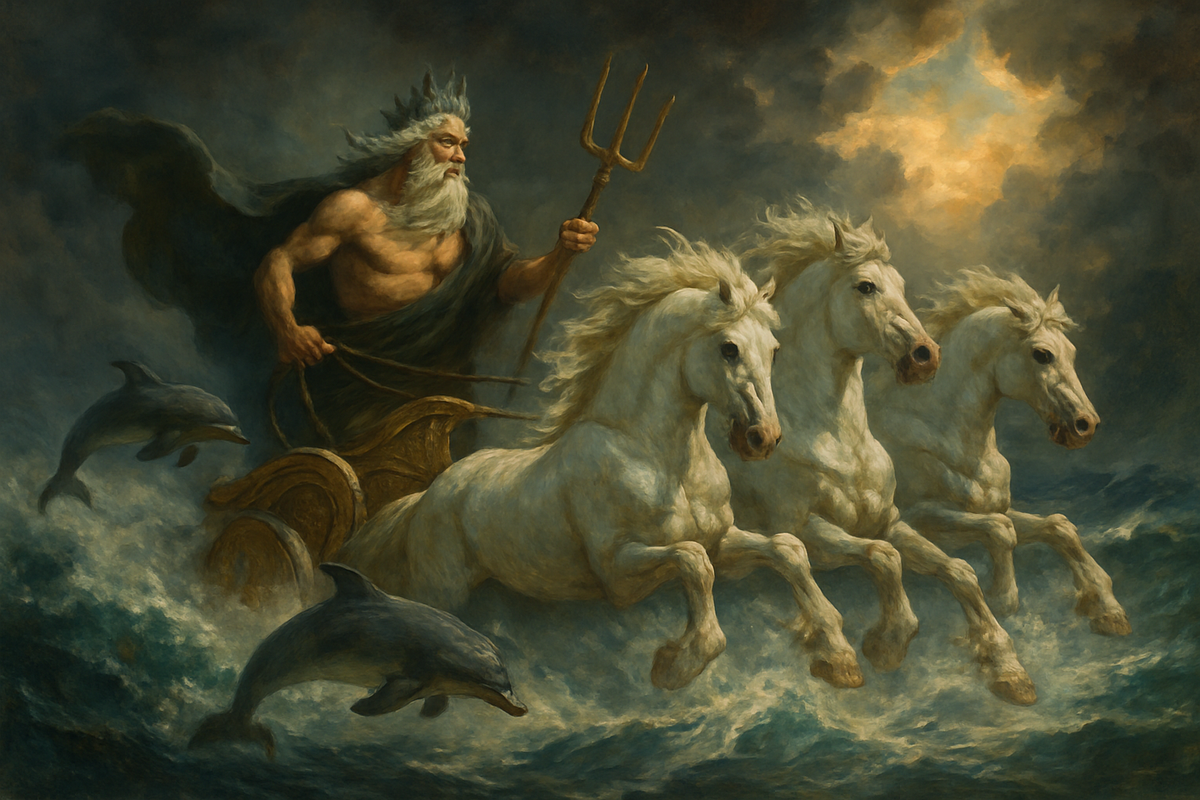
Poseidon's worship was not uniform across the Greek world, and comparing him to related figures shows how sea worship changed over time.
In Mycenaean Greece, Linear B tablets from Pylos mention "Poseidaon" as a major deity, possibly even more prominent locally than Zeus, since Pylos was a coastal, seafaring center. This suggests Poseidon's roots go back further than his later Olympian ranking implies, tied originally to earth and fertility as much as to the sea.
The Romans adapted Poseidon into Neptune, keeping the trident and horse associations but placing more weight on Neptune as a symbol of Roman naval strength during the expansion of the Republic and Empire. Roman generals sacrificed to Neptune before naval battles, much as Greek admirals had once done for Poseidon at Cape Sounion, where a temple dedicated to him still stands overlooking the Aegean.
For a broader view of how Poseidon fits among the other Olympians, including his siblings and rivals like Zeus and Aphrodite, the Greek gods list lays out the full family tree and their overlapping domains.
In modern spiritual practice, Poseidon is often invoked as a symbol of emotional depth, unpredictability, and personal power that has not been fully tamed. People drawn to his energy tend to be dealing with strong emotions that come in waves, periods of instability they cannot fully control, or a need to reconnect with their own strength after feeling powerless.
Poseidon is also associated with:
People working with sea magic or coastal traditions sometimes leave offerings of shells, seawater, or wine at the shoreline as a modern echo of ancient libations poured for Poseidon before a voyage.
Dreaming of Poseidon, or of stormy seas, tridents, or powerful horses connected to water, often points to feelings that are building beneath the surface of daily life. A calm ocean in a dream involving Poseidon can suggest emotional stability after a difficult period, while a violent storm may reflect anger or fear you have not fully processed.
A dream where Poseidon appears angry or threatening can also point to a fear of losing control, especially in situations tied to finances, career, or relationships that feel as unpredictable as the sea. On the other hand, dreaming of Poseidon calming the waters is often read as a sign that you are regaining a sense of command over a chaotic situation.
If Poseidon's imagery keeps showing up in your life through dreams, tarot, or simple fascination, there are practical ways to engage with what he represents.
None of this requires belief in Poseidon as a literal deity. The value is in using a well documented, specific mythological figure as a lens for thinking clearly about power, emotion, and unpredictability.
Poseidon is the Greek god of the sea, earthquakes, and horses. He controlled storms, tides, and the safety of ships, and ancient Greeks also credited him with creating the horse and causing tremors in the earth.
His main symbol is the trident, a three pronged spear he used to strike rocks, calm or stir the sea, and demonstrate his authority. Other common symbols include horses, bulls, dolphins, and the color of deep sea blue.
Poseidon was the son of the Titans Cronus and Rhea, making him a brother of Zeus, Hades, Hera, Demeter, and Hestia. After the defeat of the Titans, he and his brothers divided the universe, with Poseidon receiving the sea.
Poseidon is neither purely good nor evil; like most Greek gods, he is morally complicated and reacts strongly to both respect and insult. He could be generous toward sailors and cities that honored him, but became vindictive and destructive toward anyone who crossed him, as Odysseus discovered firsthand.
Poseidon's greatest weakness is his temper: he reacts to insult or rejection with disproportionate, often long-lasting anger, as seen in his decades-long pursuit of Odysseus. He also resented being ranked below Zeus despite his own power, a grievance that led him to join a failed rebellion against Zeus and that reveals a deep streak of pride and jealousy beneath his authority over the sea.
Poseidon and Neptune are essentially the same god viewed through two different cultures. The Greeks emphasized Poseidon's volatile, earth-shaking, horse-creating personality, while the Romans reshaped Neptune into a more formal symbol of naval power and military conquest, with less emphasis on his temperamental mythology and more on his usefulness as a patron of the Roman fleet.
Poseidon's Roman equivalent is Neptune, who kept the trident and horse symbolism but became more strongly tied to Roman naval power and military expansion. Roman commanders sacrificed to Neptune before sea battles much as Greek sailors once did for Poseidon.
Why did Persephone eat the pomegranate seeds? Explore the myth, family ties, and spiritual symbolism behind this famous underworld…
The Aphrodite and Adonis myth explained: a goddess, a mortal, a jealous boar, and the anemone flower born from grief and love.
Discover the true myth of Pandora, the first woman in Greek mythology, the real story behind her 'box,' and what it means today.