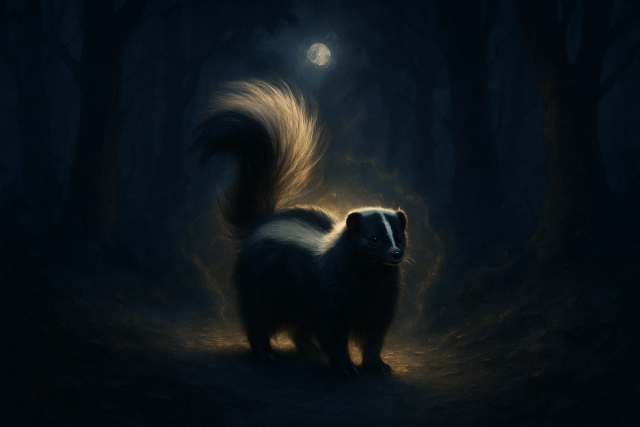
Animal Symbolism
Skunk Spiritual Meaning: The Surprising Power Behind the Stink
What if the next time you encountered a skunk, it wasn’t just bad luck—but a cosmic message wrapped in black and white fur? Skunks…
 KnowMastery
When an owl visits you at night, it's usually read as a message about hidden truths, a coming transition, or the presence of a loved one watching over you. The exact meaning shifts depending on the owl's behavior, how many times it calls, and what's going on in your life at the time. Across most spiritual traditions, a night owl visit is treated as a nudge to pay closer attention to your intuition, not as something to fear.
There's a reason that single hoot outside your window at 2 a.m. makes your stomach drop. For thousands of years, people have heard that sound and felt the same thing: a mix of dread and fascination that's hard to shake off.
You lie there in the dark, listening. The owl calls again. Your mind starts running through everyone you love, wondering if this is some kind of warning. That instinct isn't silly. It's old, and it shows up in folklore on nearly every continent.
An owl showing up after dark is tied to the bird's role as a creature of the threshold. Owls hunt in near darkness, turn their heads almost all the way around, and fly without a sound. That combination made them a natural symbol for seeing what others miss, whether that's something in the spirit world, in a dream, or in the part of yourself you've been avoiding.
A night visit from an owl generally points to one of these themes:
The idea that an owl visit means something specific isn't new, and it isn't the same everywhere. Different cultures landed on very different readings of the same bird, and that split tells you a lot about how symbolism gets shaped by local history and belief.
In Athens, the little owl (Athene noctua) was sacred to Athena, goddess of wisdom and strategy. Owls were kept near her temples and stamped on Athenian coins. Seeing an owl before a battle was taken as a sign of coming victory, because the bird was thought to lend its sharp sight and clear judgment to whoever it favored.
Among the Apache and Lakota, owl beliefs tend to be cautionary. An owl calling your name or appearing near a sick relative has historically been read as a warning tied to death or a major life transition. Other Indigenous nations treat the owl more neutrally, as a messenger whose meaning shifts with context rather than a fixed sign of doom.
The owl appeared in Egyptian hieroglyphs representing the sound "m" and was associated with night, cold, and stillness. It wasn't feared the way it later was in parts of Europe. Egyptian texts treated it as simply part of the natural order of the night sky, paired conceptually with the sun-associated falcon as its daytime counterpart.
In Hindu belief, the owl is the vehicle (vahana) of Lakshmi, the goddess of wealth and fortune. Seeing an owl, especially a white one, near the home during Diwali is sometimes taken as a sign that prosperity is close. This stands in sharp contrast to the death omens found elsewhere, and it's a good reminder that one bird can carry opposite meanings depending on where you are in the world.
Among the Yoruba people of Nigeria, the owl has historically been linked to witchcraft and night magic. A hooting owl near a compound could be read as a sign that a sorcerer was nearby or that someone intended harm. This belief sits closer to the European death-omen tradition than to the Greek or Hindu readings, though the fear here centers on human malice rather than fate itself.
In parts of England, Wales, and rural France during the Middle Ages, an owl hooting near a house was widely taken as a death omen, especially if it called three times. This belief likely grew out of real observation: owls often turn up near the sick or elderly, probably because quiet, still households attract rodents, which attract owls. The correlation got read as causation, and the superstition stuck for centuries.
Not every owl encounter carries the same weight. Paying attention to the specific details sharpens the reading.
| What You Noticed | Common Interpretation |
|---|---|
| A single hoot, then silence | A quiet nudge to slow down and reflect before acting |
| Repeated calls through the night | An urgent message, often linked to a decision you're avoiding |
| An owl perched near your window | A sign of protection or a visiting presence watching over you |
| An owl flying directly in front of you | A signal that a path is opening or closing |
| A white or snowy owl | Associated with purity, clarity, and spiritual guidance |
| A barn owl's screech (not a hoot) | Often read as a sharper warning to stay alert to deception |
For a deeper breakdown of owl colors, species, and totem meanings, the full owl symbolism guide covers that in more detail than fits here.
Not automatically. The "owl means death" association is strong in older European folklore and in some Yoruba and Indigenous traditions, but it's far from universal. In Greek and Hindu tradition, the owl is linked instead to wisdom, protection, or the presence of a goddess figure, and a white owl near Lakshmi worshippers is seen as a carrier of good fortune rather than doom.
The fear response a lot of people have is cultural conditioning more than a fixed spiritual truth. Before assuming the worst, notice how you actually felt in the moment. A visit that felt eerie but not threatening usually points to a message worth sitting with, not a warning to brace for.
Owls that show up in dreams tend to mirror their waking symbolism but turn up the volume on the personal, inward side of it.
These readings sit alongside other nocturnal symbol traditions, including the way crow sightings are read depending on their number, or how a hawk appearing during the day is treated as a very different kind of message because of its link to sunlight and clarity.
If an owl shows up and you can't shake the feeling that it means something, there are practical ways to work with the experience instead of just sitting with the unease.
Owls aren't the only animal that carries weight when they cross your path unexpectedly. The way people interpret a spider appearing in the home follows the same basic logic as the owl: a creature tied to a specific time or place shows up outside its usual pattern, and that disruption gets read as meaningful. Even gentler symbols, like a hummingbird visit tied to twin flame connections, work on the same principle of noticing when nature breaks its routine around you.
Most traditions read this as a call to pay attention, either to your intuition, an unresolved decision, or a message tied to someone in your life. It's rarely treated as a literal threat, even in folklore where owls carry heavier symbolism.
Some folk traditions, particularly in rural Europe and among certain Indigenous communities, link owl visits to visits from the dead. If the sighting happens near the anniversary of a loss or while you're actively grieving, many people find that reading brings comfort rather than fear.
This belief comes mainly from medieval European folklore and a few specific Indigenous and West African traditions, but it isn't universal. In Greek and Hindu tradition, owls are linked to wisdom and prosperity instead, so the meaning depends heavily on which cultural lens you're using.
Repeated visits are generally read as an urgent signal rather than a passing coincidence, often tied to a decision or truth you've been avoiding. It's worth tracking what's happening in your life during that stretch, since a recurring pattern usually points to something specific rather than chance.
What if the next time you encountered a skunk, it wasn’t just bad luck—but a cosmic message wrapped in black and white fur? Skunks…
What do spiders mean on Halloween? Explore spider symbolism as an omen of fate, a witch's familiar, and a surprising sign of prote…
Black cats carry centuries of myth, from witches' familiars to Japanese luck charms. Discover their real spiritual meaning today.