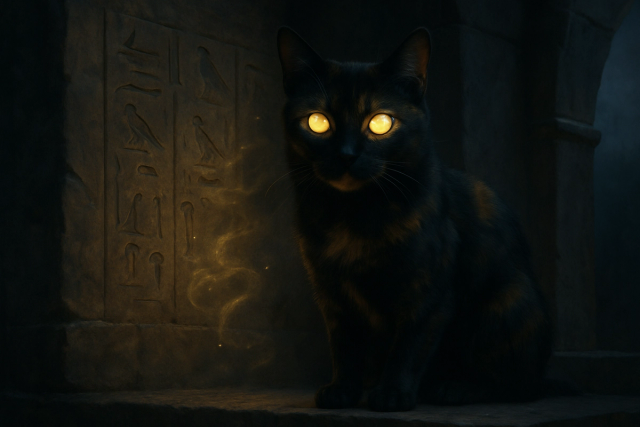
Animal Symbolism
Cat Symbolism & Spiritual Meaning: Colors, Dreams & Crossing Your Path
What does a cat symbolize spiritually? Explore cat meaning by color, culture, dreams, and spirit animal signs — plus what it means…
 KnowMastery
 Black cats symbolize mystery, intuition, and the threshold between the seen and unseen worlds. In most spiritual traditions they are not signs of evil, they are protectors, guides, and symbols of feminine power, luck, and quiet wisdom. The fear surrounding them traces mainly to the medieval European witch trials, not to the animal's older and far more respectful history across Egypt, Japan, Scotland, and the Celtic world.
There is a particular kind of silence that falls over a street when a black cat slips across it at dusk. Something in the body reacts before the mind catches up, a small jolt of recognition passed down through generations who never explained why.
For some people that jolt feels like dread. For others it feels like being noticed by something old and watchful. Both reactions point to the same thing: black cats have carried spiritual weight for thousands of years, and almost none of that weight started out as fear.
Strip away the Halloween costumes and the symbolism underneath stays remarkably consistent across cultures: black cats represent the unseen. They are linked to the moon, to night vision, and to the instinctive, psychic parts of the mind that daylight logic cannot reach. An all black coat was historically rare enough to seem supernatural, which made an already mysterious animal look even more otherworldly.
Because cats move silently and see in near darkness, they became natural symbols of:
In ancient Egypt, cats of any color were sacred, but black cats carried a special association with Bastet, the goddess of home, fertility, and protection, usually shown with the head of a cat. Killing a cat, even by accident, could carry the death penalty. Her cult center at Bubastis held an annual festival that the Greek historian Herodotus described as the largest gathering in Egypt, drawing crowds from across the region. Families mummified their cats and buried them with jewelry, believing the animal's spirit would carry protection into the afterlife. A black cat in an Egyptian household was not feared, it was treated as a living charm against misfortune.
The dark reputation of black cats in the West mostly comes from 1232, when Pope Gregory IX issued a decree called Vox in Rama linking black cats to devil worship. By the time of the European witch trials in the 1400s through 1600s, black cats were considered familiars, spirits in animal form that assisted witches. Thousands of cats were killed during this period, which some historians argue worsened the spread of the Black Death by allowing rat populations to grow unchecked.
Japanese folklore treats black cats as lucky, particularly for women. A black cat is believed to ward off evil spirits and attract suitors to single women who keep one. The maneki neko, the beckoning cat figure seen in shop windows, originally appeared in black as well as the now more common white and gold, and sailors in fishing villages historically kept black cats aboard to protect against storms and shipwreck.
In Scottish folklore, a strange black cat called the Cat Sith was said to be a fairy creature that could steal a person's soul before burial if it crossed the corpse, which is part of why wakes traditionally kept someone awake with the body at all times. The Cat Sith's power was thought to peak at Samhain, the Celtic festival that became Halloween, when the boundary between the living and the dead was believed to thin. Yet a black cat appearing unexpectedly on a doorstep was also considered a sign of coming prosperity, a contradiction that shows how the same animal could represent both danger and fortune depending on context.
| Culture or Region | Primary Meaning | Key Belief |
|---|---|---|
| Ancient Egypt | Protection, sacredness | Linked to the goddess Bastet, guardian of home |
| Medieval Europe | Evil, witchcraft | Believed to be witches' familiars |
| Japan | Good luck, romance | Brings suitors and wards off evil spirits |
| Scotland and Celtic Ireland | Mixed: danger and fortune | Cat Sith myth tied to Samhain, but doorstep visits mean prosperity |
| United Kingdom (modern) | Good luck | Opposite of American superstition, crossing your path is lucky |
| United States | Bad luck | A black cat crossing your path warns of misfortune ahead |
The meaning depends entirely on where that superstition took root. In the United States and much of continental Europe, a black cat crossing in front of you is read as a warning, a signal to slow down and pay attention before moving forward. In the United Kingdom, Ireland, and parts of Asia, it is read the opposite way, as a sign that good fortune is walking alongside you.
Outside of folk superstition, people who work with animal symbolism often read the moment differently again: a black cat crossing your path is a nudge from your own intuition, a reminder to trust a gut feeling you have been pushing aside. It works the same way a crow appearing as an omen is read as a message rather than a verdict, a prompt to pay attention rather than a warning to panic.
Dreaming about a black cat usually points inward rather than outward. Common interpretations include:
As with most animal dream symbolism, context matters more than the species itself. The same way a spider in a dream often reflects feelings about creativity or entrapment rather than literal fear of spiders, a black cat dream is rarely about cats at all.
People who feel a strong pull toward black cats as a totem or spirit animal tend to share certain traits. They trust their instincts quickly, they value solitude without being lonely, and they sense shifts in a room or relationship before anyone says a word out loud. The black cat totem is sometimes compared to the owl as a totem of night vision and hidden knowledge, though the cat's energy is more grounded and physical, tied to the body's instincts rather than purely to insight.
If a black cat keeps appearing in your life, whether in dreams, in your neighborhood, or through repeated gifts and images from other people, it is often read as an invitation to stop overriding your gut feelings with logic.
No credible spiritual tradition outside of medieval Christian Europe treats black cats as inherently evil. The bad luck association is a historical accident tied to witch panic, not a universal spiritual truth. Compare it to how scorpions carry a frightening reputation mostly because of their sting, while their actual symbolism across cultures includes protection, transformation, and even fierce loyalty. Fear of an animal's appearance or danger rarely matches the depth of what it represents spiritually.
Whether the cat shows up in a dream, on your doorstep, or as a sudden interest you cannot explain, here are a few grounded ways to respond.
Black cats share company with other creatures that unsettle people at first glance but carry layered, often positive meaning once examined closely, including the luck symbolism tied to ladybugs in Western folklore, where color and spot count change the reading entirely, much like region changes what a black cat crossing your path is believed to mean.
It depends on where you are. In the United States and much of Europe it is traditionally read as a warning to pay attention, while in the United Kingdom and Japan the same event is considered good luck. Neither interpretation is more correct than the other, they are regional folklore rather than fixed spiritual law.
Spiritually, black cats represent intuition, protection, and the connection between the physical and unseen worlds. They are tied to lunar and feminine energy in many traditions and are often seen as guardians rather than threats.
The association started in medieval Europe after Pope Gregory IX's 1232 decree linked black cats to devil worship, which fed into centuries of witch trial hysteria. Cats, especially solitary black ones kept by older single women, were assumed to be demonic familiars, a belief that had nothing to do with the animal's actual behavior.
Dreaming of a black cat usually reflects your relationship with your own intuition, independence, or suppressed feelings rather than anything about cats themselves. A calm cat in the dream often points to trust in your instincts, while an aggressive one can point to ignored anger or crossed boundaries.
What does a cat symbolize spiritually? Explore cat meaning by color, culture, dreams, and spirit animal signs — plus what it means…
Crows and ravens look alike but carry different spiritual meanings. Here's how to tell them apart and what each one is really tell…
What dove symbolism really means, from peace and the Holy Spirit to love, loss, and dreams across cultures.