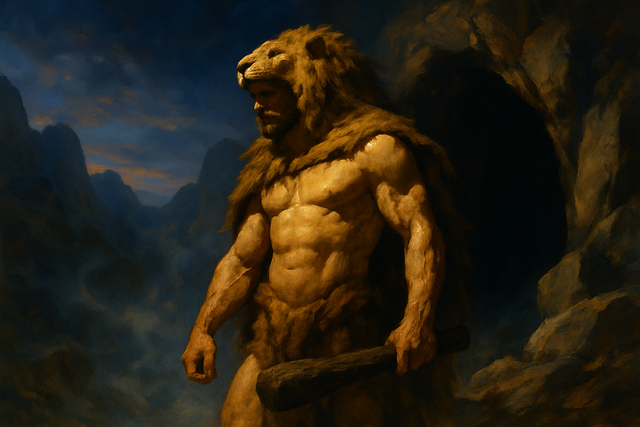
Greek Mythology
Heracles: The Twelve Labors & the Legend Explained
Discover who Heracles was, why he performed the Twelve Labors, and what his myth still teaches about strength, redemption, and inn…
 KnowMastery
 Apollo is the Greek god of music, poetry, and the arts, best known for playing the golden lyre and leading the Nine Muses in song. Son of Zeus and Leto, and twin brother of Artemis, he embodies harmony, order, and creative inspiration throughout Greek mythology. Ancient Greeks believed his music could calm gods and mortals alike, and his lyre stood as a symbol of balance between reason and feeling. He was also credited with shaping the very idea of musical harmony as the Greeks understood it.
Picture a hillside outside Delphi at dawn, mist still clinging to the olive trees. A shepherd stops mid step because somewhere above him, on Parnassus, strings are being plucked in a pattern too clean, too perfect, to belong to any human hand. That sound, according to the old stories, belonged to Apollo.
There is something in that image that still catches people off guard today. We tend to think of gods as thunder and war, not melody. Yet the Greeks placed music at the center of their most radiant god, the one linked to sunlight, prophecy, healing, and truth. That choice says a lot about how they understood beauty and order in the world.
Apollo appears in Greek mythology as one of the twelve Olympians, ruling over music, poetry, archery, prophecy, healing, and the sun. Among his many titles, Musagetes, meaning "leader of the Muses," points directly to his musical role. He is almost always shown holding a lyre, a stringed instrument said to have been invented by Hermes and given to Apollo as a gift after a childhood dispute over stolen cattle.
Unlike Dionysus, whose music stirred chaos and ecstasy through flutes and drums, Apollo's music represented clarity and restraint. Greek writers often set the two gods in contrast: Dionysian frenzy against Apollonian order. This contrast mattered enough that the philosopher Friedrich Nietzsche used it centuries later in The Birth of Tragedy to describe two opposing forces in art and human nature.
Apollo was born on the island of Delos to Zeus, king of the Olympians, and the Titaness Leto. His twin sister was Artemis, goddess of the hunt, and the two were raised with a fierce loyalty to one another that shows up again and again in myth, including their joint revenge on Niobe for insulting their mother. As one of the children of Zeus, king of the gods, Apollo held a prominent seat on Olympus and was frequently sent to mediate disputes among gods and mortals because of his reputation for fairness.
For a fuller picture of his other domains, including prophecy and the sun, the full profile of Apollo covers his complete mythology in more depth. This article focuses specifically on his identity as the god of music and what that symbolism means.
Several objects and creatures became permanently attached to Apollo's musical identity in Greek art and poetry. Each carried its own meaning beyond decoration.
| Symbol | Association | Meaning |
|---|---|---|
| Lyre | Music and poetry | Balance between emotion and reason |
| Laurel wreath | Daphne myth, victory | Honor for artistic and athletic achievement |
| Swan | Death and beauty | Grace in final moments, artistic legacy |
| Python at Delphi | Prophecy | Triumph of order over primal chaos |
| Sun | Later link to Helios | Clarity, truth, illumination |
The Nine Muses, daughters of Zeus and the Titaness Mnemosyne, each oversaw a different art: Calliope for epic poetry, Euterpe for lyric song, Terpsichore for dance, and so on. Apollo led them on Mount Helicon and Mount Parnassus, and Greek poets frequently opened their epics by invoking the Muses under his guidance for inspiration. Homer's Iliad and Odyssey both begin this way, treating musical and poetic inspiration as something granted rather than manufactured.
This pairing mattered because it linked music directly to memory and knowledge. Mnemosyne, mother of the Muses, personified memory itself, which suggests that in the Greek imagination, music was not decoration but a way to preserve truth, history, and wisdom across generations before writing was widespread.
In classical Athens, music education was considered essential to a well formed citizen, alongside gymnastics. Plato, in The Republic, argued that certain musical modes could shape character for better or worse, and he traced this belief back to Apollo's association with proportion and restraint. Competitions in lyre playing, called the Pythian Games, were held at Delphi in Apollo's honor every four years, treating musical skill with the same seriousness as athletic victory.
When the Romans absorbed Greek mythology, most gods received new names. Zeus became Jupiter, Poseidon became Neptune. Apollo was one of the rare exceptions who kept his Greek name almost entirely intact. Emperor Augustus later promoted himself as a favorite of Apollo, building a temple to him on the Palatine Hill in Rome and using the god's association with order and light to steady his own rule after decades of civil war.
Centuries later, Renaissance artists and thinkers revived Apollo as the patron of the arts. Raphael painted him presiding over the Muses in his fresco Parnassus in the Vatican, and composers named their concert halls and academies after him well into the 1800s, treating Apollo less as a religious figure and more as a symbol of artistic ideals.
Stripped of the specific myths, Apollo's musical symbolism centers on a few consistent ideas. Music, in his role, represents order imposed on raw emotion rather than emotion suppressed. His victory over the serpent Python at Delphi, after which he founded his oracle there, has often been read as a symbol of civilized structure overtaking chaos, with music as the tool of that change.
His music was also tied to healing. Apollo was father to Asclepius, god of medicine, and ancient sources describe using song and rhythm as remedies for both physical and mental distress. This connects to a broader idea found in several ancient healing traditions, sound as medicine, though the Greek version specifically credited Apollo as its divine source.
Dreaming of Apollo, a golden lyre, or music that seems to arrive from nowhere is often read as a sign of creative renewal. Because Apollo represents clarity rather than chaos, such dreams are usually taken as encouragement to bring discipline to a creative project rather than a call toward wild inspiration. A dream featuring sunlight paired with music can point toward a desire for truth or recognition, echoing Apollo's role as a god of both light and prophecy.
Dreams involving a broken lyre or silence where music should be are sometimes read as a warning against neglecting one's creative or intellectual gifts, since Apollo's myths often punished those who dismissed the value of art, as seen in his contest with the satyr Marsyas.
Apollo's story offers a few practical takeaways for anyone drawn to his symbolism today.
For readers curious how Apollo fits among the wider Greek pantheon, the full list of Greek gods puts his role in context alongside deities like Athena, goddess of wisdom, who shared Olympus with him and appears in several of his myths.
Apollo received the lyre from Hermes as a boy and quickly mastered it, and Greek myth built on this by making him leader of the Muses, the divine patrons of every art form. His association with order, light, and prophecy made music a natural extension of his character rather than a separate skill.
Apollo is almost always shown with the lyre, a small stringed instrument that Hermes invented from a tortoise shell and cow gut strings. Some later depictions also link him to the kithara, a larger and more elaborate version of the lyre used in professional performance.
Yes, Apollo is one of the few gods the Romans kept under his original Greek name rather than replacing him with a separate deity. Roman emperors like Augustus even promoted their connection to Apollo to link their rule with order, light, and artistic patronage.
Beyond music, Apollo is linked to the sun, prophecy through his oracle at Delphi, archery, healing, and poetry. His rivalry with figures like Marsyas and his role in the Trojan War round out a mythology built around order, talent, and consequence.
Discover who Heracles was, why he performed the Twelve Labors, and what his myth still teaches about strength, redemption, and inn…
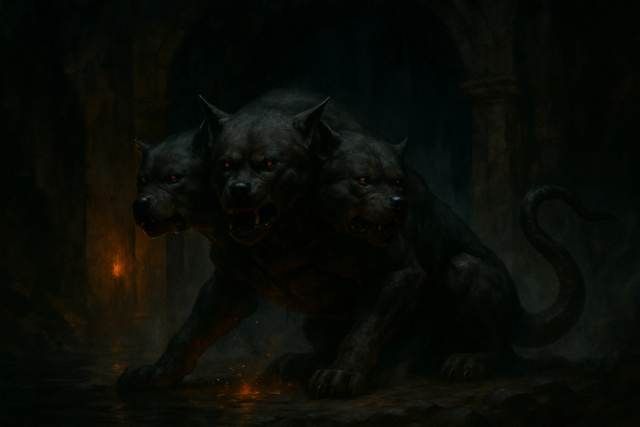
Discover who Cerberus really is, his myths, symbolism, and what this three-headed hound of Hades reveals about death, fear, and th…
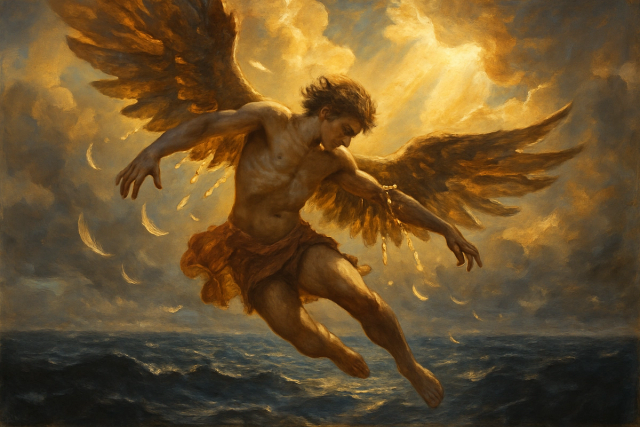
The Icarus myth explained: what the fall really means, its spiritual lessons, cultural readings, and what it teaches about ambitio…