Symbols
Leadership Symbols: 12 Icons of Power, Vision & Authority
Discover 12 powerful leadership symbols—crowns, eagles, torches & more—and what they reveal about power, vision, and authority acr…
 KnowMastery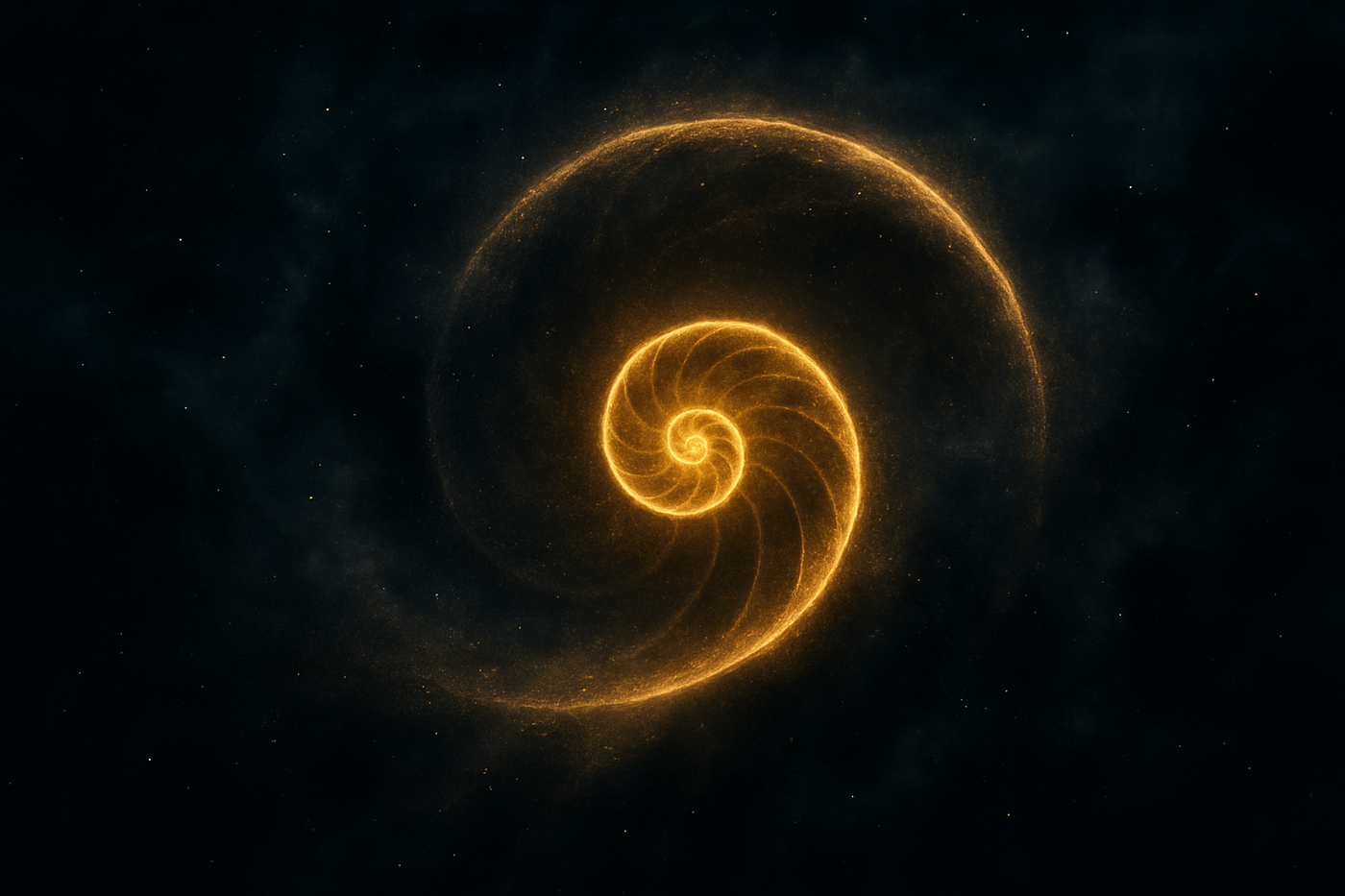
The spiral symbolizes growth, evolution, cyclical time, and the inward journey toward self-awareness. Found carved into Neolithic stone, coiled inside a nautilus shell, and spinning across the night sky as a galaxy, the spiral represents the universal pattern of expansion and return — the idea that life moves forward not in a straight line, but in ever-widening or ever-deepening loops that circle back to where they began, only wiser.
Stand in front of a spiral long enough and something in you softens. Maybe it's the way your eye naturally follows the curve, unable to stop, pulled toward a center that never quite arrives. Maybe it's older than that — a memory encoded in your cells from the double helix of your own DNA, or from nine months spent curled in a spiral before you ever took a breath.
Humans have been drawn to this shape for at least 6,000 years. Long before anyone understood Fibonacci sequences or galactic rotation, our ancestors were carving spirals into tombs, temples, and pottery — trying to say something about time, death, and rebirth that words couldn't quite capture.
At its core, the spiral is a symbol of continuous, non-linear growth. Unlike a circle, which closes in on itself and represents completion or eternity (a concept explored in depth in our piece on the balance of life's forces), a spiral never quite closes. It suggests that although we revisit familiar themes and lessons in life, we do so from a new vantage point each time — slightly higher, slightly deeper, slightly wiser.
This makes the spiral one of the most psychologically resonant symbols in human history. It mirrors:
If you're searching for symbols for growth and development, the spiral is one of the strongest candidates — but it's not the only one, and each carries a slightly different emphasis. Comparing them side by side makes it easier to choose the symbol that best matches what kind of growth you're trying to represent.
In short: choose the spiral when you want to honor a process of growth that loops and deepens over time, rather than a single moment of blooming or a fixed, rooted structure.
The spiral's meaning shifts subtly depending on where and when you find it. Three of the richest — and most different — interpretations come from Celtic Europe, Indigenous North America, and the Hindu-Buddhist tantric traditions of South Asia.
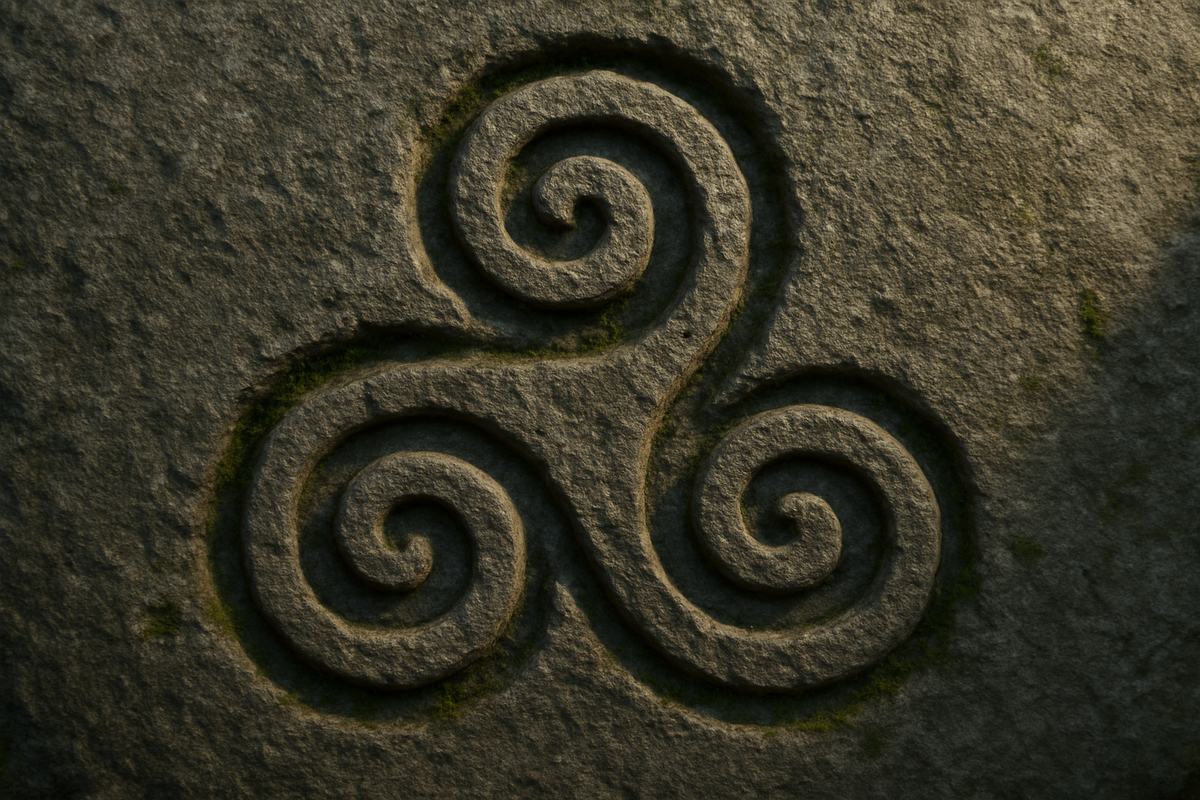
At Newgrange, a 5,200-year-old passage tomb in County Meath, Ireland, ancient builders carved a triple spiral — the triskele — into the entrance stone. Newgrange's inner chamber is illuminated primarily around the winter solstice, when sunlight enters the passage for several days before and after the shortest day, and scholars propose several interpretations of the triskele found there. This same Irish symbolic tradition lives on today in pieces like the Claddagh ring, another enduring symbol born from Ireland's layered spiritual history. The triskele later became closely associated with Celtic Christianity, sometimes appearing alongside different types of crosses in early Irish manuscripts, symbolizing the Holy Trinity — a theme explored further in our broader guide to Catholic symbols.
Across the American Southwest, Hopi and Puebloan peoples carved spirals into rock faces at sites like New Mexico's Petroglyph National Monument. For the Hopi, the spiral often represents migration — the long, winding journey of a clan across the land in search of their destined home — as well as the center of the universe, or Sipapu, from which humanity emerged. Some spirals mark solstice sunlight alignments, functioning as calendars carved in stone.
In Hindu and Buddhist tantric traditions, spiritual energy called kundalini is depicted as a serpent coiled in three-and-a-half spirals at the base of the spine. Through meditation and breathwork, this energy is said to uncoil and rise through the chakras, spiraling upward toward enlightenment. It's a vivid, embodied version of the same idea found at Newgrange: the spiral as a path of ascension.
In New Zealand, the Māori koru takes its form from the unfurling frond of the silver fern (Cyathea dealbata). Carved into meeting houses through traditional whakairo woodwork and etched into skin through tā moko, the koru represents new life, growth, strength, and the peaceful unfolding of potential. Unlike the Celtic triskele's focus on the afterlife or the Hopi spiral's focus on migration, the koru is fundamentally optimistic — a symbol of beginnings rather than endings.
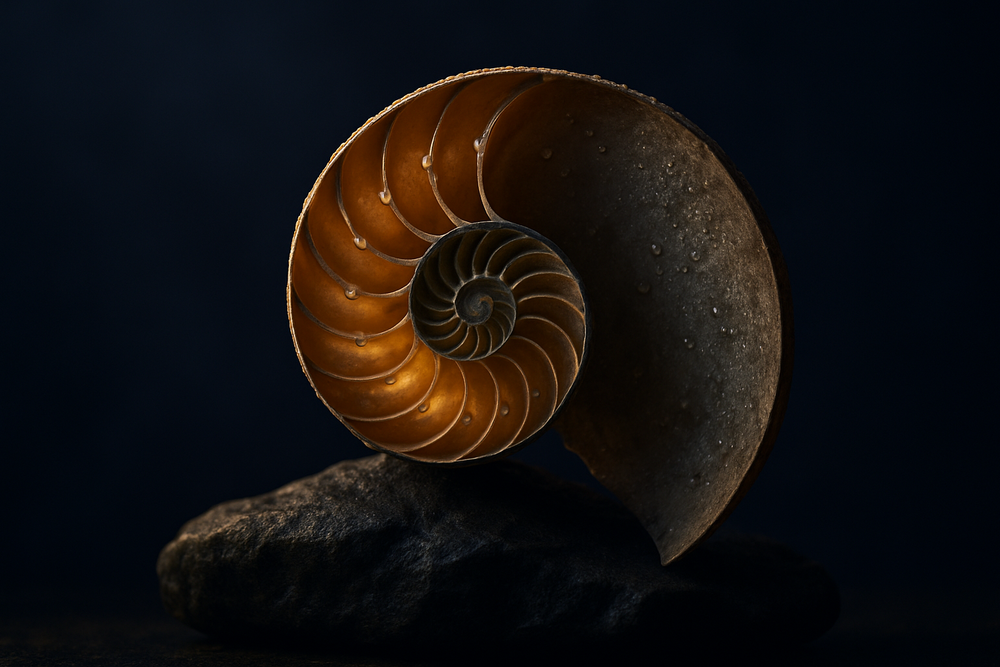
Long before mathematicians named it, nature had already perfected the spiral. The nautilus shell, the arrangement of sunflower seeds, the curl of a fern frond, and the arms of spiral galaxies like our own Milky Way all follow a logarithmic pattern closely related to the Fibonacci sequence — a numerical relationship also explored in numerology and the meaning of numbers. This natural recurrence is part of why the spiral feels less like a human invention and more like something we discovered — a blueprint written into the fabric of the universe itself.
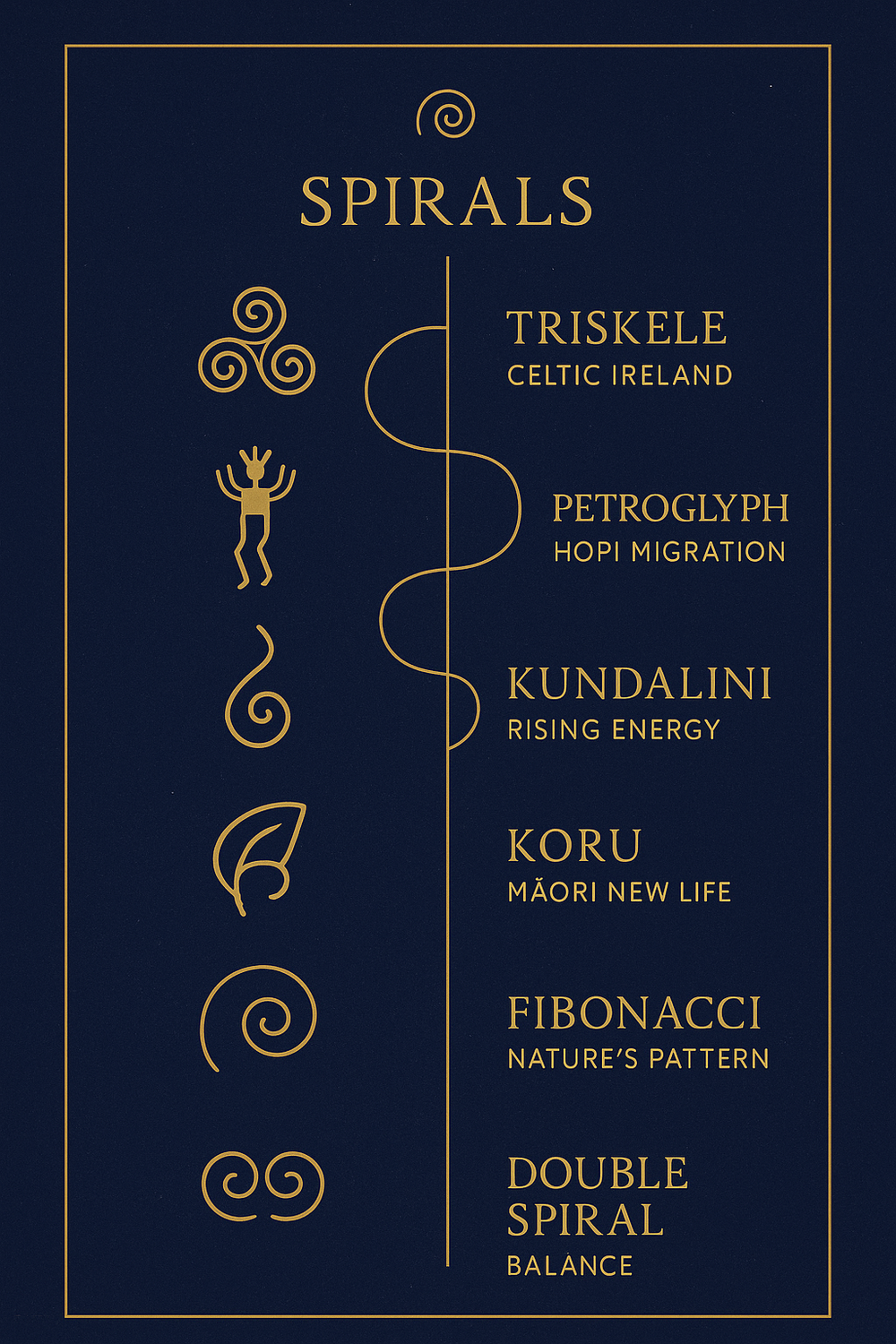
| Spiral Type | Cultural or Natural Origin | Core Symbolic Meaning |
|---|---|---|
| Triple Spiral (Triskele) | Celtic Ireland, Newgrange | Life, death, rebirth; earth-sea-sky |
| Single Petroglyph Spiral | Hopi & Puebloan peoples | Migration, emergence, center of the universe |
| Kundalini Coil | Hindu & Buddhist tantra | Rising spiritual energy, enlightenment |
| Koru | Māori, New Zealand | New life, growth, unfolding potential |
| Golden/Fibonacci Spiral | Nature, sacred geometry | Divine proportion, natural growth |
| Double Spiral | Neolithic Europe | Duality, balance, new beginnings |
Because these three shapes are often confused in symbolic readings, it helps to see their core meanings laid out directly. Each represents a fundamentally different relationship to time and change.
| Shape | Symbolic Meaning | Best Represents |
|---|---|---|
| Spiral | Cyclical growth, evolution, return with new perspective | Personal transformation, spiritual ascent, life cycles |
| Circle | Wholeness, unity, eternity, completion | Unbroken bonds, infinity, balance |
| Line | Linear progress, direction, a fixed path from A to B | Timelines, goals, one-time achievement |
When a spiral appears in a dream, it often reflects where you stand in your own personal cycle of growth. Dreaming of climbing or floating up a spiral staircase can suggest spiritual ascension, gained clarity, or a sense that you're finally rising above a problem you've circled for months. Descending into a spiral, tunnel, or vortex, on the other hand, frequently points to introspection — a call to look inward, confront the subconscious, or process something buried.
A tightening spiral (one that closes in) can symbolize anxiety, obsessive thinking, or a feeling of being pulled toward something you can't control — while an expanding, outward spiral tends to represent liberation, creative breakthrough, or spiritual awakening. As with the protective symbolism found in a dream catcher, spirals in dreams are often less about fear and more about the mind processing and filtering experience.
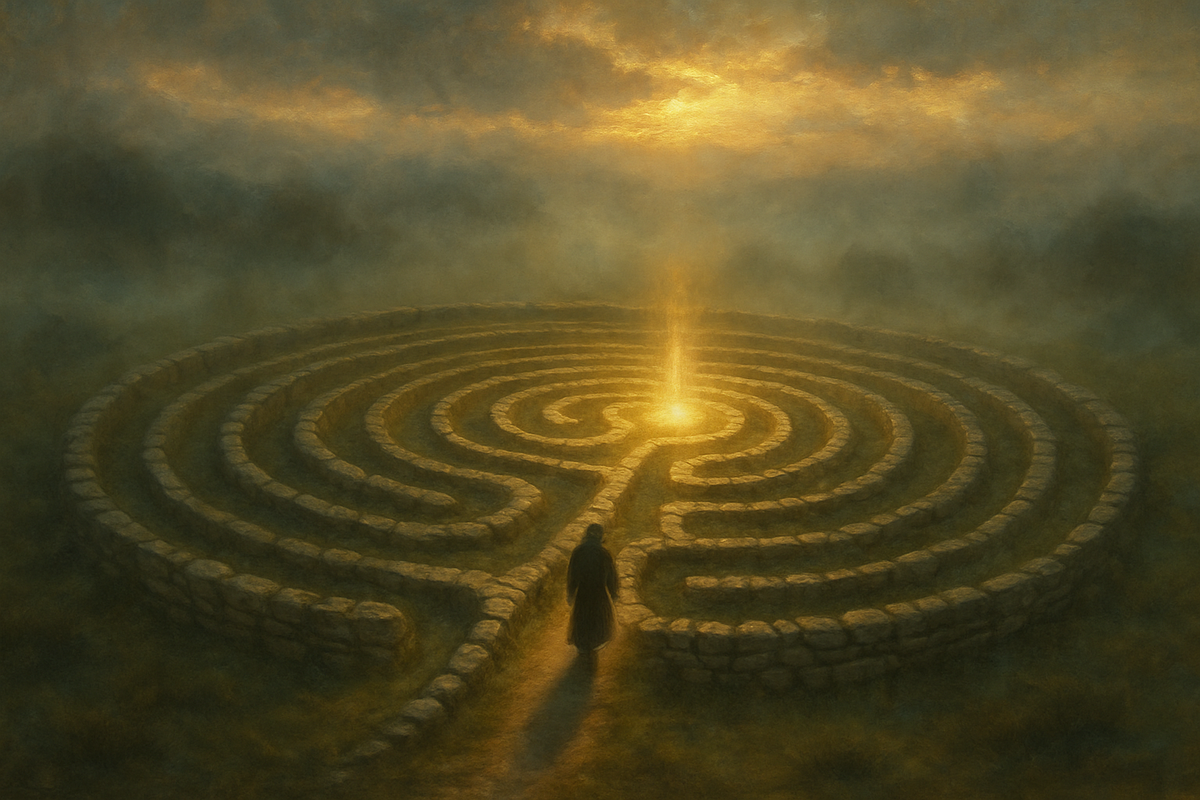
Perhaps the most enduring modern use of spiral symbolism is the labyrinth — a single winding path, unlike a maze, with no dead ends and no wrong turns. Walking a labyrinth, such as the famous stone one at Chartres Cathedral in France, is a walking meditation: the path spirals inward toward a center (often associated with self-knowledge or divine connection), then spirals back out into the world, transformed.
This inward-then-outward movement is a physical metaphor for psychological integration — similar in spirit to the balanced roots-and-branches symbolism found in the Tree of Life. You go inward to face yourself honestly, and you emerge changed, carrying that clarity back into daily life.
You don't need a stone monument to make the spiral meaningful. Consider these practical ways to bring the symbol into your daily spiritual practice:
Spiral tattoos remain popular precisely because the shape is so flexible in meaning — a small spiral behind the ear can quietly represent personal growth, a larger triple spiral on the forearm might honor Celtic heritage, and a spiral paired with waves often symbolizes the ocean's tides or emotional resilience. As with most symbols chosen for permanent ink, the exact meaning of a spiral tattoo is deeply personal — many wearers choose it specifically to mark a turning point: recovery, a new chapter, or survival of something difficult. In jewelry form, a simple silver or gold spiral pendant carries the same weight in a quieter, everyday way.
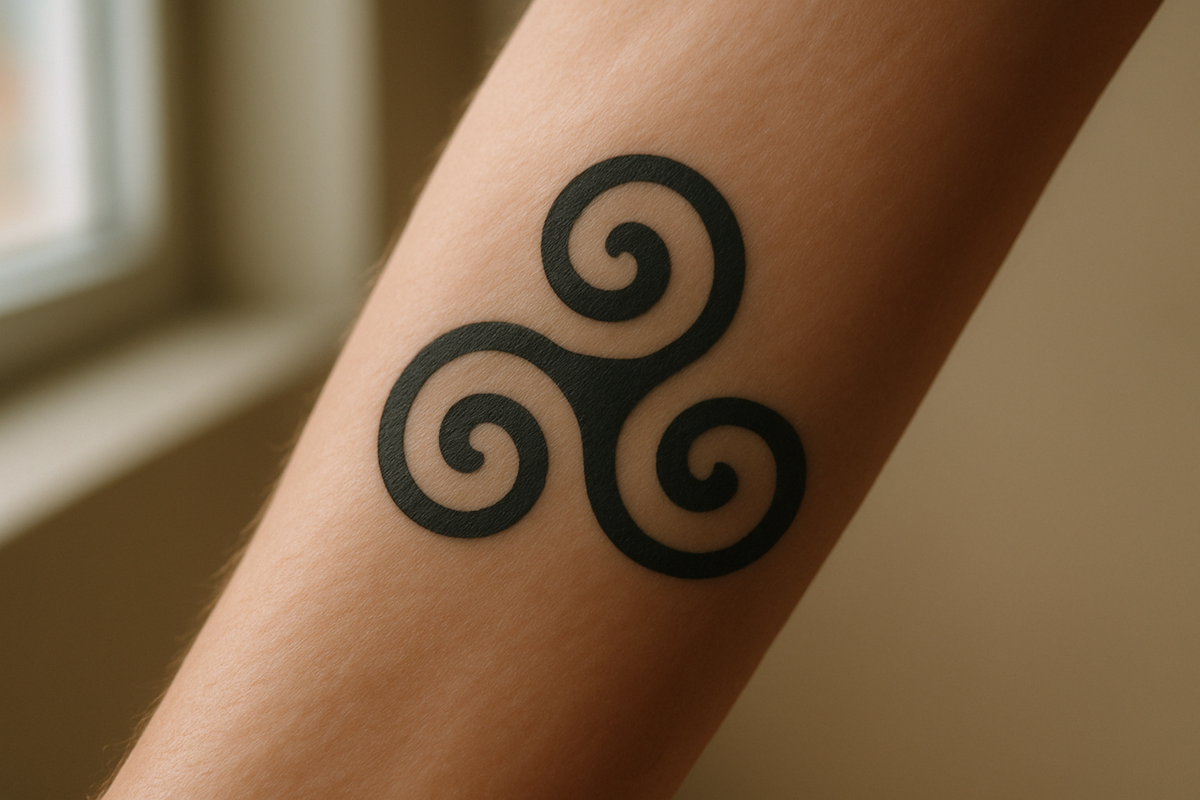
It's worth noting how differently a spiral tattoo reads compared to other popular tattoo symbols. Where the spiral speaks to motion, growth, and cyclical change, a symbol like the anchor represents the opposite impulse — stability, groundedness, and staying firmly rooted through life's storms. Many people choose one or the other depending on whether they want to commemorate a period of transformation or a hard-won sense of steadiness.
Spiritually, a spiral represents the soul's evolving journey — growth, transformation, and the cyclical return to familiar lessons from a higher level of understanding. It's frequently linked to meditation, kundalini energy, and the path toward enlightenment or deeper self-awareness.
A circle typically symbolizes wholeness, unity, or eternity because it has no beginning or end and always closes. A spiral, by contrast, never fully closes — it represents ongoing movement, growth, and change, showing that we revisit themes in life but never in exactly the same place twice.
Dreaming of a spiral often reflects your relationship with growth and control: climbing or rising within a spiral can suggest gained clarity or spiritual progress, while descending or feeling trapped in one may point to introspection, anxiety, or unresolved subconscious material.
Spirals appear independently across Celtic, Hopi, Hindu, Māori, and Neolithic European cultures because the shape mirrors patterns observed everywhere in nature — from shells to storms to the stars — making it an intuitive, near-universal symbol for growth, cycles, and cosmic order long before these cultures had any contact with one another.
Alongside the spiral, the most common symbols for growth and personal development are the Tree of Life, which represents rooted, branching expansion, and the phoenix, which represents transformation through destruction and rebirth. The lotus and sprouting seed are also widely used, each emphasizing a slightly different stage or style of growth.
There isn't a single universal name for "the spiral symbol," since its name changes by culture and context. The Celtic triple spiral is called a triskele or triskelion, the Māori version is known as a koru, and the naturally occurring form found in nature is often called the golden or Fibonacci spiral.
The spiral itself isn't a core Christian symbol, but the Celtic triple spiral was later adopted by early Irish Christians as an informal representation of the Holy Trinity — Father, Son, and Holy Spirit as three interconnected aspects of one whole. This blending reflects how Celtic Christianity often layered older spiritual symbols, like the triskele, onto new theological meaning rather than discarding them entirely.
Discover 12 powerful leadership symbols—crowns, eagles, torches & more—and what they reveal about power, vision, and authority acr…

Discover what dogs, anchors, oak trees, Claddagh rings and Celtic knots symbolize as loyalty in myth, dreams, tattoos and daily li…
Discover 29 powerful symbols of unity — from the circle and Tudor Rose to the dove, Triquetra, and Chalcedony — and what each one …