
Animal Symbolism
Otter Symbolism: Spiritual Meaning, Totem & Dream Guide
What do otters symbolize spiritually? Explore otter meaning in dreams, as a totem animal, and across Native American, Celtic & Asi…
 KnowMastery
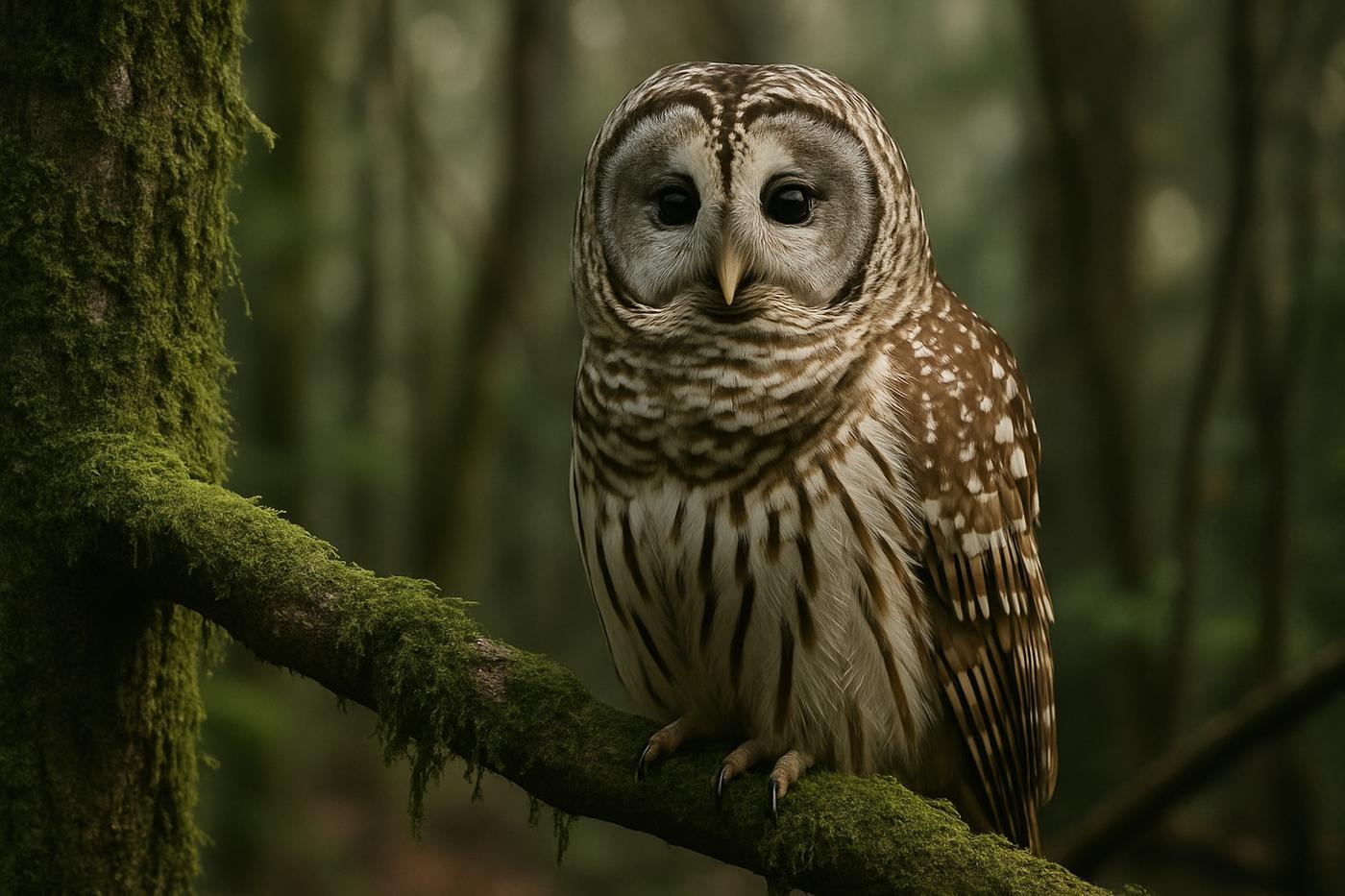
Ever heard the haunting call of a barred owl and felt a shiver down your spine? It’s not just the eerie sound that captivates; it’s the profound spiritual messages these nocturnal guardians carry. Let’s delve into the mystique of the barred owl and uncover the wisdom it offers.
Last updated: this month | Researched and written by the KnowMastery editorial team, drawing on folklore, ornithology, and spiritual symbolism traditions.
A barred owl's call spiritually means a message of awakening, intuition, and transformation is arriving in your life. Its signature "who cooks for you" hoot is traditionally interpreted as a nudge to trust your inner voice, pay attention to overlooked truths, and prepare for a meaningful shift — whether that's a decision, a relationship, or a new chapter unfolding.
The barred owl is a potent symbol of wisdom, intuition, and transformation. Its presence often signifies a call to delve deeper into one’s inner self and embrace the mysteries of life.
“The barred owl doesn’t just see in the dark; it teaches us to find light within our own shadows.”
The barred owl’s distinctive call, often rendered as “Who cooks for you? Who cooks for you all?” carries layers of meaning beyond its melodic rhythm. But that's only one of several vocalizations this owl makes, and each one carries its own spiritual nuance.
This eight-note, rhythmic call is the barred owl's most recognizable sound and its primary territorial announcement. Spiritually, it represents stability and self-inquiry — a reminder to ask yourself who or what is truly nourishing your life. Hearing this call repeatedly is often read as encouragement to re-examine your relationships, habits, and sources of energy.
Barred owls also produce an unsettling, descending cackle that sounds almost like laughter. This vocalization is typically linked to emotional release and the shedding of old patterns. Many spiritual traditions interpret this sound as a sign that something you've been holding onto — fear, grief, resentment — is ready to be let go.
Barred owls produce screams, cackles, and shrieks year-round, but these calls peak during their late-winter-to-early-spring courtship and territorial defense season. These more intense calls are associated with passion, boundary-setting, and the fierce protection of what matters most. If you hear this call, it may be prompting you to defend your priorities more boldly or to express emotions you've been suppressing.
Hearing a barred owl’s call can be a profound experience, urging introspection and heightened awareness.
While all owls share an association with wisdom and the unseen, each species carries its own symbolic flavor. Here's how the barred owl compares to three other commonly encountered owls.
| Owl | Core Symbolism | Energy Style |
|---|---|---|
| Barred Owl | Wisdom, intuition, transformation, vocal guidance | Talkative, present, direct |
| Great Horned Owl | Power, fierce independence, authority | Commanding, intense, protective |
| Barn Owl | Clairvoyance, secrets, ghostly omens | Silent, ethereal, mysterious |
| Screech Owl | Subtle warnings, hidden truths, small shifts | Quiet, cautious, watchful |
Barred owls are unusually vocal compared to other owl species like barn owls and screech owls, and are also fairly often seen or heard in forested and suburban areas. Where a barn owl's silence suggests hidden knowledge and a great horned owl's presence suggests dominance, the barred owl's open, conversational calls suggest a spirit guide who actively wants to be heard.
People who carry the barred owl as a totem or spirit animal are often described as perceptive, adaptable, and unusually comfortable navigating ambiguity. They tend to thrive in transitional periods of life rather than fearing them, and they often serve as the "truth-teller" in their friend group or family.
If the barred owl has appeared repeatedly in your life — through sightings, dreams, or even images — it may be inviting you to embrace this role as an intuitive voice of reason for those around you.
Across various cultures, the barred owl and owls in general hold significant spiritual and symbolic meanings, ranging from omens of death to emblems of wisdom.
In many Native American tribes, owls, including the barred owl, are seen as messengers and protectors. Their calls are often interpreted as omens or guidance from the spirit world. Some tribes, such as certain Plains nations, viewed the owl's call at night as a warning to be heeded, while others saw it as a sign that an ancestor's spirit was nearby.
In modern Neopagan tradition, which draws loosely on Celtic imagery, the owl is sometimes associated with the crone aspect of the Maiden-Mother-Crone Triple Goddess. The owl was sacred to Athena in Greek tradition, while medieval European folklore most often cast the owl in a negative light, associating it with darkness, death, and ill omen, though specific beliefs about its calls varied from region to region.
In parts of East Asia, owls have historically carried more cautionary symbolism, sometimes linked to bad luck or scolding spirits, while in other Eastern traditions owls are respected as protectors of the home at night. This cultural split mirrors the wider global pattern: the owl is rarely seen as neutral — it is almost always a powerful omen, whether welcomed or feared.
In some cultures, owls symbolize death or transition, representing the passage between the physical and spiritual realms. Conversely, others view them as symbols of wisdom and knowledge, scholars of the night who have access to insight unavailable during daylight hours.
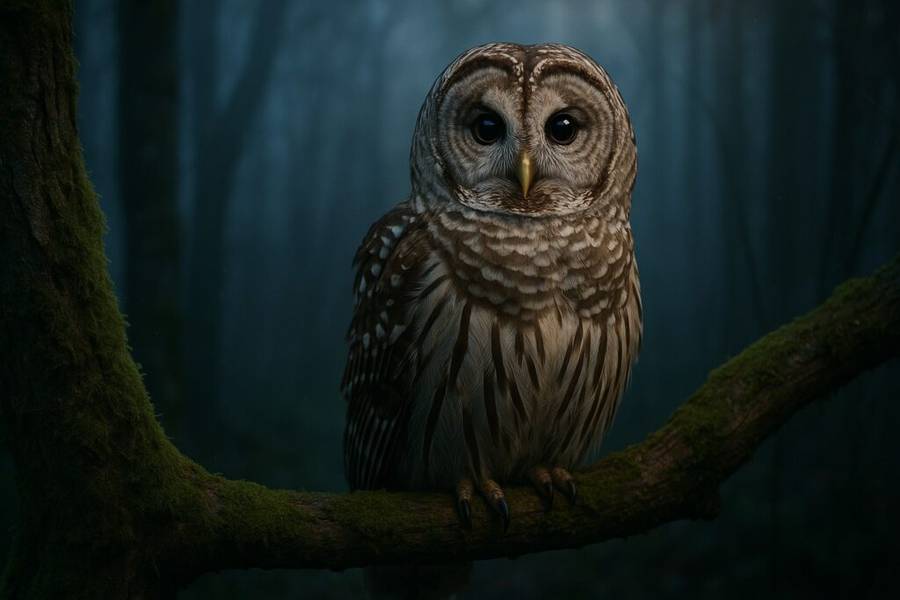
Spotting a barred owl during the day is rare and often considered a powerful spiritual sign. Because barred owls are primarily nocturnal and crepuscular, a daylight appearance tends to stand out as unusual enough to carry weight.
Daytime encounters with barred owls can serve as wake-up calls, prompting action and reflection.
Dreaming of a barred owl can carry significant spiritual messages and insights.
| Dream Scenario | Interpretation |
|---|---|
| Owl watching silently | Encouragement to observe and reflect before acting. |
| Owl calling out | A message or warning from the subconscious or spiritual realm. |
| Owl flying away | Letting go of past issues or moving forward in life. |
| Owl attacking | Facing fears or confronting hidden aspects of oneself. |
Dreams featuring barred owls often prompt introspection and can guide personal growth.
The barred owl doesn’t ask for your attention—it commands it, just like your soul when it has something vital to say.
Hearing a barred owl call is spiritually interpreted as a message urging introspection, awakening, or transformation. It's often read as a nudge to trust your inner wisdom or act on a truth you've been avoiding.
The "who cooks for you" phrase is the barred owl's territorial hoot, used to mark its range and communicate with mates. Spiritually, it's interpreted as a prompt to evaluate who or what is nourishing your energy and intentions.
The barred owl symbolizes vocal, present-moment guidance and intuitive communication, while the great horned owl represents raw power, fierce independence, and authority. Where the barred owl invites conversation and reflection, the great horned owl commands respect through quiet dominance.
An up-close encounter with a barred owl often signals an urgent spiritual message requiring immediate attention. It may be time to make a major life decision, confront your fears, or fully embrace your intuitive power.
What do otters symbolize spiritually? Explore otter meaning in dreams, as a totem animal, and across Native American, Celtic & Asi…
What does a peacock symbolize spiritually? Explore its meaning in dreams, feather colors, love, mythology, and everyday sightings.

Discover what penguins symbolize spiritually — totem meaning, dream interpretation, love/loyalty, tattoos and Christian symbolism …