Greek Mythology
Apollo: Greek God of Music — Lyre, Muses & Symbolism
Why is Apollo the Greek god of music? Explore his lyre, the Muses, laurel, and swan symbolism, plus how he differs from Apollo the…
 KnowMastery
 The myth of Icarus and Daedalus tells of a father and son who escape imprisonment on Crete using wings made of feathers and wax. Daedalus warns his son not to fly too high or too low, but Icarus, thrilled by flight, soars toward the sun. The heat melts the wax, his wings fall apart, and he drowns in the sea below. At its core, the myth is a warning against ignoring wise counsel and flying past the limits set for you, whether through pride or sheer ambition.
Picture the moment before the fall. A boy who has never known the sky suddenly owns it. Wind under borrowed feathers, the island shrinking beneath him, his father's voice growing fainter with distance. There is nothing villainous in Icarus. There is only joy, and then there is gravity.
That is what makes this story last. It is not about a monster or a curse. It is about a kid who got exactly what he wanted for a few glorious minutes, and a parent who did everything right and still had to watch it happen. Few myths from Greek mythology hit as hard, because almost everyone has either been Icarus or loved someone who has.
Daedalus was an Athenian craftsman, inventor, and architect famous across the ancient world for his skill. King Minos of Crete hired him to build the Labyrinth, a maze constructed to contain the Minotaur, the half bull, half man creature born to Minos's wife Pasiphae. Daedalus built the maze so well that even he struggled to find his way out of it.
After the hero Theseus used a ball of thread from Ariadne, Minos's daughter, to navigate the Labyrinth and kill the Minotaur, Minos suspected Daedalus had helped the pair. Furious, he locked Daedalus and his young son Icarus inside a tower, or in some versions within the Labyrinth itself, cutting off every route by land and by sea. Minos controlled the island and its ships. Escape by water was impossible.
Daedalus, true to his reputation as the greatest craftsman in the Greek world, looked at the one path Minos could not block: the open sky. He gathered feathers of different sizes, from the smallest down to larger wing feathers, and bound them together with thread and wax, shaping two pairs of wings that curved like a bird's.
Before they flew, Daedalus fitted the wings to Icarus's shoulders and gave him a warning that would define the entire myth. Fly too low, he said, and the sea spray will soak the feathers and drag you down. Fly too high, and the sun's heat will melt the wax holding them together. The only safe path was the middle course, directly between sea and sky.
Father and son launched from the tower and flew out over the Aegean Sea. At first Icarus stayed close, mimicking his father's steady wingbeats. Fishermen and shepherds below looked up in disbelief, certain they were watching gods pass overhead. For Icarus, the fear faded and the thrill took over. He climbed higher, chasing the open sky, until the sun's heat softened the wax binding his feathers.
The feathers loosened one by one. Icarus felt his arms beating against bare air with nothing to catch him. He fell from the height of the sky into the sea that now bears his name, the Icarian Sea, near the island of Icaria. Daedalus circled back, calling his son's name, and found only feathers floating on the water. He buried what remained of Icarus on a nearby island and flew on alone to Sicily, where he lived out his life and never built wings again.
The myth works on more than one level, and that is why it has survived for close to three thousand years.
In a spiritual reading, the sun Icarus flies toward often stands in for divine power, enlightenment, or a goal that looks pure and attainable from a distance but demands more than the human form can bear. Some interpreters connect the sun's heat to the realm of Apollo, the god most associated with light, music, and prophetic truth in later Greek tradition, even though the sun itself was originally the domain of the Titan Helios.
Read this way, Icarus is not punished by an angry god. He is undone by his own ambition meeting a physical limit that had nothing to do with morality. That distinction matters. The myth does not say dreaming big is wrong. It says that dreams need structure, timing, and respect for conditions outside your control, including the literal pull of Poseidon's sea below him, which was just as deadly as the sun above.
The earliest surviving full account comes from the Roman poet Ovid in his Metamorphoses, written around 8 CE, though the myth is older and appears earlier in the Greek mythographer Apollodorus's Bibliotheca. Ovid frames Icarus's fall with tenderness rather than judgment, lingering on Daedalus's grief and the physical details of feathers scattering on the waves. For Roman audiences, the story doubled as a meditation on fatherhood and the cost of invention, themes that landed hard in a culture obsessed with engineering, architecture, and the limits of human skill.
The myth found new life in the 16th century through Pieter Bruegel the Elder's painting Landscape with the Fall of Icarus, now held in the Royal Museums of Fine Arts of Belgium in Brussels. It shows a farmer plowing a field, a shepherd tending sheep, and a tiny pair of legs disappearing into the sea in the background, barely noticed. Bruegel's point was sharp: the world keeps turning even during someone else's catastrophe. In 1955, psychologist Henry A. Murray coined the term "Icarus complex" to describe a personality pattern marked by grandiose ambition, a craving for admiration, and a tendency toward self-destructive risk taking, a direct borrowing from the myth's emotional core.
| Element | Icarus | Daedalus |
|---|---|---|
| Role | Son, impulsive flyer | Father, master craftsman |
| Outcome | Dies falling into the sea | Survives, reaches Sicily |
| Represents | Ambition, impulsiveness, youth | Wisdom, caution, experience |
| Key mistake | Flies too high toward the sun | Cannot stop his son once airborne |
| Legacy | Icarian Sea named after him | Credited with many later inventions in myth |
Dreams about flying close to the Icarus myth often show up when someone feels a surge of confidence, new freedom, or sudden success after a period of restriction. If the dream turns into a fall, it can reflect a fear that the good fortune is fragile or that you have overcommitted to something without a backup plan. Dreaming of melting wings or losing control mid-air frequently points to anxiety about a specific decision, a job change, a relationship, a financial risk, where part of you suspects you have pushed past a reasonable limit.
Dreaming of Daedalus-like figures, someone building you a way out of a trapped situation, can suggest that help is available but that the responsibility for using it wisely still rests with you. The myth works well as a dream symbol because it splits the experience into two roles: the one who builds the escape and the one who has to resist the pull of excess once free.
The story is more useful as a mirror than as a warning sign to avoid ambition altogether. A few practical ways to apply it:
Greek mythology, including figures like Athena, goddess of wisdom and craft, often rewarded skill paired with discipline and punished skill paired with arrogance. Icarus had the skill handed to him. What he lacked was the discipline to use it within its limits, and that gap is the entire meaning of the myth.
The moral centers on moderation and respect for limits. Flying too high or too low both lead to disaster, so the real lesson is about staying on a steady, realistic course rather than chasing extremes in either direction.
Icarus ignored his father's warning and flew too close to the sun, which melted the wax holding his wings together. Daedalus followed his own advice and kept to the middle altitude, which is why he reached Sicily safely while his son fell into the sea.
Most classical readings treat him as a tragic figure rather than a villain, someone undone by youthful excitement and a very human desire to test new freedom. Ovid's version in particular treats his death with sympathy, focusing on Daedalus's grief rather than condemning Icarus.
The phrase is shorthand for overreaching, taking on too much risk or ambition without respecting practical limits. It shows up in business, politics, and everyday speech whenever someone's success collapses because they pushed past a sustainable point.
Why is Apollo the Greek god of music? Explore his lyre, the Muses, laurel, and swan symbolism, plus how he differs from Apollo the…
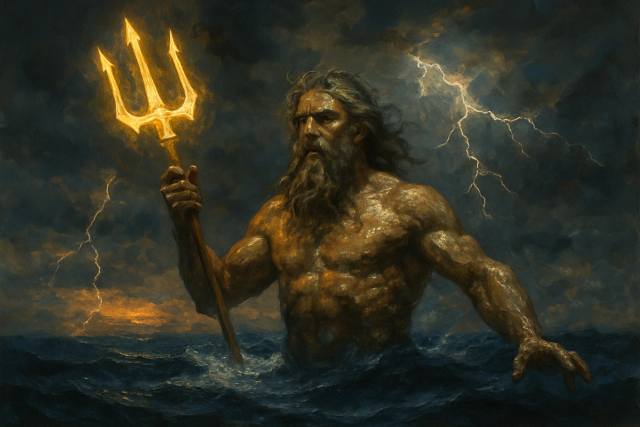
Poseidon, Greek god of the sea: his trident, powers, family, famous myths, Roman equivalent Neptune, and his meaning in dreams tod…
Uncover 10 surprising facts about Hera, Greek queen of the gods, from her sacred animals to her fierce role as protector of marria…