Greek Mythology
Orpheus and Eurydice: Myth, Story, Ending & Symbolism
The full myth of Orpheus and Eurydice, its ancient sources, ending, and what the tragic backward glance symbolizes about grief and…
 KnowMastery
 Hera was the Greek goddess of marriage, women, and family, and the queen of Mount Olympus. Most people know her only as Zeus's jealous wife, but she was also worshipped as a protector of childbirth, a fierce warrior in her own right, and one of the oldest deities in the Greek pantheon. Temples were built in her honor centuries before the Parthenon existed, and her cult at Argos and Samos predates much of the worship we associate with Zeus himself.
Most people picture Hera as a bitter figure chasing after Zeus's lovers. That image sticks because the stories about her jealousy are dramatic and easy to repeat. But behind that reputation is a goddess that cities depended on, that soldiers prayed to before battle, and that held the title Queen of Heaven long before most other Olympian cults existed.
Once you look past the revenge stories, a stranger and more interesting figure appears. She was worshipped as a virgin, a wife, and a widow in the same year, depending on the season. She had a temple older than any built for Zeus. Here are ten facts that show the Hera the ancient Greeks actually prayed to.
Archaeological evidence from Samos and Argos shows Hera had established cult centers by the 8th century BCE, home to some of the earliest monumental temples in the Greek world. Her worship on Samos may even predate the arrival of Zeus worship in the region. This suggests Hera was not added to the pantheon simply as a wife figure. She was a major independent goddess whose cult absorbed older Aegean mother-goddess traditions before being folded into the Olympian family described in Greek mythology.
Linguists still debate the origin of the name Hera. Some tie it to the Greek word for season or ripeness, ora, connecting her to fertility and the natural cycle of marriage and childbirth rather than to Zeus at all. Others link the name to hero, suggesting a title of honor rather than a description of her marital status. Either way, her name was never meant to define her purely as someone's spouse.
In the version recorded by the geographer Pausanias, Zeus first approached Hera by transforming himself into a wounded cuckoo bird. Hera, moved by pity, picked up the bird and held it against her chest to warm it, at which point Zeus resumed his true form and forced himself upon her. Ashamed, Hera agreed to marry him to restore her honor. It is a strange origin story for the goddess of marriage, one that starts with deception rather than devotion, and it colors much of her later behavior toward Zeus throughout Greek myth.
At Nauplia, near Argos, a spring called Kanathos was said to be where Hera bathed each year and emerged as a virgin again. This ritual was tied to the Heraia festival and reflected the belief that Hera existed in three distinct states across the year: Pais, the maiden, Teleia, the fulfilled wife, and Chera, the widow or separated woman. This triple identity made her far more complex than the single role of jealous wife that later stories reduced her to.
When Zeus turned his lover Io into a cow to hide her from Hera, Hera was not fooled. She sent the hundred-eyed giant Argus Panoptes to guard the cow. After Hermes killed Argus on Zeus's orders, Hera took his hundred eyes and placed them on the tail feathers of the peacock, her sacred bird, as a tribute to his loyalty. The peacock still represents Hera in art today, alongside the cow and the pomegranate, a symbol of fertility and marriage.
| Symbol | Meaning |
|---|---|
| Peacock | Watchfulness and royal authority, linked to the myth of Argus |
| Pomegranate | Fertility, marriage, and the cycle of seasons |
| Cow | Fertility and maternal protection, from her epithet boopis, ox-eyed |
| Diadem or crown | Her status as queen of Olympus |
| Cuckoo | Her courtship by Zeus and the arrival of spring |
In one lesser known version of the myth, recorded by the writer known as Pseudo-Eratosthenes, Hermes tricked Hera into nursing the infant Heracles, Zeus's son by a mortal woman, by presenting the baby while she slept. Her divine milk was so powerful that when Heracles bit down too hard, she pulled away, and the spray across the sky formed the Milky Way, called Galaxias in Greek, meaning milky circle. Hera later became Heracles' fiercest tormentor anyway, sending madness upon him that led to the deaths of his own children, and assigning him the Twelve Labors through his cousin Eurystheus.
According to the Iliad, Hera once conspired with the sea god Poseidon, Athena, and other gods to bind Zeus in chains while he slept. The plot was discovered before it could succeed, and Zeus punished Hera by hanging her from the sky in golden chains with anvils tied to her feet. This story rarely appears in popular retellings today, but it shows Hera as a political actor willing to challenge the king of the gods directly, not merely react to his affairs.
Hera despised the Trojans after the Judgment of Paris, in which Paris chose Aphrodite over Hera and Athena as the most beautiful goddess. Throughout Homer's Iliad, Hera manipulates events, seduces Zeus to distract him, and personally urges on the Greek forces to ensure Troy's destruction. Her rivalry with Aphrodite shaped the entire outcome of the war, making Hera a driving force behind one of the most famous conflicts in Greek storytelling.
While Zeus was worshipped everywhere from Dodona to Olympia, Hera's most important cult centers were the Heraion of Argos and the Heraion of Samos, both massive sanctuaries built specifically for her worship. The Argive Heraion held a famous chryselephantine statue of Hera by the sculptor Polykleitos, comparable in scale and reverence to the great statues built for Zeus and Athena elsewhere in Greece. Her festival, the Heraia, included athletic competitions for unmarried women, among the earliest recorded sporting events reserved specifically for females in the ancient world.
When the Romans adapted Greek religion, Hera became Juno, queen of the Roman pantheon and protector of the state itself, not just marriage. Juno Moneta, one of her Roman titles, gave her name to the Roman mint and eventually to the English word money. The Roman version softened some of Hera's vengeful storylines and emphasized her civic protection instead, showing how the same goddess could be reshaped by a different culture's priorities.
Hera does not show up in ancient dream manuals the way Hermes or Asclepius do, but she has become a common reference point in modern psychological and spiritual reading of dreams. In Jungian frameworks, Hera is often used as shorthand for the archetype of the committed partner, the figure who values structure, loyalty, and social order within a relationship. Dreaming of a crowned woman, a queen figure, or a peacock is sometimes read in these systems as a signal about fidelity, partnership boundaries, or anger toward a partner that has not been addressed directly.
In contemporary Hellenic polytheism and modern pagan practice, some worshippers invoke Hera specifically in rituals about marriage vows, renewing commitments, or standing firm within a long-term relationship. Her jealousy myths get treated less as a character flaw in these settings and more as an example of demanding accountability from a partner who has broken trust.
Hera's stories are often read as tales of jealousy, but they can also be understood as stories about boundaries, loyalty, and the cost of betrayal in any relationship, human or divine. Her insistence on being treated as an equal partner instead of a background figure to Zeus reflects a demand for respect that still applies far outside ancient religion.
For anyone studying Greek religion, Hera sits alongside figures like Athena and Artemis as proof that the Olympian goddesses held real civic and spiritual authority, not just supporting roles in male gods' stories.
Hera was the Greek goddess of marriage, women, and childbirth, and she held the title Queen of Olympus as Zeus's wife. She was also worshipped as a civic protector in cities like Argos and Samos, where her temples predate many other Olympian sanctuaries.
Zeus had numerous affairs with mortal women and other goddesses throughout Greek mythology, often resulting in children who became demigods or heroes. Hera's anger in these myths was usually directed at Zeus's lovers and offspring rather than at Zeus himself, since as queen she could not easily punish her husband directly.
The peacock and the cow are Hera's primary sacred animals. The peacock comes from the story of the giant Argus, while the cow relates to her common epithet boopis, meaning ox-eyed, which described her striking gaze in ancient poetry.
Yes, Juno is the Roman equivalent of Hera, and she inherited most of Hera's roles as queen of the gods and protector of marriage. The Romans expanded her role to include protection of the state itself, giving her titles like Juno Moneta that had no direct Greek precedent.
The full myth of Orpheus and Eurydice, its ancient sources, ending, and what the tragic backward glance symbolizes about grief and…
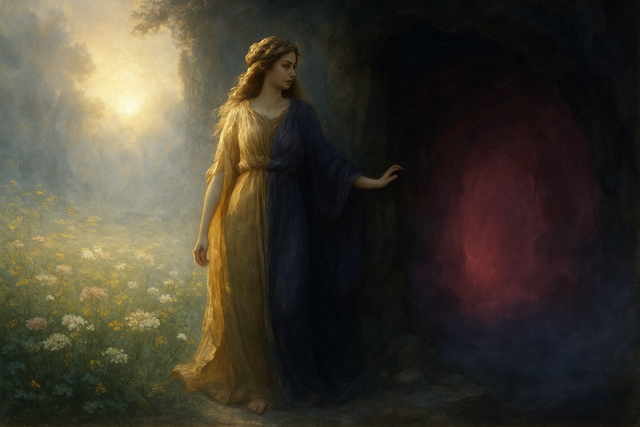
Persephone's myth, symbolism, and spiritual meaning — how the Greek goddess of spring became Queen of the Underworld.

Who was Prometheus? Explore the Titan's myth, punishment, fire symbolism, tattoo meaning, and what he teaches us about progress an…