
Greek Mythology
Prometheus: Myth, Symbolism & Meaning of the Fire-Bringer
Who was Prometheus? Explore the Titan's myth, punishment, fire symbolism, tattoo meaning, and what he teaches us about progress an…
 KnowMastery
 The myth of Echo and Narcissus tells the story of a nymph cursed to only repeat the last words spoken to her, and a beautiful young man who falls in love with his own reflection and wastes away staring at it. Found in Ovid's Metamorphoses, the tale explains the origin of the word "narcissism" and the natural phenomenon of an echo. At its core, it is a warning about vanity, unreciprocated love, and the danger of loving an image instead of a real person.
There is something unbearably sad about a voice that can never speak its own words again. Echo loved fully, openly, with her whole chest, and the gods took away the one thing she needed most: the ability to say so.
Narcissus, by contrast, never had to say anything. He simply looked down into still water one afternoon and forgot how to look away. Two different kinds of loneliness, tangled together in one story that the Greeks told around fires for centuries.
Ovid wrote the most complete version of this myth around 8 CE, though older fragments of the Narcissus story existed in Greek oral tradition before that. The tale begins with two separate curses that eventually meet in the same forest.
Echo was a mountain nymph known for her endless talking. According to Ovid, she used to distract Hera, queen of the gods, with long stories while Zeus pursued other nymphs in the woods. When Hera realized she had been tricked, she punished Echo directly: from that day forward, Echo could only repeat the final words anyone said to her. She lost her own voice completely, left only with the power to reflect back what others spoke first.
This detail matters. Echo's punishment was not silence. It was the loss of original expression, the inability to ever initiate, only respond.
Narcissus was the son of the river god Cephissus and the nymph Liriope. A seer named Tiresias had warned his mother that the boy would live a long life "as long as he never knows himself." Narcissus grew up extraordinarily beautiful, and he rejected every suitor, man or woman, who came to him.
Echo saw him hunting in the forest and fell in love instantly. She followed him silently until he sensed someone nearby and called out, "Who's here?" Echo could only answer, "Here!" When he eventually called for her to come to him, she rushed forward and tried to embrace him. Narcissus recoiled, telling her he would rather die than let her touch him. Echo, heartbroken, withdrew into the mountains, wasting away until only her voice remained, which is why an echo today is sound without a body.
One of Narcissus's other rejected admirers prayed to the goddess of vengeance, Nemesis, asking that he feel the same unanswered longing he caused in others. Nemesis granted the prayer. Narcissus came upon a clear pool, bent to drink, and saw his own reflection for the first time. He fell completely in love with it, not realizing it was himself. He could not leave the water's edge, could not eat or sleep, and eventually died there, staring at an image that could never love him back. Where he died, a flower grew, the narcissus, which still bears his name.
Greek myths rarely exist just to entertain. This one works on at least two levels at once, one about love directed outward and one about love turned entirely inward.
Narcissus gave us the clinical term "narcissism," first used by psychologist Sigmund Freud in the early 1900s to describe excessive self-regard and an inability to form genuine attachments to others. But the myth is more specific than a simple warning against vanity. Narcissus does not love himself in a healthy way, he loves an image, something external and ultimately empty. The water shows him a surface, not a soul. That distinction, between real self-knowledge and obsession with appearance, is the actual point of the story.
Echo represents a different danger: the total erasure of self in service of someone else's attention. She has no voice of her own left by the time she meets Narcissus, and loving him costs her the last of her physical form. Her story reads like an early account of codependency: shrinking yourself down to nothing trying to be heard by someone who was never going to listen.
In later Greek thought, the myth connects closely to the Delphic maxim "gnothi seauton," or "know thyself," inscribed at the temple of Apollo at Delphi. Tiresias's prophecy, that Narcissus would live long only if he never knew himself, reframes the whole story as a parable about self-knowledge. Narcissus does not die because he looks at his reflection, he dies because he mistakes that reflection for another person and never recognizes it as himself. The tragedy is a failure of self-awareness, not simply vanity.
Psychologically, the pool functions the way modern therapists talk about projection. Narcissus projects longing onto an image and never does the internal work of understanding what he actually wants. Echo, meanwhile, offers a mirror of a different kind: a person who has lost her own voice entirely because she organized her identity around being desired by someone unavailable.
Ovid's version is the most famous, but it was shaped by the literary culture of Augustan Rome, which loved stories about transformation and poetic justice. Ovid frames Narcissus's death as balanced punishment: he who refused love is doomed by love itself, a tidy moral structure typical of Roman retellings of older Greek material.
A separate, earlier Greek source, recorded by the 2nd-century writer Pausanias, offers a quieter version with no Echo at all. In it, Narcissus has a twin sister who dies, and he visits the pool to see her face reflected in his own, not out of vanity but grief. This version removes the curse and the punishment entirely and turns the myth into a story about mourning. Even a famous myth like this one was not a fixed text, different regions and periods told it differently depending on what lesson they wanted to pass down.
By the Renaissance, painters like Caravaggio returned to Ovid's version specifically, using Narcissus staring into dark water as a meditation on mortality and illusion, a theme that fit neatly alongside other classical subjects involving Aphrodite and ideals of beauty that Renaissance artists were actively reviving from antiquity.
In dream symbolism, these two figures often stand for opposite poles of the same anxiety: the fear of not being heard, and the fear of becoming too absorbed in your own image.
| Aspect | Echo | Narcissus |
|---|---|---|
| Core wound | Loss of voice and identity | Inability to see beyond himself |
| Cause of suffering | Punished by Hera for deception | Cursed by Nemesis for cruelty to others |
| What remains after death | A disembodied voice, the natural echo | A flower bearing his name |
| Modern symbolic meaning | Codependency, loss of self in love | Vanity, self-obsession, lack of self-knowledge |
The story still has practical use beyond classroom analysis. It describes two real patterns people fall into, and naming them helps break them.
The myth also sits comfortably alongside other stories in the wider Greek gods tradition that deal with pride and consequence, figures who overstep and are answered with precise, fitting punishment rather than random bad luck.
The myth warns against two extremes: losing yourself completely in love for someone who does not reciprocate, and becoming so absorbed in your own image that you cannot connect with anyone real. Both Echo and Narcissus die from an inability to form a genuine, mutual relationship.
Narcissus was cursed by the goddess Nemesis after he cruelly rejected everyone who loved him, including Echo. The curse made him fall in love with the first beautiful thing he saw, which turned out to be his own reflection in a still pool, and he had no way of recognizing it was himself.
It contains love but is better described as a tragedy about unreturned affection. Echo loves Narcissus and is rejected, then Narcissus is cursed to love an image that can never love him back, so neither character experiences love that is mutual or sustainable.
Sigmund Freud adapted the term from this myth in the early 20th century to describe excessive self-regard and a reduced capacity for genuine emotional connection with others. The term has since become standard in psychology to describe a personality pattern centered on grandiosity and a need for admiration.
Who was Prometheus? Explore the Titan's myth, punishment, fire symbolism, tattoo meaning, and what he teaches us about progress an…
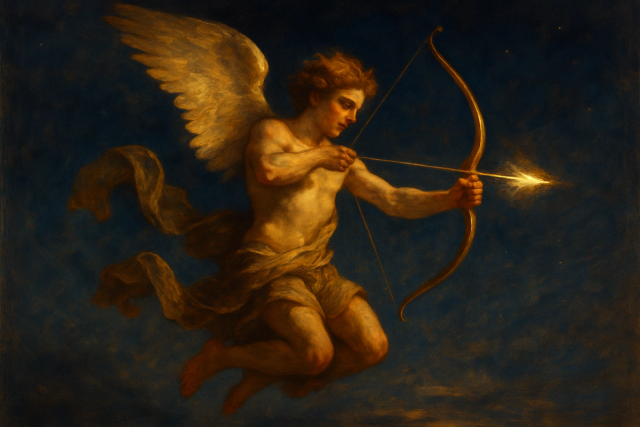
Who is Eros? Discover the Greek god of love and desire—his myths, symbols, spiritual meaning, and how to invoke his passionate ene…
Discover why Apollo is the Greek god of music, his lyre, the Muses, and what his myths reveal about harmony, art, and inspiration.