Greek Mythology
Theseus and the Minotaur Myth Explained
The full myth of Theseus and the Minotaur: its origins, symbolism, dream meaning, and how to apply its lesson on courage to real l…
 KnowMastery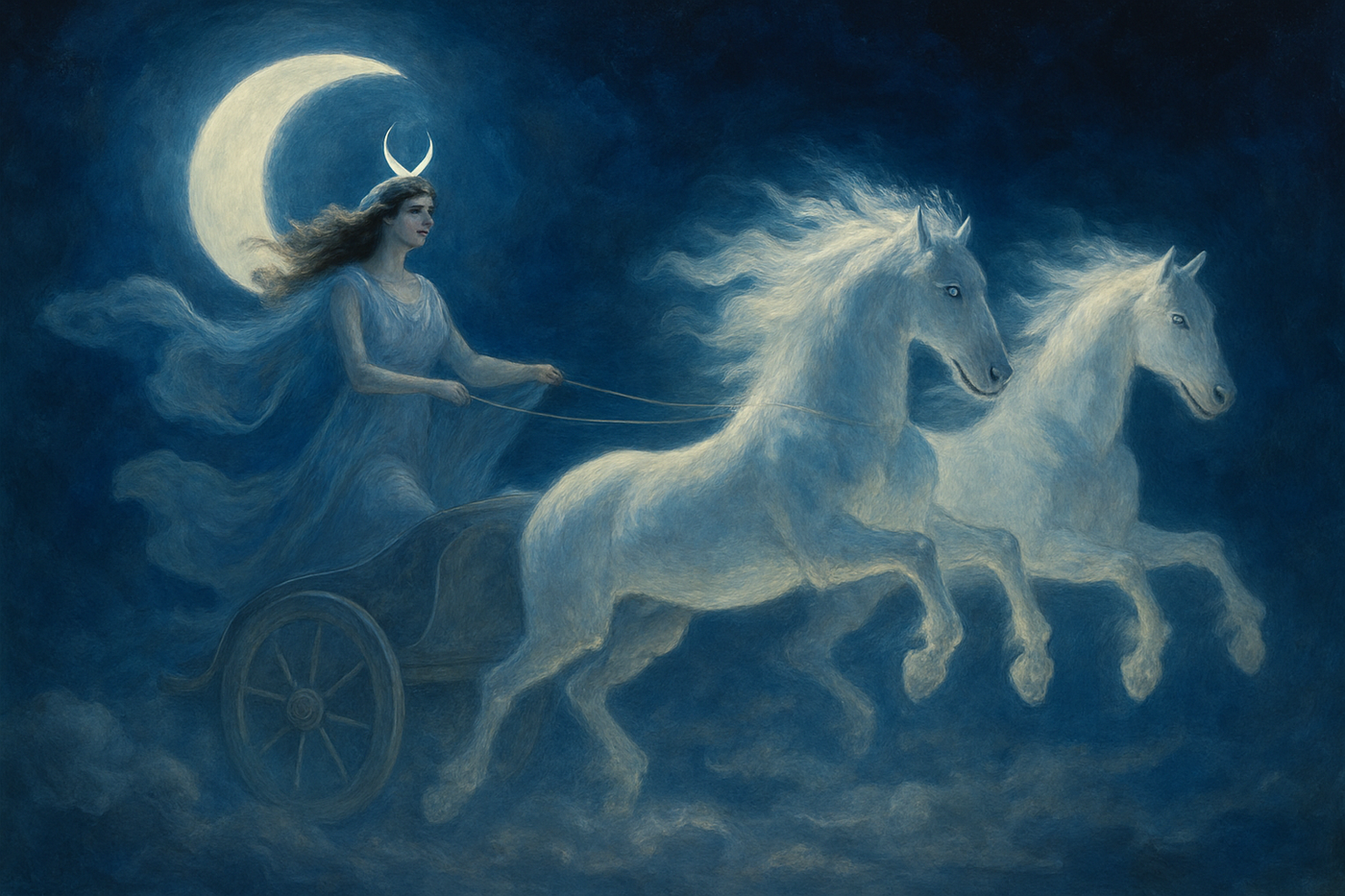
Selene is the Greek Titan goddess who personifies the Moon, driving a silver chariot across the night sky each evening to light the darkness. She embodies intuition, cyclical change, romantic longing, and reflected rather than self-made light.
Daughter of the Titans Hyperion and Theia, she is sister to Helios (the Sun) and Eos (the Dawn), forming a divine trio that governs the rhythm of day and night. There is something achingly tender about a goddess who cannot stop moving, who crosses the heavens every single night yet is remembered mostly for one act of stillness: watching over a sleeping man she loved. Selene's story is not one of thunderbolts or conquest. It is quieter, stranger, and in many ways more human than the tales of her Olympian cousins.
She glows rather than blazes. She watches rather than commands. And perhaps that is why, thousands of years later, people still look up at a full moon and feel that same ache — the sense of being seen by something distant, luminous, and just out of reach.
| Attribute | Detail |
|---|---|
| Domain | The Moon, nighttime illumination, monthly cycles |
| Parents | Hyperion (Titan of light) and Theia (Titan of sight) |
| Siblings | Helios (the Sun) and Eos (the Dawn) |
| Consort | Endymion, the mortal shepherd |
| Roman Name | Luna |
| Symbol | Crescent moon crown, silver chariot, torch |
Selene belongs to the generation of deities before the Olympians took control of the cosmos. She is a Titan goddess, not one of the twelve Olympians like Zeus, which places her among the older, more primal forces of nature — sky, sun, moon, sea, and time itself. According to Hesiod's Theogony, Selene was born from Hyperion and Theia, making her a cousin of sorts to the later Olympian order. The Homeric Hymn 32, composed centuries later and dedicated entirely to her, praises Selene's "far-flung ray" and describes her radiant, deathless beauty as she rounds the sky in her chariot.
Each night, Greek poets imagined her rising from the eastern edge of the world, crowned with a crescent or full lunar disc, driving a chariot pulled by two white horses, a pair of oxen, or sometimes winged steeds — accounts vary. She traveled the sky until dawn, when her sister Eos and brother Helios would begin the cycle again. Understanding this Selene moon goddess meaning — light without heat, presence without force — is key to seeing why she endured in art and poetry long after her worship faded.
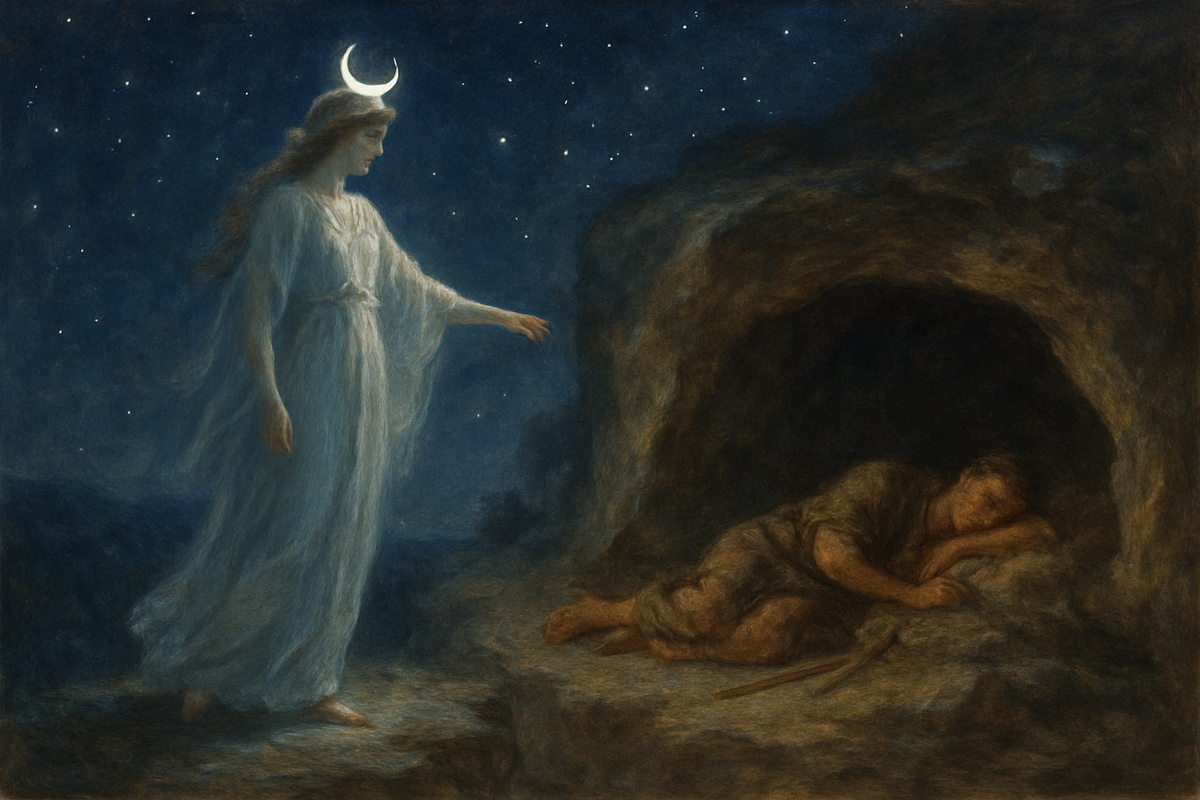
The most enduring myth about Selene involves Endymion, a beautiful mortal shepherd (in some tellings a king or hunter) whom she fell deeply in love with. Unwilling to watch him age and die, Selene begged Zeus to grant him eternal youth. Zeus agreed — but with a haunting condition: Endymion would sleep forever, frozen in perpetual, dreamless youth.
Selene accepted the bargain. Every night, she descended from the sky to gaze upon him as he slept in a cave on Mount Latmus in Asia Minor, and it is said she bore him fifty daughters, one for each lunar month of the Olympic cycle. The myth captures something profoundly bittersweet: a love that is eternal precisely because it can never fully be reciprocated in waking life. Selene is forever the one who watches, who loves from a distance, who gives light without demanding it back — a devotion that echoes the kind of eternal, unshakable romance more often associated with Aphrodite, the goddess of love herself.
Ancient poets used this story to explain the moon's pale, wistful quality — always present, always watching, but never quite touchable, much like Selene's own unattainable romance. The Roman poet Ovid retold the tale in his own verses, and by the time it reached Renaissance painters, Endymion's eternal sleep had become a favorite symbol of love that outlasts mortality itself. The Selene and Endymion myth remains one of the most retold love stories to come out of Greek mythology precisely because it asks what devotion looks like when it can never be fully returned.
Selene's iconography is remarkably consistent across Greek art and poetry, which helps modern readers identify her instantly in ancient vase paintings, coins, and temple reliefs. Each Selene goddess symbol carries its own layer of meaning, from the crown she wears to the animals that pull her chariot.
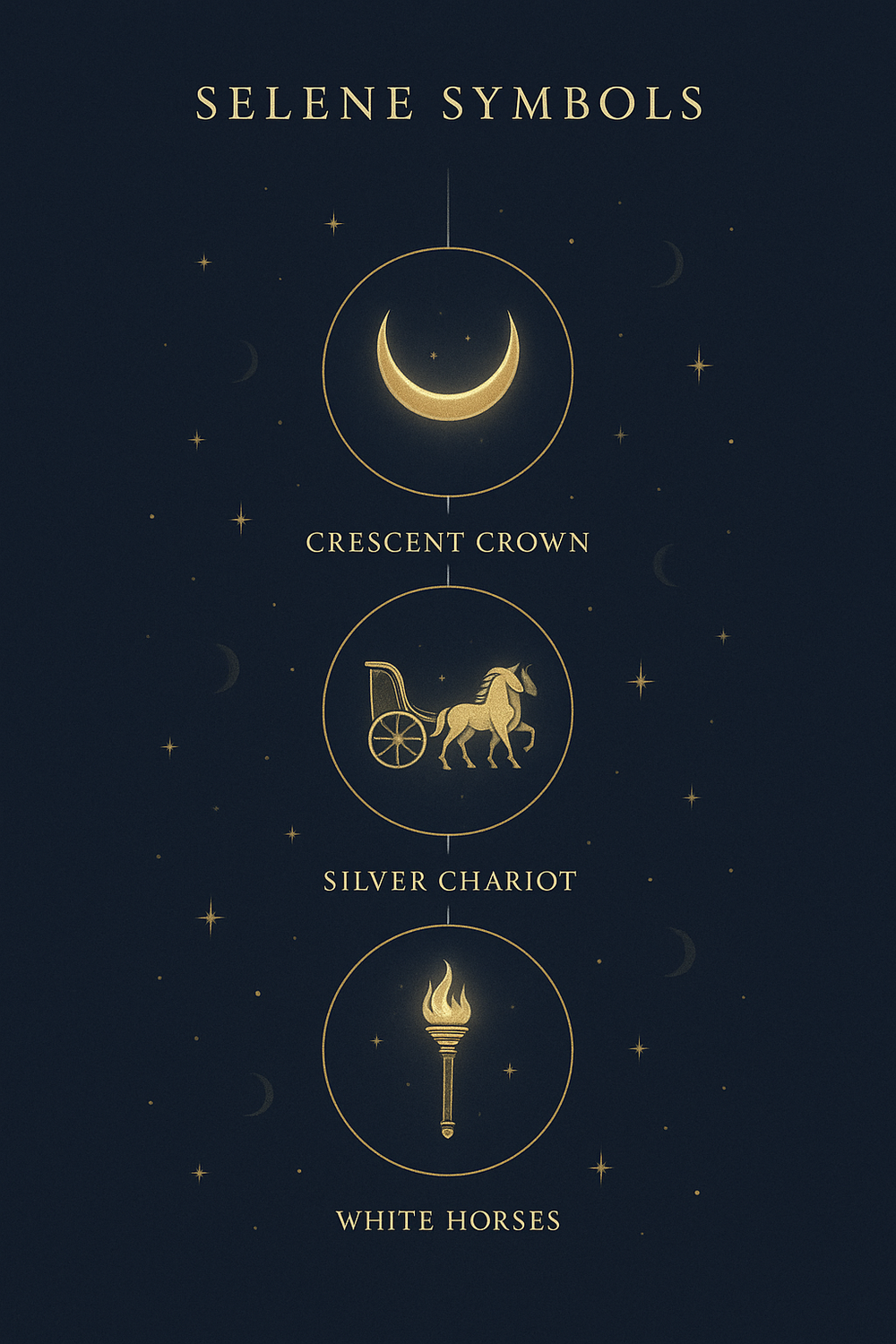
| Symbol | Meaning |
|---|---|
| Crescent or full moon crown | Divine authority over the lunar cycle |
| Silver chariot | Nightly journey across the heavens |
| White horses or oxen | Purity, steady rhythm of time |
| Torch | Illumination in darkness, guidance |
| Flowing veil or robe | Mystery, the veiled nature of night |
| Owl | Nocturnal wisdom, quiet observation |
Unlike her brother Helios, who is depicted with a radiant, fiery crown, Selene's imagery is soft-edged and cool-toned — silver rather than gold, pale rather than blazing. This visual contrast reinforced the ancient Greek understanding of the moon as reflective rather than self-generating light, a concept later confirmed by astronomy but intuited by myth long before.
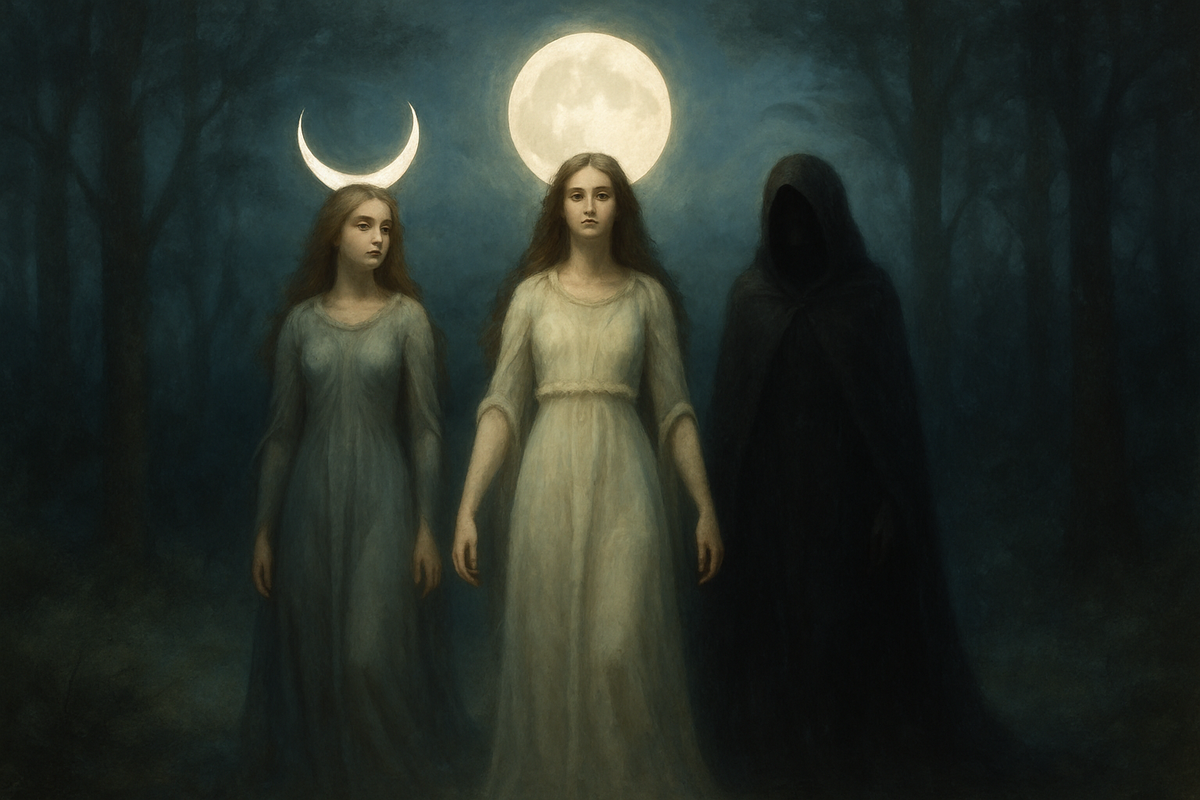
One of the most common points of confusion in Greek mythology is the overlap between Selene, Artemis, and Hecate. In the earliest myths, these were three distinct goddesses with separate domains. Over time, especially during the Hellenistic period, poets and philosophers began merging them into a single "triple goddess" archetype representing the moon's three phases.
This triadic model became especially popular in later Orphic and Roman literature, where the three were sometimes invoked together as a single lunar force with three faces. It's worth noting that this blending was a literary and religious development rather than an original feature of early Greek religion — Selene predates this syncretism by centuries. A similar impulse to tie lunar authority to calendar-keeping and divine order appears far outside Greece too: the Mesopotamian moon god Sin (also called Nanna) governed the months in Babylonian religion in much the same way Selene's fifty daughters mark out the lunar year in Greek myth.
Beyond her myths, Selene carries rich symbolic weight in spiritual and esoteric traditions, both ancient and modern. Much of the modern interest in the Selene moon goddess meaning comes from her association with reflection, intuition, and the parts of ourselves that only surface in quiet or darkness.
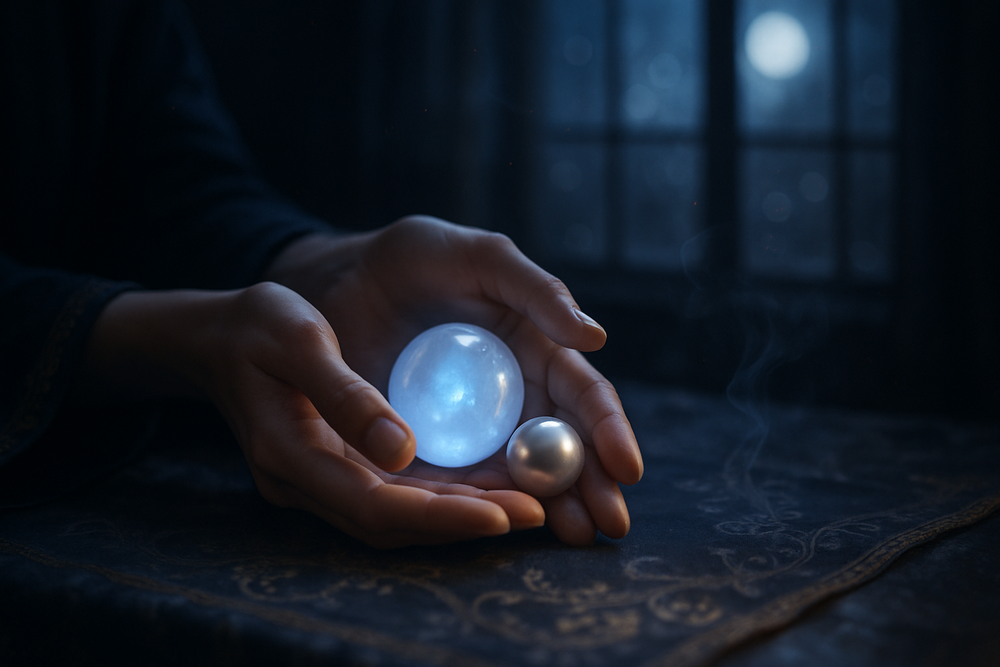
Because the moon reflects rather than generates light, Selene is often associated with intuition, receptivity, and inner knowing rather than outward assertion — a contrast frequently drawn against solar deities like Apollo. To invoke Selene spiritually is to honor the quieter forms of insight: dreams, gut feelings, and emotional clarity that arrive in stillness rather than through force.
Selene's fifty daughters, tied to the months of the lunar calendar, reflect the ancient association between the moon and biological, agricultural, and emotional cycles. In this sense she shares symbolic territory with Demeter, though Demeter governs the earth's fertility while Selene governs the rhythmic, cyclical timing behind it.
The Romans adopted Selene almost wholesale as Luna, giving her temples on the Aventine Hill in Rome and associating her with the passage of time itself, since the Latin word "mensis" (month) derives from the same root as "moon." In Neoplatonic allegory, Porphyry treated the lunar sphere as a symbolic threshold where souls descend into material 'genesis' and ascend back to the intelligible realm, an idea some later interpreters read as casting Selene as a kind of cosmic intermediary between heaven and earth.
When Selene or moon imagery appears in dreams, it is traditionally interpreted through several lenses:
Dream interpreters who draw on classical symbolism often frame Selene-related dreams as messages about patience — reminding the dreamer that, like the moon's own cycle, not everything can be rushed toward fullness.
Whether approached as mythology, psychology, or personal spiritual practice, Selene offers a practical framework for modern life:
None of this requires belief in ancient deities literally — it simply borrows Selene's poetic logic: that illumination doesn't always need to be loud, and that watching, waiting, and reflecting are valid forms of power too.
The table below situates Selene among other Greek deities tied to light and sky, making it easy to see at a glance how her lunar domain differs from solar, dawn, and prophetic powers.
| Deity | Domain | Symbol |
|---|---|---|
| Selene | The Moon | Crescent, silver chariot |
| Helios | The Sun | Golden chariot, radiant crown |
| Eos | The Dawn | Rosy fingers, saffron robe |
| Apollo | Sun, prophecy, music (later syncretized with Helios) | Lyre, laurel |
| Artemis | Hunt, wilderness (later linked to the moon) | Bow, stag |
This comparison shows how Selene fits into a broader family of celestial deities. While gods of storm and war command dramatic forces, Selene's realm is far gentler — the passage of night itself, measured out in silver light.
No, they were originally distinct goddesses. Selene was always the personification of the moon itself, while Artemis was the goddess of the hunt and wilderness; the two were only merged into a shared "moon goddess" identity in later Greek and Roman literature.
Selene is the Greek goddess of the moon, believed to personify the moon itself as it travels across the night sky. She is also associated with the passage of months, nighttime illumination, and quiet, reflective intuition.
Selene fell in love with Endymion, a mortal shepherd whom Zeus granted eternal youth in exchange for eternal sleep. She visited him nightly on Mount Latmus and, according to myth, bore him fifty daughters.
Selene's Roman counterpart is Luna, who inherited nearly identical imagery and symbolism, including the silver chariot and crescent crown. The word "lunar," still used today, comes directly from her Roman name, while "month" derives from the same linguistic root as "moon."
The name Selene comes from the ancient Greek word "selas," meaning light, brightness, or gleam. It was used as a direct title for the moon itself before becoming the personal name of the goddess who embodied it.
As the personification of the moon, Selene's central power is her control over lunar light and the moon's nightly and monthly cycles. Later traditions also credited her with a subtler influence over dreams, intuition, and the emotional rhythms tied to moonlight, though she was never depicted with dramatic combat powers like the Olympians.
Selene is typically pronounced "seh-LEE-nee," with the stress on the second syllable. The name is often shortened in casual speech to "seh-LEEN," reflecting how it evolved into the modern given name Selena.
Selene is neither good nor evil in Greek mythology; ancient religion generally did not frame deities in moral binaries. She is consistently portrayed as a gentle, romantic, and somewhat melancholic figure rather than a malevolent or destructive one, making her one of the more sympathetic minor deities in the Greek pantheon.
The full myth of Theseus and the Minotaur: its origins, symbolism, dream meaning, and how to apply its lesson on courage to real l…

What is Cerberus? Meet the three-headed hound of Hades - his myths, parents, symbolism, and what he reveals about death, fear, and…

What is the Minotaur? Explore Crete's bull-headed monster, the Labyrinth, Theseus's quest, and its symbolism in myth and psycholog…