Greek Mythology
Echo and Narcissus Myth Explained: Meaning & Lessons
The full story of Echo and Narcissus, what it symbolizes about self-love and longing, and what this Greek myth still teaches us to…
 KnowMastery
Eros is the Greek god of love, desire, and erotic attraction—the personification of the sudden, overwhelming pull one being feels toward another. Ancient sources describe him two ways: as a primordial force born from Chaos at the dawn of creation, or as the winged son of Aphrodite who fires arrows that make gods and mortals fall instantly in love.
Close your eyes and picture the moment attraction strikes—the quickened pulse, the sudden inability to look away, the ache logic cannot explain. The Greeks gave that exact sensation a name and a face. They imagined it as an arrow loosed from an unseen bow, striking without warning, turning kings into fools and strangers into soulmates.
That is Eros: not a gentle cherub on a greeting card, but a raw, ungovernable power the ancients believed could unmake empires and remake hearts. To understand him is to understand why love has always felt less like a decision and more like a force of nature.
| Aspect | Details |
|---|---|
| Domain | Love, desire, erotic attraction |
| Parents | Chaos (primordial account) or Aphrodite and Ares (later account) |
| Roman Name | Cupid |
| Symbols | Bow and golden arrows, wings, torch, blindfold |
| Consort | Psyche, mortal woman later made immortal |
Eros embodies desire in its most immediate, physical form—distinct from the tender devotion of marriage or the deep companionship the Greeks called philia. His name is the root of the English word "erotic," a linguistic fingerprint of how central he was to Greek ideas about passion. Unlike most Olympians, Eros has no single fixed biography; Greek poets and philosophers told at least three distinct stories about where he came from and what he represents.
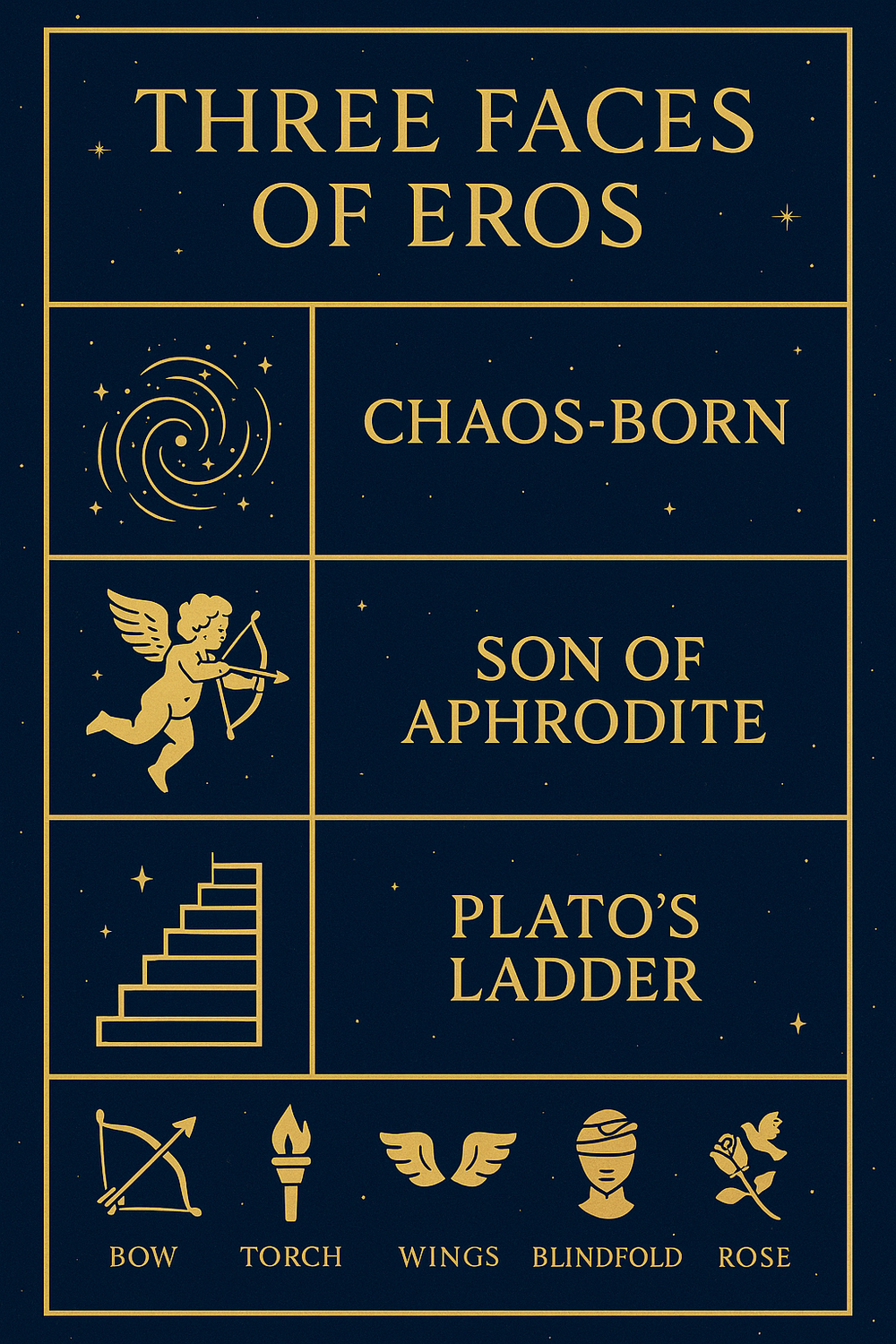
The earliest surviving account comes from Hesiod's Theogony (8th century BCE), where Eros emerges alongside Chaos, Gaia (Earth), and Tartarus at the very beginning of existence. In this version, Eros is less a personality than a cosmic principle—the attractive force that pulls elements together, without which nothing could unite or reproduce. Parmenides described Eros as the first god fashioned by an unnamed goddess, whom some ancient commentators, such as Aetius, later identified with Ananke, the goddess of necessity, while others such as Plutarch identified her as Aphrodite.
By the Classical period, poets like Simonides and later Roman writers reimagined Eros as the son of Aphrodite, with Ares named as his father in some traditions. This younger Eros is a playful, occasionally cruel child-god armed with a bow and two kinds of arrows: golden-tipped shafts that inspire passionate love, and blunt lead-tipped ones that create aversion and coldness. This is the figure who eventually became the Roman Cupid, the chubby-cheeked archer familiar from Valentine's Day imagery.
In Plato's Symposium (4th century BCE), the priestess Diotima offers a third version entirely: Eros is not a god but a daimon, a spirit born of Poverty (Penia) and Resource (Poros), forever caught between lack and fulfillment. This Eros drives the soul's ascent from desire for one beautiful body, to love of beauty in all bodies, to love of ideas and virtue, and finally to love of the eternal Form of Beauty itself. This philosophical reading—later called the "Platonic ladder of love"—strips away the arrows and wings entirely, treating Eros as the engine of intellectual and spiritual longing, not just romance.

| Aspect | Primordial Eros (Hesiod) | Eros, Son of Aphrodite |
|---|---|---|
| Origin | Born from Chaos at creation | Child of Aphrodite (and often Ares) |
| Nature | Cosmic force of attraction | Playful, willful, sometimes vengeful |
| Role | Enables union across the cosmos | Personally causes individuals to fall in love |
| Common era | Archaic Greek poetry | Classical & Hellenistic art, later Roman Cupid |
The richest surviving Eros story appears in the Roman writer Apuleius's novel The Golden Ass (2nd century CE), though it draws on older Greek folk motifs. Aphrodite, jealous of a mortal woman named Psyche's beauty, orders her son Eros to make Psyche fall in love with something monstrous. Instead, Eros accidentally pricks himself with his own arrow and falls hopelessly in love with her.
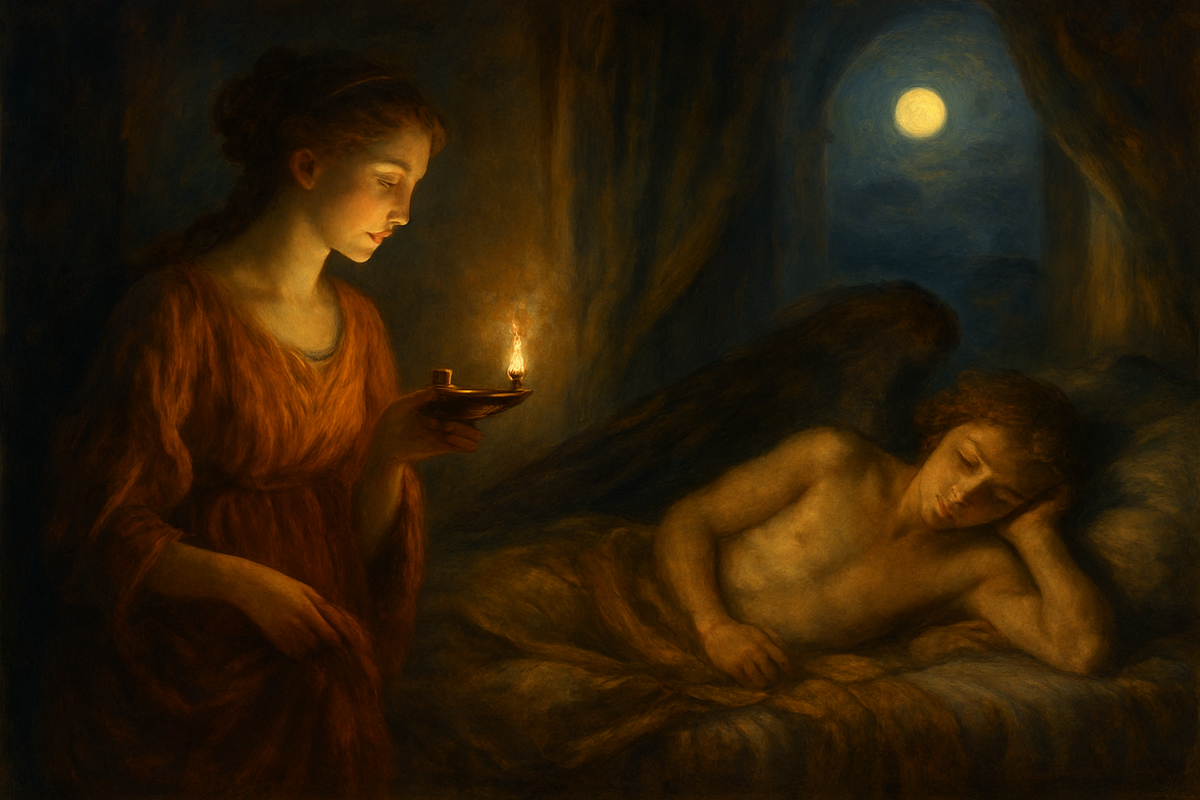
He visits Psyche only at night, forbidding her to see his face. When curiosity gets the better of her and she lights a lamp to look at him, hot oil falls on his shoulder, waking him, and he flees. Psyche then undertakes a series of impossible trials set by Aphrodite—sorting seeds, gathering golden fleece, retrieving a box from the underworld—to win him back. Zeus ultimately grants her immortality, and the couple is united forever, their daughter named Voluptas, or Pleasure.
This myth is often read as an allegory: the soul (Psyche) must endure trial and self-knowledge before it can be permanently united with desire (Eros). It's one of the few Greek myths where love is not just an event but an earned transformation—a theme that resonates with Plato's own idea of desire as a ladder to be climbed, not a lightning bolt to be passively received.
Ancient vase paintings and sculpture consistently associate Eros with a specific set of symbols that carried clear meaning to Greek audiences:

In modern spiritual and psychological contexts, "Eros" has outgrown its mythological origins to describe a broader energy. Sigmund Freud famously used Eros as shorthand for the life instinct—the drive toward pleasure, connection, and creation, which he contrasted with Thanatos, the death drive. In this framework, Eros isn't only about romance; it's the underlying impulse behind creativity, ambition, and the will to build rather than destroy.
In contemporary spiritual practice, invoking Eros energy is often associated with:
While Eros is a distinctly Greek figure, his image traveled and transformed across centuries:
The Romans absorbed Eros almost wholesale as Cupid (from cupido, "desire"), but softened him into a smaller, more domesticated figure—often shown as an infant accompanying Venus (Aphrodite's Roman counterpart), emphasizing playful mischief over cosmic power.
Italian Renaissance philosophers, particularly those influenced by Neoplatonism, revived the older Hesiodic and Platonic ideas of Eros as a cosmic and spiritual principle. Painters like Botticelli depicted Cupid/Eros hovering near Venus not merely as comic relief but as a symbol of divine love drawing the soul toward beauty and, ultimately, toward the divine itself—a direct visual echo of Diotima's ladder.
Eros rarely acted alone in the wider Olympian pantheon; his pull toward desire often stood in contrast to more disciplined deities like Artemis, whose fierce independence and devotion to the hunt made her one of the few goddesses traditionally unmoved by romantic entanglement.
| Deity | Culture | Primary Domain |
|---|---|---|
| Eros | Greek | Desire, attraction, erotic love |
| Cupid | Roman | Romantic mischief, matchmaking |
| Aphrodite | Greek | Beauty, love, sexuality (Eros's mother) |
| Kamadeva | Hindu | Desire and romantic love |
Because Eros rarely appears literally in modern dreams, dream interpreters usually treat symbols associated with him as messages about desire the dreamer may be suppressing:
Whether or not you take the myth literally, Eros offers a useful symbolic framework for reconnecting with desire in a healthy, intentional way:
For readers exploring the wider pantheon behind Eros's family tree, the Greek gods list offers context on how figures like Zeus and Apollo relate to the Olympian order Eros operates alongside, even as an older, more elemental force.
Eros is neither an Olympian nor a Titan; in Hesiod's earliest account he is a primordial deity born directly from Chaos at the start of creation. In later, more popular myths he is instead portrayed as a minor god, the son of Aphrodite, which is the version most familiar from art and the Psyche story.
Eros and Cupid are essentially the same figure viewed through different cultural lenses—Eros is the Greek original, while Cupid is the Roman adaptation. Cupid is typically portrayed as a chubby, mischievous infant, while Eros in earlier Greek art and philosophy could be either a powerful cosmic force or a graceful winged youth.
Eros's defining power is inspiring irresistible love or desire, traditionally through golden arrows that create passion and leaden arrows that create aversion or indifference. In his primordial form, his "power" is broader still: he is the attractive force that allows any union or creation to occur in the universe.
Sources disagree: Hesiod's Theogony presents Eros as having no parents, emerging from Chaos itself alongside the earliest gods. Later Greek and Roman tradition instead names Aphrodite as his mother, sometimes with Ares named as his father.
Eros is pronounced "EHR-oss" in English, though the ancient Greek pronunciation was closer to "EH-ros," with a short, clipped vowel sound. Both pronunciations are widely accepted, and the name shares its root with the English word "erotic."
In the myth of Eros and Psyche, Eros ultimately marries the mortal woman Psyche after she completes a series of trials set by his mother, Aphrodite. Zeus grants Psyche immortality so the couple can be together permanently, and their union produces a daughter, Voluptas, or Pleasure—making Psyche Eros's canonical consort.
Spiritually, Eros today represents the raw creative and romantic energy that drives passion, ambition, and connection rather than a literal deity to worship. Modern seekers often invoke "Eros energy" as a metaphor for reawakening desire, embracing sensuality, and following attraction as a signal toward what truly matters, rather than a specific ritual practice.