Greek Mythology
Persephone and Hades Myth Explained: Love, Death, Rebirth
The full story of Persephone and Hades: the abduction, the pomegranate seeds, and what this ancient myth of loss and renewal reall…
 KnowMastery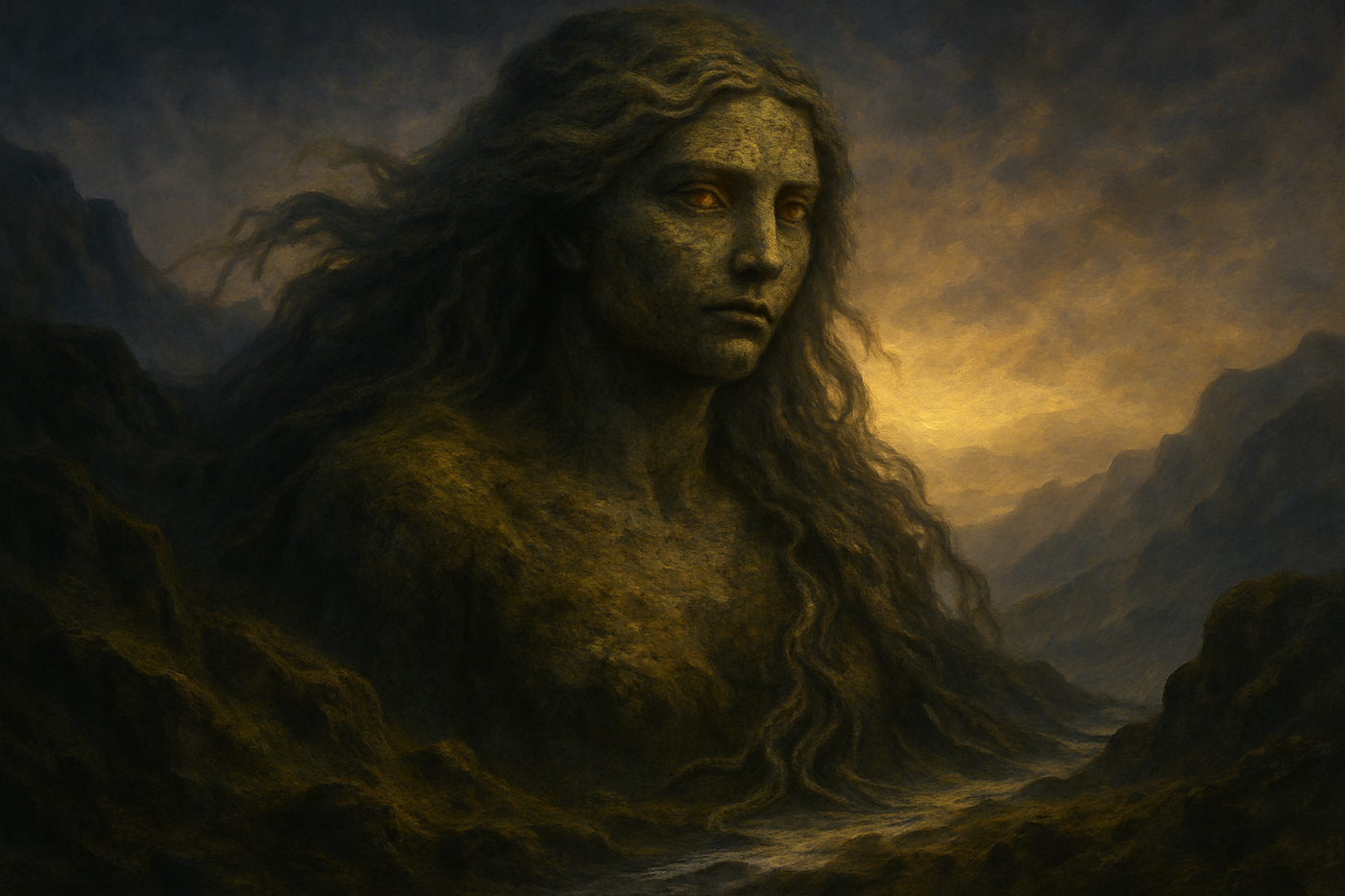
Gaia is the primordial Greek goddess who personifies the Earth itself. She is the living ground, mountains, and fertile soil made divine, not merely a deity who rules over the planet from afar. Born directly from Chaos at the dawn of creation, she is the mother of the Titans, the Cyclopes, the sea, the sky, and ultimately of every god listed in the Greek gods pantheon. The words "geography" and "geology" come from the Greek earth-word "ge," a form closely related to "gaia" and to the goddess Gaia's own name.
Gaia is pronounced GAY-uh or GUY-uh, depending on regional accent and whether you're following the more Anglicized or the more classical Greek vowel sound. Both pronunciations are widely accepted in English, and you'll hear scholars, podcasters, and documentary narrators use either one.
| Attribute | Details |
|---|---|
| Name | Gaia (also spelled Gaea) |
| Pronunciation | GAY-uh or GUY-uh |
| Domain | The Earth itself; primordial ground, mountains, and fertility |
| Parents | None — self-generated from Chaos |
| Consort | Uranus (the Sky), later Pontus and Tartarus |
| Children | The Titans, Cyclopes, Hecatoncheires, Giants, and Typhon |
| Roman Equivalent | Terra (also called Tellus Mater) |
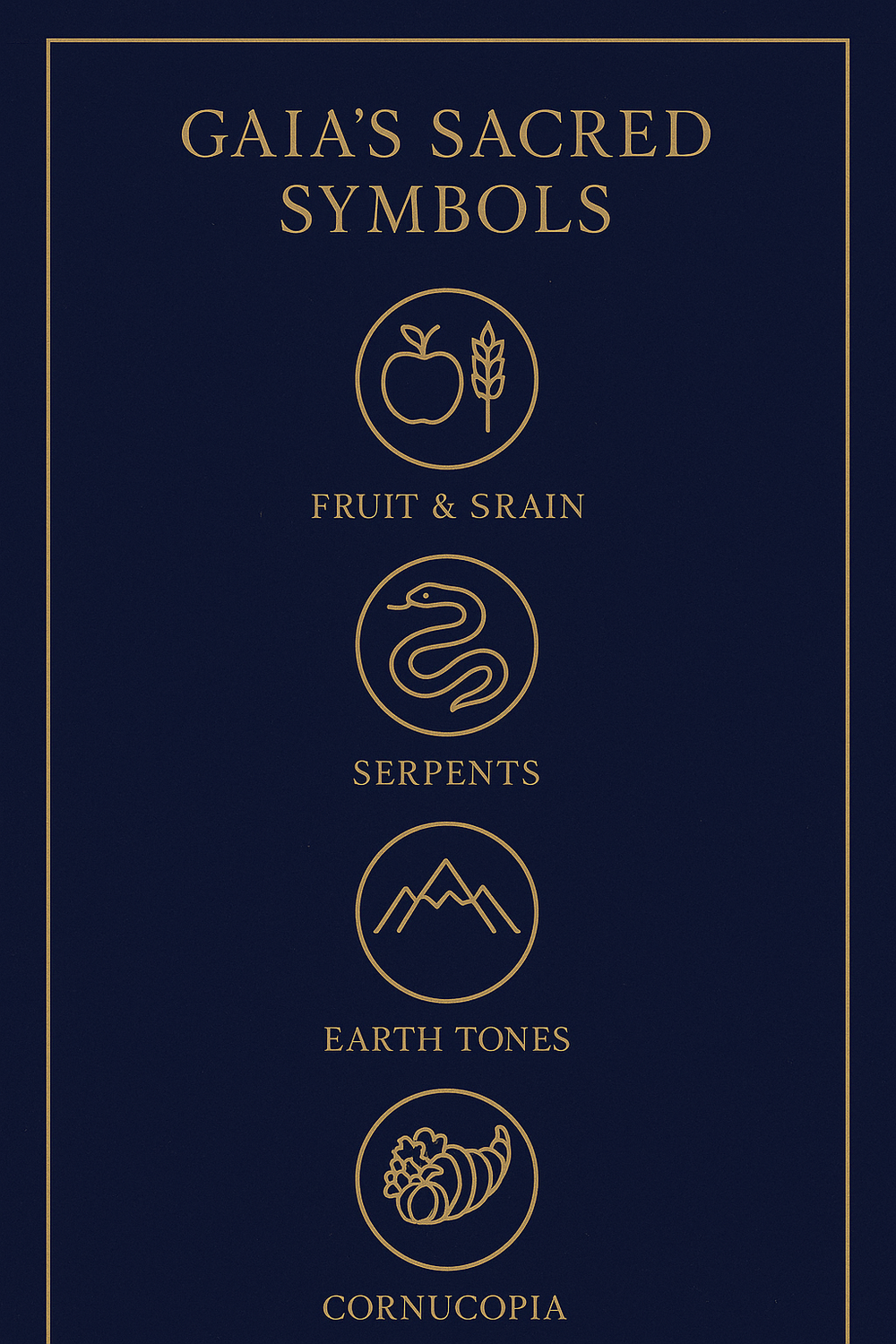
| Symbols | Fruit and grain, serpents, mountains, the color green and deep brown |
Picture the very first sunrise. There is no sky yet, no ocean, no gods with golden thrones — only a vast, formless dark called Chaos. And then, from that emptiness, something stirs: broad-breasted Gaia, solid and eternal, rising up to become the floor of everything that will ever exist.
She does not ask permission to exist. She simply is — patient, fertile, and quietly furious when her children are wronged. Long before Zeus ever held a thunderbolt, Gaia was already old, already a mother, already grieving and scheming in the dark.
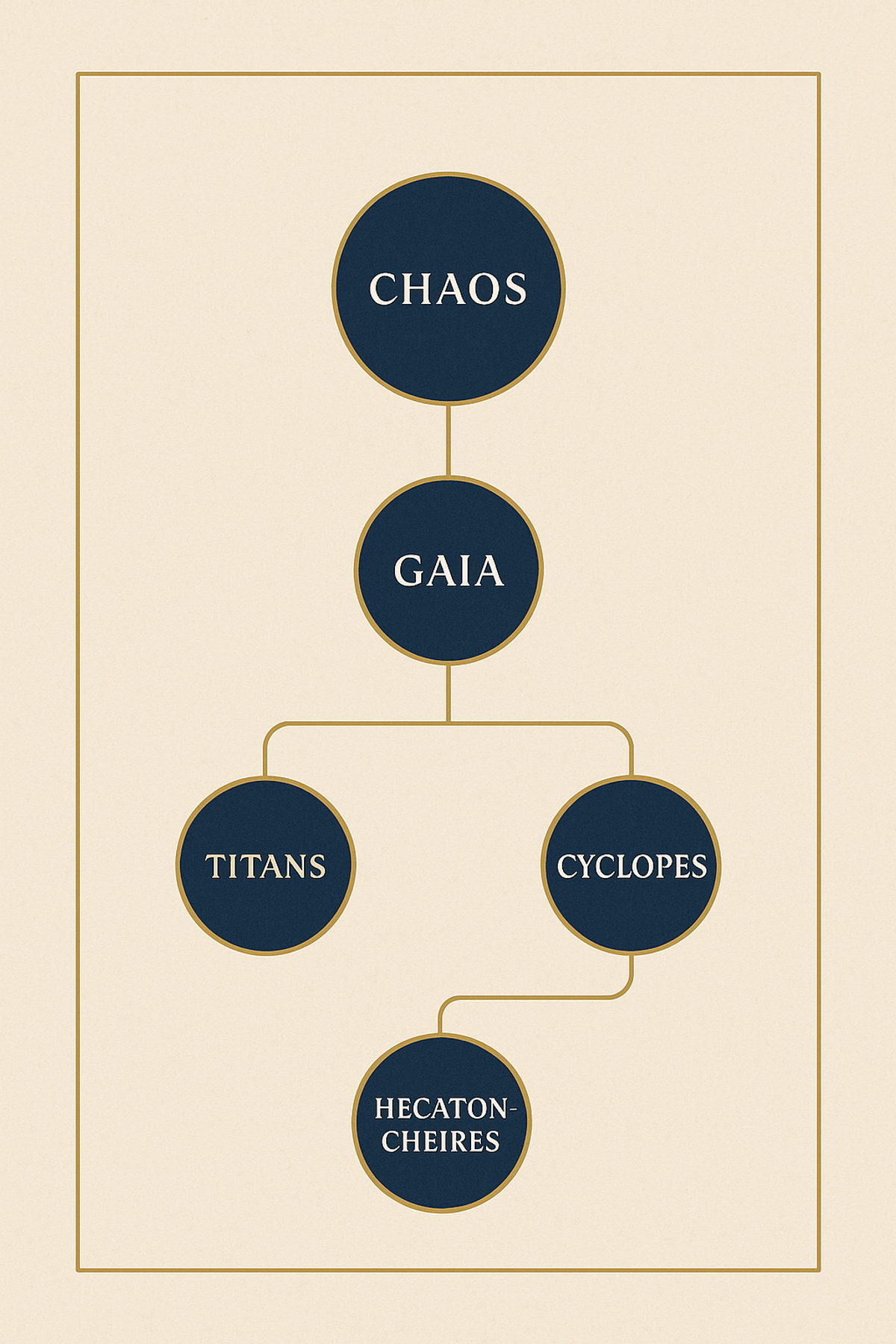
According to Hesiod's Theogony, the oldest surviving Greek creation account, Gaia emerged spontaneously after Chaos, followed shortly by Tartarus (the abyss) and Eros (desire). Gaia then produced Uranus (the Sky), Pontus (the Sea), and the Ourea (the Mountains) without any partner — an act of pure, self-generating creation that marks her as the ultimate source deity of the Greek cosmos.
Unlike Olympian gods who have clear domains — war, wisdom, the hunt — Gaia's "domain" is existence itself. She is not a goddess of the earth; she is the earth, given consciousness and voice. This distinction mattered spiritually: worshippers didn't pray to Gaia to change the weather or bless a harvest (that was more the province of Demeter); they invoked her for binding oaths, for the dead returning to soil, and for the deep, immovable truth beneath all things. In various Greek oaths, most famously in poetry such as the Argonautica, speakers swore 'by Gaia and Ouranos' (Earth and Sky), though the specific civic oaths recorded at Athens and Delphi do not themselves name Gaia. Later, when Zeus and his siblings ruled Olympus, it was Gaia's blood memory that connected every generation back to her, including queenly figures like Hera, who inherited her authority as part of that same cosmic lineage.
Gaia is not a Titan — she is older and more fundamental than the Titans themselves. The Titans are her children, born from her union with Uranus, which makes Gaia a full generation senior to Cronus, Rhea, and the rest of that famous twelve. In the Greek cosmological hierarchy, Gaia belongs to the primordial deities, a small group (alongside Chaos, Tartarus, Eros, and a few others) that existed before any structured "generation" of gods began. This is why Gaia is sometimes called a "protogenos" rather than a Titan or an Olympian — she predates both categories entirely.
As a primordial force rather than a specialized deity, Gaia's powers are sweeping and largely unbounded compared to later gods with narrower portfolios.
With Uranus, her own son and consort, Gaia birthed the twelve Titans (including Cronus and Rhea), the one-eyed Cyclopes, and the hundred-handed Hecatoncheires. This union was fraught from the start — Uranus, fearful of his monstrous children, imprisoned them inside Gaia's own body, causing her unbearable pain.
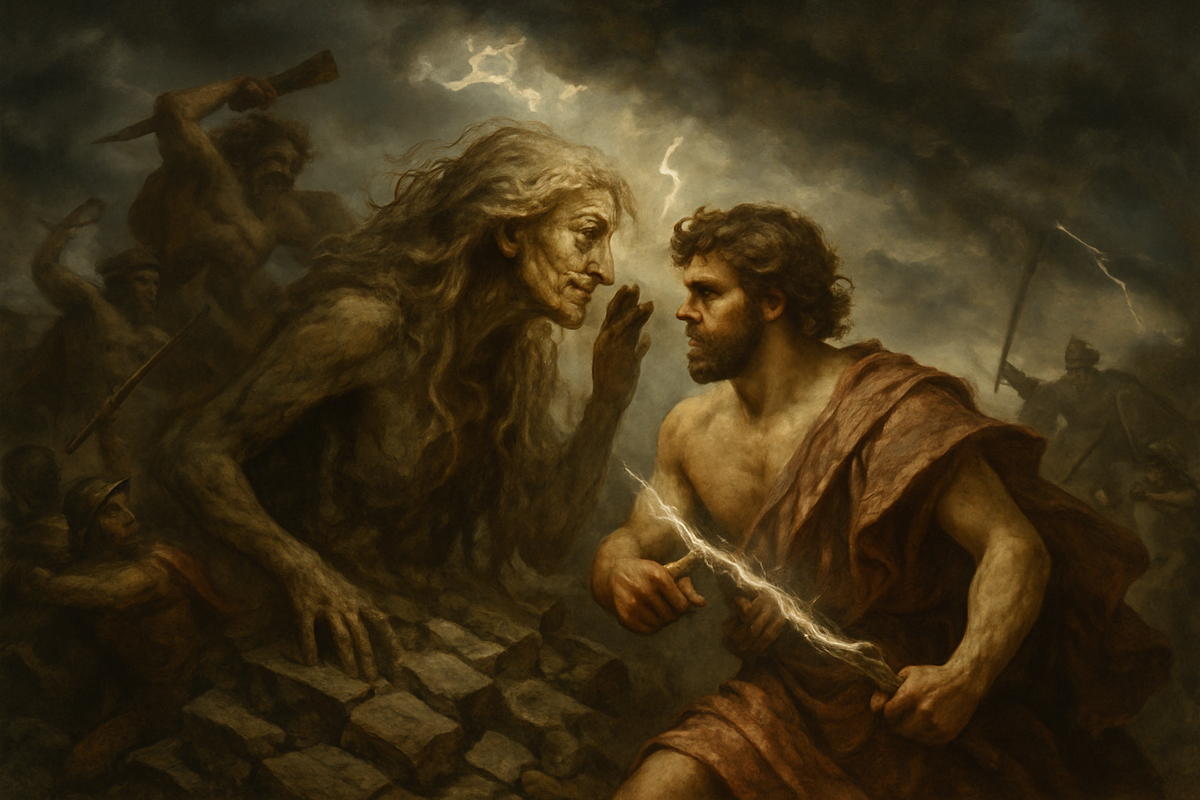
It was Gaia who fashioned a great sickle of grey flint and convinced her son Cronus to castrate Uranus, freeing her imprisoned children and ending the first tyranny of the sky. From the blood that fell to earth sprang the Furies, the Giants, and the ash-tree nymphs called the Meliae — proof that even violence, in Gaia's hands, becomes generative rather than merely destructive.
Across esoteric and Jungian traditions, Gaia represents the primal, unconditioned feminine — creation without a father, fertility without dependency. She is often discussed alongside later maternal goddesses such as Demeter and Aphrodite, though where those goddesses embody specific gifts (grain, love), Gaia embodies existence in its rawest, most unmediated form. Spiritually, she is invoked as a symbol of groundedness, resilience, and the quiet authority of things that endure — mountains, bedrock, ancient forests.
In 1972, chemist James Lovelock proposed the "Gaia Hypothesis" with microbiologist Lynn Margulis, suggesting Earth's biosphere functions as a single self-regulating organism — a scientific echo of the ancient myth. This idea was quickly embraced by modern earth-based spirituality, neopaganism, and the environmental movement, where "Gaia" now serves as shorthand for planetary consciousness itself. Contemporary practitioners often treat Gaia not as a historical relic but as a living presence to be in relationship with — through gardening, land acknowledgment, or seasonal ritual work.
Gaia is Greece's answer to a nearly universal archetype: the earth as mother. Comparing her to other traditions reveals both striking similarities and important cultural differences.
| Deity | Culture | Core Association | Key Difference from Gaia |
|---|---|---|---|
| Gaia | Greek | Primordial earth, source of all gods | Self-generating; predates all other deities |
| Pachamama | Inca / Andean | Fertility, mountains, harvest | Actively worshipped with offerings today; more agrarian focus |
| Danu | Celtic / Irish | Mother of the Tuatha Dé Danann | Associated with rivers and sovereignty, less cosmological |
| Nüwa | Chinese | Creator and repairer of the world | Shapes humanity from clay rather than birthing gods directly |
| Prithvi | Vedic / Hindu | Earth goddess, paired with sky father Dyaus | Part of a balanced sky-earth couple, less independently primordial |
| Terra Mater | Roman | Earth mother, honored at the Fordicidia festival | Largely absorbed Gaia's mythos with fewer independent myths of her own |
What sets Gaia apart is her sheer cosmological seniority — she isn't one goddess among many earth spirits, but the literal foundation from which the entire divine family tree, including Zeus, eventually grows.
Gaia's role rarely stops at the first generation. She reappears throughout Greek myth as the great instigator of cosmic justice, often on behalf of wronged children.
These myths reveal a consistent pattern: Gaia is patient for eons, but when her children are oppressed, she becomes the most dangerous force in the cosmos.
Dream interpreters often treat earth, soil, and Gaia-like maternal figures as symbols of grounding, security, and unresolved connection to home, body, or ancestry.
You don't need to build an altar to feel Gaia's presence — her worship was always tactile, seasonal, and grounded in the body. Consider these practical approaches:

Gaia is rarely depicted with weapons or thrones like the Olympians; her iconography is quieter and more elemental.
Gaia is the primordial Greek goddess who personifies the Earth, emerging from Chaos at the very beginning of creation. She is the mother of the Titans, Cyclopes, and countless other divine beings, making her the ancestral source of nearly the entire Greek pantheon.
Gaia is most commonly pronounced GAY-uh, though GUY-uh is also widely accepted and often used in more classical or scholarly contexts. Either pronunciation is considered correct in modern English usage.
Gaia is older than the Titans — she is their mother, not one of them. She belongs to the primordial generation of deities that existed before the Titans were born, making her a full generation senior to figures like Cronus and Rhea.
In Roman mythology, Gaia's equivalent is Terra, sometimes also called Tellus Mater ("Mother Earth"). The Romans largely absorbed Gaia's mythological role into Terra but gave her fewer independent myths of her own, focusing instead on agricultural festivals like the Fordicidia.
Gaia's powers center on life-giving fertility, command over land and earthquakes, and the ability to grant prophecy, as seen in her original ownership of the Delphic oracle. She also wields enormous influence over cosmic events, shaping outcomes like the Titanomachy and the rise of the Giants without fighting directly.
Gaia predates Zeus and is technically his great-grandmother, giving her immense cosmological seniority, but she rarely rules directly. Instead, she acts as a kingmaker and avenger, influencing events like the Titanomachy and the rise of the Giants rather than holding a throne herself.
Spiritually, Gaia represents groundedness, unconditional fertility, and the self-sustaining power of nature. In modern usage, she has also become a symbol for planetary consciousness through the scientific "Gaia Hypothesis" and the broader environmental movement.
Gaia is often used interchangeably with "Mother Nature" in modern language, but historically she was a specific mythological figure with her own genealogy, myths, and worship practices in ancient Greece. "Mother Nature" is a broader, culture-spanning concept, while Gaia is its most fully documented ancient expression.
The full story of Persephone and Hades: the abduction, the pomegranate seeds, and what this ancient myth of loss and renewal reall…
Discover the dog, the loom, and the twin stars ancient Greeks and other cultures used to represent unbreakable loyalty.
Meet Eros, the Greek god of desire and romantic love: his myths, symbols, Roman twin Cupid, and what his story reveals about passi…