
Symbols
Moon Symbolism: Mystical Meanings and Influence
The Moon has been a source of wonder and inspiration for humanity since the dawn of time. Its ever-changing phases and the gentle …
 KnowMastery
Finding a feather is widely interpreted as a spiritual sign - a message from angels, deceased loved ones, or spirit guides confirming that you are protected, guided, and reminded of your own freedom. The color, location, and timing of the discovery are believed to shape its specific meaning: a white feather often signals peace or a visit from someone who has passed, a black feather points to protection or transformation, and a feather that appears mid-decision is read as encouragement to trust your instincts.
You're walking down an ordinary street, thinking about someone you lost, or wrestling with a decision you can't quite make - and there it is. A single feather, resting on the pavement where it has no business being. No bird in sight. No wind to explain how it landed just so, right in front of you.
That small pause you feel isn't silly. Humans have been reading feathers as messages for thousands of years, long before anyone called it "a sign." They fall from the sky like tiny scraps of something larger - flight, spirit, breath - and they land at our feet as if placed there on purpose.
A feather is a physical fragment of a bird - the very creature ancient cultures across the world associated with the soul, the breath, and the passage between earth and sky. Birds fly where humans cannot, so their feathers became natural symbols of transcendence: rising above hardship, receiving divine communication, or moving between the visible and invisible worlds. Losing a feather costs a bird nothing; finding one, symbolically, costs you nothing either - which is part of why the sign feels so gentle and so easy to trust.
In modern spiritual practice, especially within New Age and angel-communication traditions, an unexpected feather is read as a quiet nudge from the universe rather than a dramatic announcement. It's a whisper, not a shout - and that subtlety is part of why people find it so moving: it feels personal, timed, and meant only for them.
These themes overlap constantly in practice - a single feather can feel like proof of protection and a farewell hug from someone you loved, both arriving in the same quiet breath.
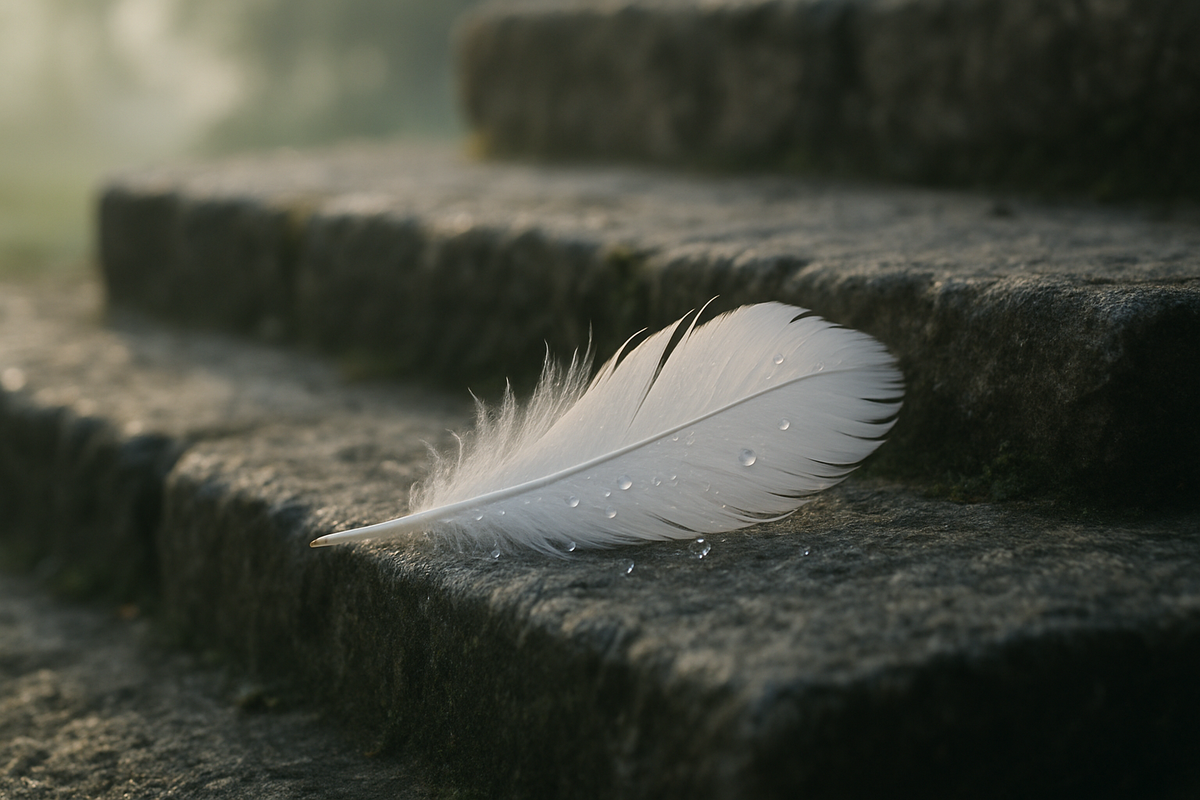
Color is one of the first details people notice, and different hues have accumulated distinct folk meanings over generations of spiritual storytelling.
| Feather Color | Common Symbolic Meaning |
|---|---|
| White | Peace, purity, angelic presence, confirmation that a loved one is at rest |
| Black | Protection, mystery, releasing old patterns, sometimes a warning to stay alert |
| Brown | Grounding, stability, home, connection to nature and ancestors |
| Grey | Neutrality, a pause before clarity, balance between two decisions |
| Blue | Communication, truth-telling, protection during travel |
| Yellow | Joy, optimism, renewed energy and confidence |
| Red | Passion, courage, vital life force, a call to take bold action |
| Speckled/mixed | Complexity, a message with layered meaning, transition between two states |
Just as color carries weight in this tradition, it also shapes meaning elsewhere - the interplay of light and dark expressed in yin yang symbolism is a good reminder that contrast itself can carry significance beyond the literal shade in front of you.
In angel-belief traditions, feathers are considered one of the most direct signs that a guardian angel is nearby. The idea draws on the biblical imagery of angels with wings - if an angel brushes close to you, the thinking goes, it might leave behind a physical trace. Finding a feather during prayer, meditation, or a moment of doubt is often taken as confirmation that you are not alone and that your request or worry has been heard.
This belief pairs naturally with the practice of numerology, where people look for repeating numbers alongside feathers as a double confirmation - spotting a feather at 11:11, for example, is considered an especially strong sign in online spiritual communities.
One of the most emotionally resonant beliefs is that a feather appearing shortly after a death - at a funeral, near a grave, or in a place strongly associated with the person - is their way of saying they're at peace. Grief counselors note that these small, meaningful coincidences (sometimes called "grief signs") can offer genuine psychological comfort, regardless of one's spiritual stance, by giving mourners a tangible moment to pause and feel connected.
Feather symbolism is not a single tradition but a tapestry woven from many distinct cultures, each attaching its own weight and meaning to the plume.
Among Plains Nations such as the Lakota, Cheyenne, and Pawnee, feathers - particularly eagle feathers - are sacred objects reserved for those who have earned deep respect through acts of courage, wisdom, or service. Eagle feathers are worn in ceremonial regalia, used in healing rituals, and bestowed as honors rather than casually found or purchased. This same worldview shaped objects like the dream catcher, an Ojibwe tradition in which feathers hanging from the hoop let good dreams glide gently down to the sleeper while bad dreams are caught in its web.
In ancient Egyptian mythology, the goddess Ma'at - representing truth, balance, and cosmic order - was depicted with a single ostrich feather. In the Hall of Judgment, a deceased person's heart was weighed against Ma'at's feather; a heart lighter than the feather meant the soul was pure enough to pass into the afterlife. This is arguably the origin of the feather's enduring link to truth, moral lightness, and passage into another world.
In Celtic folklore, birds were considered messengers between the mortal world and the Otherworld, and their feathers carried residual magic. In the Irish legend of the Children of Lir, four royal children are transformed into swans for nine hundred years, cementing the swan's association with transformation, grace, and sorrow patiently endured. Ravens, by contrast, appear throughout old European tales as omens of prophecy and warning - in Norse mythology, the god Odin kept two ravens, Huginn and Muninn, who flew across the world each day and returned to whisper what they'd seen.
In Christian art and tradition, wings and feathers are almost synonymous with angels, and the dove's feather specifically recalls the Holy Spirit descending at Christ's baptism. Feathers in this context symbolize divine peace, guidance, and grace extended toward believers.
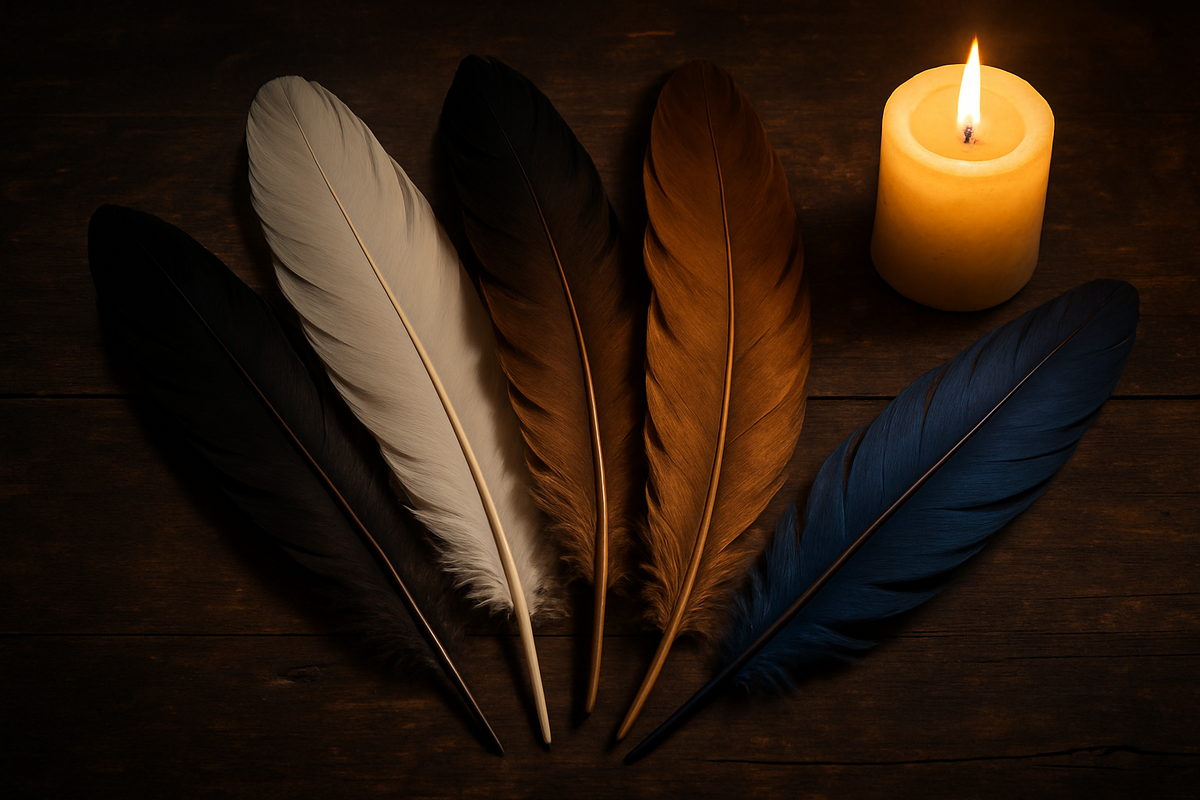
Dreaming of feathers tends to mirror their waking symbolism but filtered through your subconscious state.
Dream feathers, like symbols of stability such as the anchor, often surface during periods when your waking mind is craving reassurance that things will hold steady.
Whether you interpret it mystically or simply as a meaningful coincidence, a found feather is an invitation to pause. Consider these steps:
Many spiritual traditions interpret this as a sign of guidance, protection, or reassurance arriving at a meaningful moment. It's often read as confirmation that your thoughts, prayers, or worries have been "heard" by a guardian presence, especially if it happens while you're mid-decision or mid-thought.
White feathers are the most commonly cited spiritual sign, generally associated with peace, purity, and angelic presence. They're frequently reported after the loss of a loved one as a comforting symbol that the person is at rest.
In most traditions, feathers are considered positive omens - signs of protection, guidance, or comfort rather than bad luck. Darker feathers like black ones are sometimes seen as a call for caution rather than misfortune, but even these are usually framed as protective rather than negative.
Yes - eagle feathers are tied to honor and courage in Plains Nations traditions, dove feathers to peace and the Holy Spirit in Christian symbolism, and raven feathers to prophecy or warning in Norse and European folklore. The species can add another layer of meaning on top of the feather's color and the situation in which it was found.
The Moon has been a source of wonder and inspiration for humanity since the dawn of time. Its ever-changing phases and the gentle …
Discover what the Om symbol truly means—its Hindu, Buddhist, and Jain roots, dream symbolism, and how to use it in daily life.

Discover what the sun symbolizes across cultures, from divine power to spiritual rebirth, and how to use its energy in daily life.