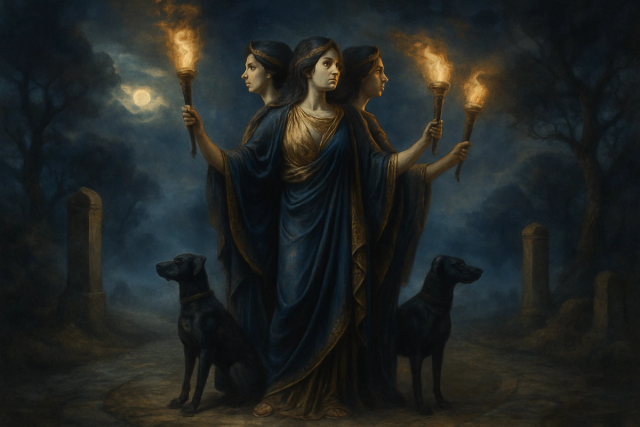
Greek Mythology
Hecate: Greek Goddess of Magic, Crossroads & the Moon
Discover Hecate, the Greek goddess of magic, crossroads, and the moon—her myths, symbols, dream meanings, and how to honor her tod…
 KnowMastery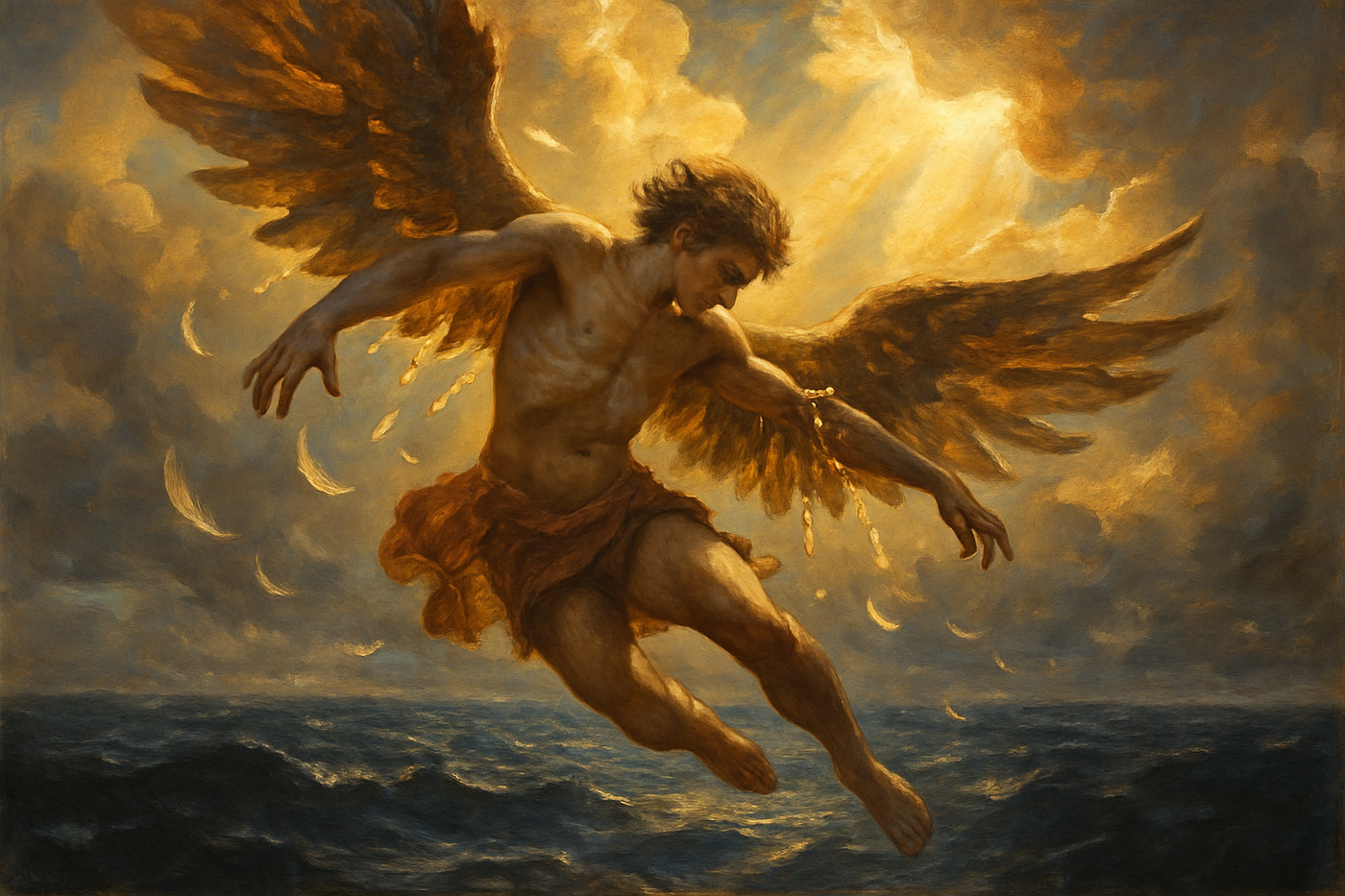
The Icarus myth means that unchecked ambition and pride, when they override wisdom and warning, lead to a fall. Icarus, the son of the inventor Daedalus, escaped imprisonment on wings of feathers and wax, only to fly too close to the sun despite his father's clear instructions. The wax melted, his wings failed, and he drowned in the sea below. At its core, the story is a warning about hubris, the specific Greek idea of pride so great it defies the natural order and invites ruin.
There is something almost unbearably human about Icarus. He is not a villain. He is a boy given wings for the first time in his life, feeling the wind lift him higher than any mortal had gone before, and forgetting, in that rush of joy, that the sky was never meant to hold him.
That single moment of forgetting is why this myth has survived nearly three thousand years. It is not really about wings or wax. It is about what happens inside a person the instant they believe the rules no longer apply to them.
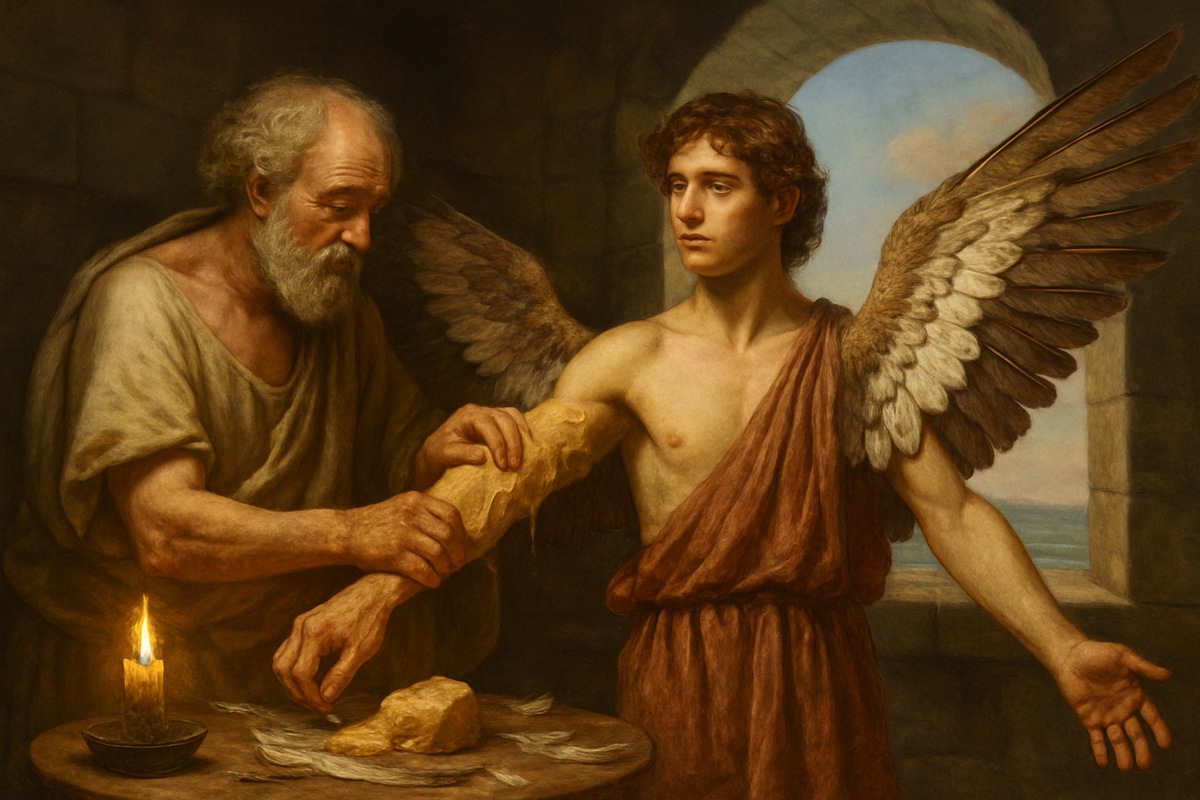
Daedalus was a master craftsman working under King Minos of Crete. According to the poet Ovid in his Metamorphoses, Daedalus built the famous Labyrinth that housed the Minotaur, and Minos later trapped him and his son Icarus on the island to keep the Labyrinth's secrets safe. With no ship allowed to leave Crete, Daedalus decided the only way out was through the air.
He gathered feathers and bound them together with thread and wax, crafting two sets of wings. Before they took off, he gave Icarus a clear warning: fly too low, and sea spray will soak the feathers; fly too high, and the sun's heat will melt the wax. The only safe path was the middle course.
Icarus did not listen. Caught up in the thrill of flight, he climbed higher and higher until the wax gave way. He fell into the body of water later named the Icarian Sea in his memory, near the island of Icaria in the Aegean. Daedalus made it to Sicily alone, grieving the son he could not save.
The story works on several layers at once, and each one has kept scholars and readers returning to it for centuries.
In ancient Greek thought, hubris was not simple confidence. It was pride so extreme it insulted the gods and the natural order they governed. Overreaching mortals in Greek mythology almost always meet the same fate as Icarus. Phaethon, son of the sun god Helios, begged to drive his father's chariot and lost control, scorching the earth before Zeus struck him down to stop the damage. Icarus's fall follows the same pattern: talent and privilege given generously, then destroyed by a refusal to respect limits.
Daedalus represents accumulated experience and caution. He is the one who built the wings, tested the design, and understood exactly where the danger lay. Icarus represents youth, appetite, and the belief that rules exist for other people. The tragedy is not that Icarus wanted to fly high. It is that he had already been told, by someone who loved him and knew better, exactly how high was too high.
Daedalus's instruction to fly neither too low nor too high is often read as an early expression of moderation, an idea that runs through much of Greek mythology and its gods. The safe zone between extremes shows up again and again in Greek philosophy, most famously in Aristotle's idea of the golden mean. Icarus is a cautionary tale wrapped around that same lesson: excess in either direction destroys you.
Every detail in the myth carries weight. The table below breaks down the main symbols and their traditional meanings.
| Symbol | What It Represents |
|---|---|
| The wings | Human potential, talent, and the desire to transcend natural limits |
| The wax | Fragile achievement built through skill rather than divine gift, easily undone by excess |
| The sun | Divine power and glory, associated with the sun god Apollo, which mortals cannot approach without consequence |
| The sea | The unconscious, oblivion, and the domain of Poseidon, ruler of the waters that finally claim Icarus |
| Daedalus | Experience, caution, and the grief of watching someone ignore hard-earned wisdom |
| The middle flight path | Balance, moderation, and the narrow space between fear and recklessness |
Beyond its moral lesson, the story of Icarus carries a spiritual weight that different traditions have picked up in different ways.
Some readers see Icarus not as foolish but as brave. His flight can represent the soul's genuine desire to move beyond ordinary limits, to touch something higher than the daily grind of survival. Read this way, the myth is less about punishing ambition and more about the price that transcendence sometimes demands. Flight itself was not the sin. Forgetting the warning was.
In a more psychological reading, Daedalus and Icarus can be seen as two parts of a single person: the wise inner voice and the ego that wants glory now. The gods in this myth, including Zeus who governed cosmic order, and Athena who embodied practical wisdom, stand for the discipline that keeps ambition from consuming itself. When the ego drowns out that inner voice, the fall becomes inevitable.
Icarus did not build the wings. He was given them. His failure came from skipping the slow, careful understanding his father had earned through years of craft. Spiritually, this points to the danger of wanting the results of mastery without doing the work that makes mastery safe.
For the Greeks, Icarus fit into a pattern seen across their myths and plays: mortals who forget their place suffer for it. This was not cruelty for its own sake. It reflected a worldview in which the cosmos had an order, maintained by figures like Zeus, and violating that order through pride brought consequences regardless of intention. The myth was told to children and adults alike as a straightforward lesson about respecting limits and listening to elders.
By the sixteenth century, the myth had picked up new layers. The Flemish painter Pieter Bruegel the Elder's Landscape with the Fall of Icarus shows a farmer plowing his field, a shepherd tending sheep, and a ship sailing past, none of them noticing the small splash of Icarus's legs disappearing into the sea in the corner of the canvas. The poet W.H. Auden later wrote about this painting directly, observing how suffering happens "while someone else is eating or opening a window or just walking dully along." In this reading, the myth becomes less about Icarus's mistake and more about the world's quiet indifference to individual tragedy.
The phrase "flying too close to the sun" has moved well past Greek mythology into everyday speech. People use it to describe anyone who overreaches: a startup founder who expands faster than the business can support, a politician who assumes public patience will last forever, or an athlete who takes on more risk than their training justifies.
The psychiatrist Henry Murray coined the term Icarus complex in the twentieth century to describe a personality pattern built on grandiosity, a hunger for admiration, and a pull toward high visibility goals that often ends in a dramatic collapse. The pattern shows up in people who chase status and attention while skipping the slow work that sustainable success actually requires, the same gap that doomed Icarus.
Dreaming of flying like Icarus, or falling from a great height, often reflects real tension between ambition and fear in waking life.
These dreams are usually less about literal danger and more about an internal signal that ambition has outpaced grounding.
The Icarus story is not just a warning to stay small. Read carefully, it offers practical guidance for anyone chasing something ambitious.
The moral is that pride and excess ambition, when they ignore experienced warning, lead to downfall. The story teaches the value of moderation and listening to those who have more experience, rather than avoiding ambition altogether.
Icarus flew too high because he became caught up in the thrill and freedom of flight and forgot his father Daedalus's specific warning about the wax melting near the sun's heat. His fall came from excitement overriding memory and caution, not from malice or stupidity.
The term Icarus complex, coined by psychiatrist Henry Murray, describes a personality drawn to grandiosity and high risk ambition that often ends in a dramatic fall. It captures the same tension the myth explores between reaching for glory and having the grounding needed to sustain it.
Icarus is neither a clear hero nor a simple fool. He is written as a sympathetic figure who genuinely wanted to be free and to experience flight, but whose lack of restraint turned that desire into tragedy. That mix of sympathy and consequence is what makes him one of the most human characters in Greek mythology.
Discover Hecate, the Greek goddess of magic, crossroads, and the moon—her myths, symbols, dream meanings, and how to honor her tod…
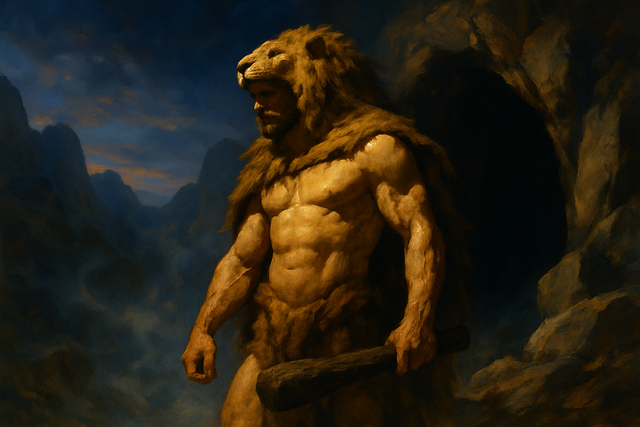
Discover who Heracles was, why he performed the Twelve Labors, and what his myth still teaches about strength, redemption, and inn…
Discover who Medusa really was, why she turned people to stone, and what her snake-haired image symbolizes in myth, dreams, and cu…