Symbols
12 Symbols of Bravery: Lion, Eagle, Dragon & Sword Meanings
Explore 12 powerful symbols of bravery and courage—lion, eagle, dragon, sword, wolf, phoenix and more—and what each means across m…
 KnowMastery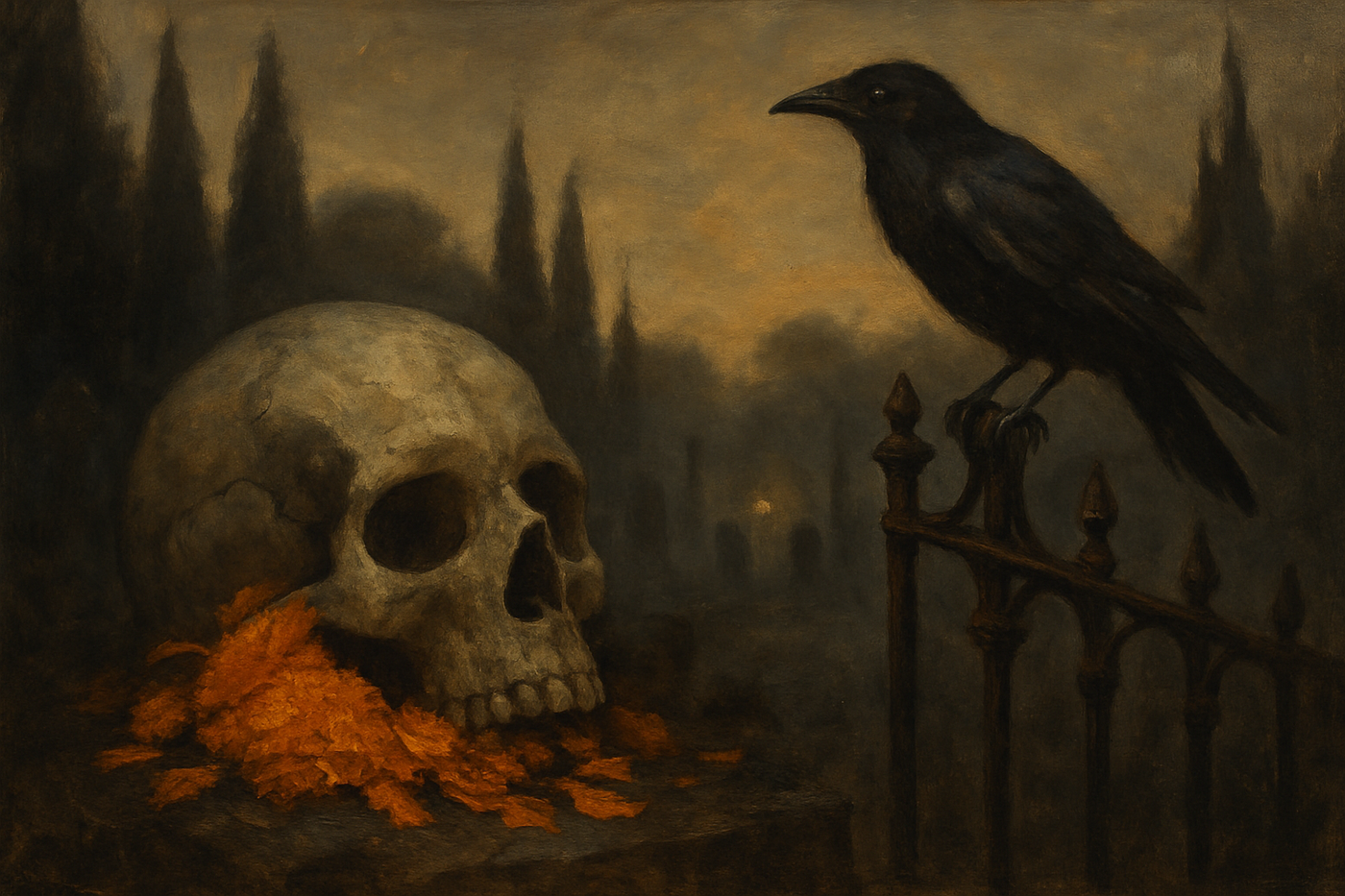
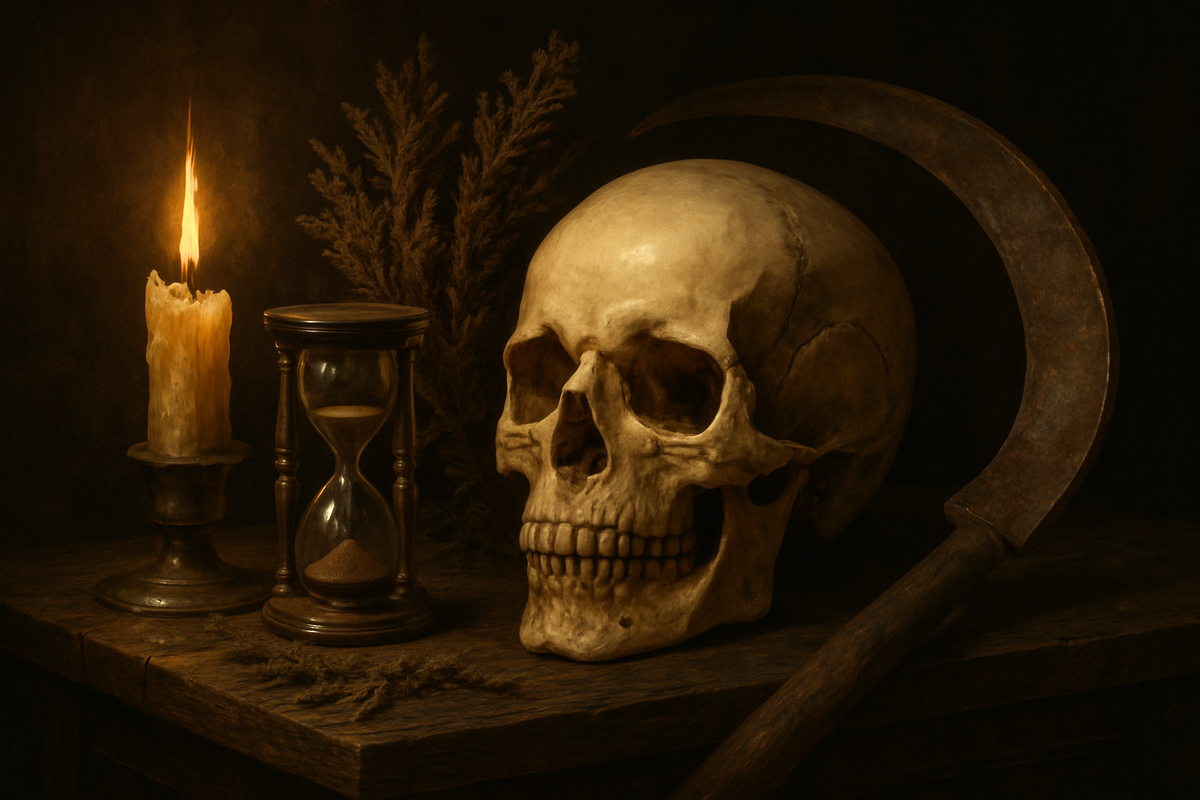
Symbols of death are images, objects, and figures that cultures use to represent mortality, the passage into an afterlife, or a spiritual force tied to dying. Common examples include the skull, the scythe, the raven, the hourglass, and figures like the Grim Reaper or the Egyptian god Anubis. Colors carry weight too, black in most Western funerals, white in China and parts of India. These symbols rarely express fear alone. Most carry ideas of transformation, protection, remembrance, or a cycle that keeps turning even after a person is gone.
A skull carved into a gravestone. A black winged raven perched on a fence post at dusk. A scythe leaning against a barn door, forgotten until someone remembers why it's there. These images unsettle before the mind can explain why. They reach into something older than language: a shared human need to give shape to the one thing every person on earth has in common.
Long before anyone wrote down what a symbol meant, someone had already painted it on a cave wall, carved it into a tomb, or stitched it into a burial shroud. The symbols outlived the people who made them, and they still carry weight now, in tattoos, jewelry, films, and folklore most people encounter without ever asking where the image came from.
Every culture that buries its dead has also tried to explain death through images. A symbol gives people something to hold onto when words fail, at a funeral, in a moment of grief, or in the quiet fear that comes before sleep. Some symbols point to the end of the body. Others point past it, toward a soul that keeps moving, a spirit that watches over the living, or a cycle that starts again somewhere else.
How a culture pictures death usually depends on how it pictures the afterlife. A society that treats death as final tends to produce stark, heavy imagery: bare bones, shadows, silence. A society that treats death as a doorway tends to produce symbols full of color and motion: flowers, butterflies, dancing skeletons dressed for a party. The same event, the end of a life, gets illustrated in almost opposite ways depending on what people believe happens next.
Some symbols appear again and again across very different regions of the world, though the meaning attached to each one can shift sharply depending on who is using it.
| Symbol | Origin or Culture | Core Meaning |
|---|---|---|
| Skull | Global, especially Mexico and Europe | Mortality, memento mori, the equality of all people in death |
| Scythe | Medieval Europe | The harvest of souls, personified as the Grim Reaper |
| Raven or crow | Norse mythology, Celtic folklore | Omen of death, messenger between worlds |
| Hourglass | Renaissance Europe | Time running out, the fixed length of a human life |
| Cypress tree | Ancient Greece, Mediterranean cultures | Mourning, the underworld, planted in cemeteries |
| Marigold | Mexico | Guiding the dead home during Dia de los Muertos |
| Butterfly | Ancient Greece, Japan, Mexico | The soul leaving the body, rebirth |
| Jackal (Anubis) | Ancient Egypt | Guardian of the dead, guide through judgment |
| White chrysanthemum | Japan, China, parts of Europe | Funeral flower, grief, honoring the deceased |
The Egyptians treated death as a transition to prepare for, not an ending to fear. Anubis, shown with the head of a jackal, guided the soul through the underworld and presided over the weighing of the heart against the feather of Maat, the goddess of truth. If the heart was lighter than the feather, the soul passed on to the afterlife. If not, it was consumed by Ammit, a creature part crocodile, part lion, part hippopotamus. Tombs were filled with symbols meant to help the dead, from scarab beetles representing rebirth to the ankh, a cross shaped symbol of eternal life still recognized today, worth comparing with the many types of crosses found in later Christian tradition.
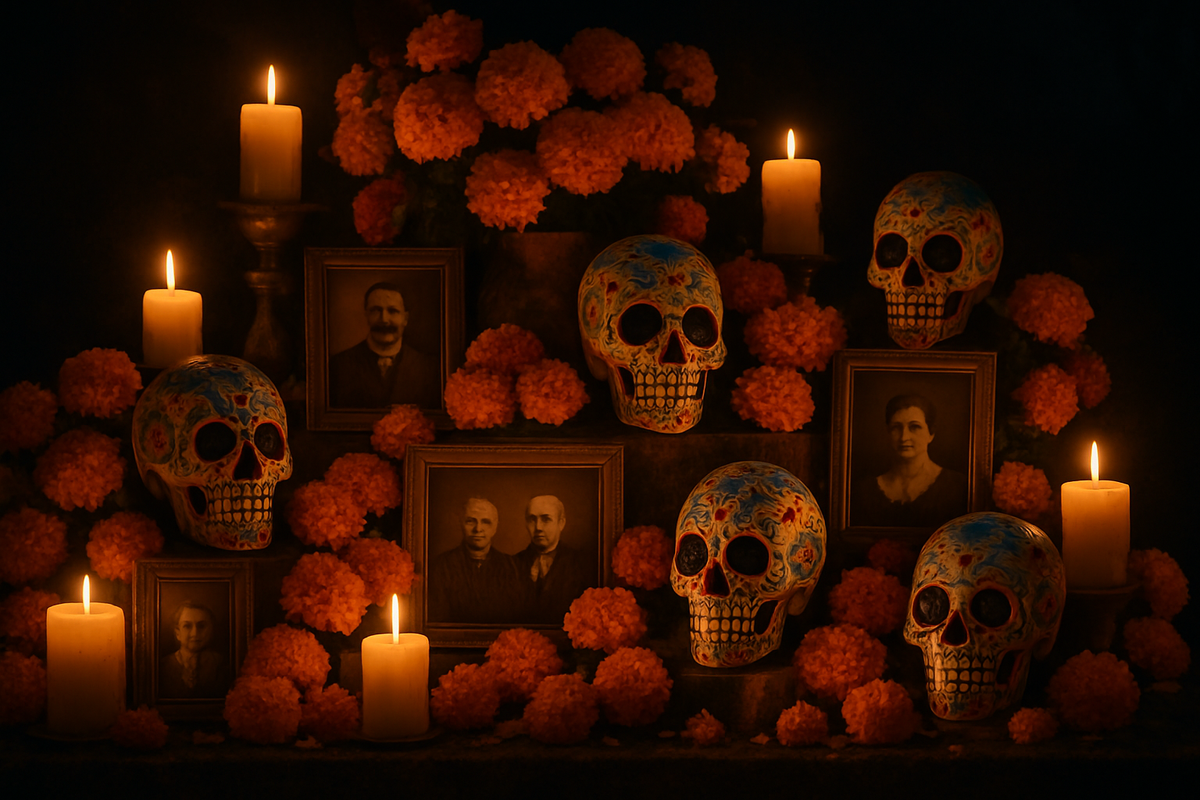
Mexican tradition, shaped by both Aztec belief and Spanish Catholicism, treats death as something to welcome back rather than push away. During Dia de los Muertos, families build altars called ofrendas, covered in marigolds, candles, sugar skulls, and photographs of relatives who have passed. La Calavera Catrina, the elegant skeleton in a wide hat first drawn by artist Jose Guadalupe Posada in the early 1900s, has become the defining image of the holiday. The skull here is not grim. It is dressed up, celebrated, and used as a reminder that death touches everyone equally, regardless of wealth or status.
In Norse belief, ravens carried heavy meaning. Odin kept two ravens, Huginn and Muninn, who flew across the world each day and returned to whisper what they had seen. Ravens also circled battlefields, which linked the bird directly to death in the Norse imagination. In Norse mythology, Valkyries chose slain warriors to carry to Odin's hall of Valhalla, though tradition holds they claimed only half of the battle-dead, with the goddess Freyja's realm of Folkvangr receiving the rest. Death in this tradition was not something to dread quietly. It was tied to honor, and the raven became the symbol that carried that idea forward.
Nineteenth century Britain turned grief into a visible, almost formal practice. Mourning jewelry made from jet, onyx, or the hair of the deceased was worn for months after a death, and the length of mourning dress signaled exactly how recently a person had died. Cemeteries were designed as gardens, planted with weeping willows and cypress trees. Flowers carried their own coded meanings: white lilies for purity, ivy for immortality, poppies for eternal sleep. This was a culture that did not hide from death but built a visual language around processing it.
Outside specific cultural traditions, death symbols often show up in personal spiritual practice as reminders rather than warnings. Seeing a skull in meditation or artwork can point to the idea of ego death, the letting go of an old identity rather than physical dying. A raven appearing repeatedly in someone's life might be read as a sign that a chapter is closing so a new one can begin.
The yin yang symbol offers one of the clearest examples of death treated as half of a whole rather than the opposite of life. In that framework, death is not a failure of the system, it is the necessary dark half that gives the light half its shape. A similar idea appears in the tree of life, where roots reaching into the earth represent death and decay feeding the growth happening above ground. Numbers get pulled into this too. In numerology, certain numbers like 13 in the West or 4 in parts of East Asia are treated as unlucky because of their association with death, a connection explored further in guides to numerology.
Dreaming about skulls, coffins, funerals, or dying is rarely a literal warning. In most dream interpretation traditions, death imagery points to change: the end of a job, a relationship, a habit, or a version of yourself you are outgrowing. A few common patterns show up often:
People troubled by recurring death dreams sometimes hang a dream catcher above the bed, a practice rooted in Ojibwe tradition that is meant to filter troubling dream energy before it takes hold.
Death symbols are not only for funerals and folklore. People use them in ordinary, personal ways to process loss, mark transitions, or stay grounded when life feels unstable.
None of this requires belief in any particular afterlife. It simply gives grief and mortality a shape you can hold, look at, and set down when you need to.
The skull is likely the most widely recognized death symbol across cultures, appearing in Mexican Day of the Dead art, European memento mori paintings, and countless pirate flags and warning signs. Its universality comes from the fact that a skull is what remains of every person after the body decays, making it an unavoidable, literal image of mortality.
In folklore, ravens and crows are often read as messengers connected to death or major change, largely because of their role in Norse mythology and Celtic legend. A repeated sighting is usually interpreted as a nudge to pay attention to an ending or transition happening in your life rather than a literal prediction of death.
Mexican tradition, especially around Dia de los Muertos, treats death as a continuation of the relationship with loved ones rather than a permanent separation. The colorful, dressed up skeletons like La Calavera Catrina reflect a belief that death should be met with celebration and remembrance instead of fear.
No, dreaming about death almost never predicts a literal event. Most dream interpretation traditions read it as a symbol of transformation, meaning something in your life, a job, a relationship, or an old habit, is ending to make room for something new.
Explore 12 powerful symbols of bravery and courage—lion, eagle, dragon, sword, wolf, phoenix and more—and what each means across m…
Discover what pumpkins really symbolize beyond Halloween: harvest abundance, protection, fertility, and spiritual meaning across c…
What goes on an ancestor altar and why? A guide to the symbols, objects and traditions families use to honor the dead.