Religion
11 Types of Crosses and What Each One Symbolizes
Discover the meaning behind the Latin cross, crucifix, Celtic cross and more — their history, symbolism, and how to choose one tha…
 KnowMastery
The bottony cross, also spelled botonny or treflée, is a Christian cross whose four arms end in small trefoil buds resembling three-petaled clovers or budding flowers. Each trefoil is read as a symbol of the Holy Trinity, so the whole cross becomes a sign of the Father, Son, and Holy Spirit repeated four times over. It has been used since the Middle Ages in heraldry, church architecture, and Catholic devotional art, and today it appears on jewelry, gravestones, and military insignia as a quiet marker of faith and remembrance.
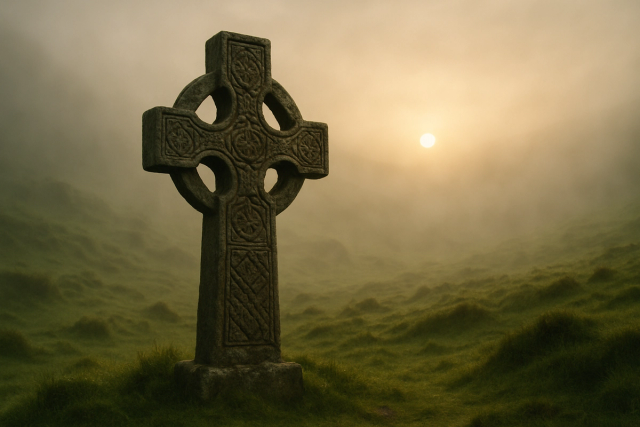
There is something almost tender about this cross. Unlike the stark lines of a plain Latin cross, the bottony cross looks like it is growing, as if the wood of Calvary had taken root and begun to flower. People who have stood in old European cemeteries know the feeling: moss-covered stone crosses with these soft, rounded tips, standing quietly for centuries while everything around them changed.
That image, a cross that buds instead of simply ending, is why this symbol has outlived so many of the empires and orders that once carried it into battle. It survived the Crusades, the fall of monarchies, and two world wars, and it still shows up on rings, pendants, chapel walls, and family headstones today, often chosen by people who want something gentler than a bare crucifix.
A bottony cross is a cross pattée or Latin cross variant where each arm terminates in three rounded lobes instead of a flat edge or a point. The name comes from the French word "bouton," meaning button or bud, which describes the small round clusters at the tip of each arm. In heraldic Latin it is sometimes recorded as "crux florida," or flowering cross, and older English blazon texts occasionally call it a "trefly" cross.
It is closely related to the cross treflée, which has more pronounced, leaf-like trefoils, and is often confused with the cross patonce, whose arms flare outward into pointed petals rather than rounded buds. It is also distinct from the cross moline, whose ends split and curl outward like a millrind rather than budding. The distinction matters in heraldry and in different types of crosses, where small design choices change the symbolic reading entirely.
The dominant interpretation across Christian art history ties directly to the number three. Each trefoil at the end of an arm has three lobes, and the cross has four arms, giving twelve points in total if you count them individually, a number linked in scripture to the twelve apostles and the twelve tribes of Israel. The most consistent reading, though, stays simple: three lobes, three persons of the Trinity, repeated on every arm so that no matter which direction the cross is viewed from, the message of unity in three persons is present.
The bottony cross entered wide use in the twelfth and thirteenth centuries, during the height of European heraldic design. Noble families and knightly orders needed symbols that were easy to carve into stone, stamp into metal, and recognize from a distance on a battlefield banner. The rounded trefoil ends were sturdier to cast in metal than sharp points, which made the design practical as well as symbolic. Thirteenth-century English armorial rolls, including collections like the Dering Roll, record crosses with budded terminals granted to gentry and clergy-linked families, often those with a history of church patronage or crusading service.
Variants of the botonny cross appeared in the seals and banners of several Christian military orders active during the Crusades. The Knights Templar are most associated with the plain red cross pattée, and the Teutonic Order used a stark black cross with straight arms, but related regional commanderies and lesser orders used trefoil-tipped versions on their own insignia, chapel carvings, and tomb markers. The budded cross communicated the same loyalty to Christ and Trinity as the plainer versions, but with a softer, more ornamental finish suited to ceremonial use rather than battlefield banners alone.
By the nineteenth and twentieth centuries, the cross botonny had moved from battlefield heraldry into civic and memorial contexts. It appears on certain regimental badges in British and Commonwealth military tradition, and on gravestones in old churchyards across England, France, and Germany. The Victorian taste for Celtic revival design, visible in cemeteries like Highgate in London and Père Lachaise in Paris, favored softened, floriated cross forms over bare geometric ones, and the budded tips were thought to suggest resurrection rather than finality.
Within Catholic tradition, the bottony cross is read primarily as a devotional symbol rather than a doctrinal one. It appears on rosaries, vestments, reliquaries, and processional crosses, often chosen specifically because its rounded, flowering form fits more gracefully into embroidery and metalwork than sharp-edged crosses. Among the many Catholic symbols and their meanings, the bottony cross sits alongside the trefoil, the fleur-de-lis, and the triquetra as a visual shorthand for the Trinity that does not require words to explain itself.
Some parish traditions also connect the budded tips to the idea of the cross as the Tree of Life, referencing the image in Revelation of a tree whose leaves bring healing to the nations. Read this way, the cross is not just an instrument of suffering but a living thing that puts out new growth, a visual argument for resurrection built right into the shape of the symbol. A related idea shows up in Ireland, where some of the high crosses at sites like Clonmacnoise blend the ringed Celtic cross with floriated, bud-like terminals, mixing two separate symbolic traditions into one stone.
Not every Christian tradition reads the budded cross the same way, and the differences are worth knowing if you are choosing one for jewelry, a tattoo, or a gift. The context it was carved or worn in usually tells you which meaning was intended.
| Tradition | How the Bottony Cross Is Used | Primary Meaning Emphasized |
|---|---|---|
| Roman Catholic | Rosaries, vestments, processional crosses, gravestones | Trinity, resurrection, Tree of Life |
| Anglican/Episcopal | Church architecture, memorial plaques | Remembrance, continuity of faith |
| Medieval heraldry | Coats of arms, family crests, knightly seals | Loyalty, rank, crusading vow |
| Eastern Orthodox (related trefoil forms) | Iconostasis carvings, church domes | Divine order, Trinity, heavenly hierarchy |
For comparison, a plain Latin cross emphasizes the fact of the crucifixion itself, a Celtic cross adds the circle of eternity around the center, and a Maltese cross signals the eight beatitudes used by the Knights Hospitaller. The bottony cross stands apart by softening the geometry altogether, trading sharp edges for something that looks like it is still alive.
Dream interpreters who work within Christian symbolic frameworks generally treat a budded or flowering cross as a positive sign rather than a warning. Seeing one in a dream is often read as a message of spiritual growth, a sense that a difficult period is turning into something fruitful. Some interpretations tie it to guidance from a higher power, similar to how people describe sensing guardian angel signs during a hard season of life.
A few common dream contexts and their typical readings:
If the bottony cross has caught your attention through jewelry, a family heirloom, a tattoo idea, or a recurring dream, here are a few grounded ways to work with its symbolism rather than just admire it.
Whatever drew you to the bottony cross, whether it was a family heirloom, a visit to an old churchyard, or a dream you cannot quite shake, the symbol has a long paper trail behind it. It was carried by knights, carved by stonemasons, and stitched into vestments long before it reached a jewelry counter, and that history is part of what gives it weight today.
It primarily symbolizes the Holy Trinity, since each arm ends in a three-lobed trefoil representing the Father, Son, and Holy Spirit. It also carries secondary meanings of growth, renewal, and protection, since the bud shape suggests new life rather than finality.
It is used across both traditions, though it is more frequently seen in Catholic rosaries, vestments, and processional crosses, as well as in Anglican memorial architecture. It is not exclusive to one denomination and appears in medieval heraldry that predates the Reformation entirely.
A bottony cross has rounded, bud-like trefoils at the end of each arm, while a patonce cross flares outward into pointed, leaf-like shapes. Both appear in heraldry and both reference growth imagery, but the bottony's rounded form reads as softer and more floral by comparison.
Most people choose it as a personal symbol of faith, resilience, or family heritage, particularly if the design appears on an ancestral coat of arms. Because of its Trinity symbolism, it is also chosen by people who want a cross design that feels less severe than a plain Latin cross.
Discover the meaning behind the Latin cross, crucifix, Celtic cross and more — their history, symbolism, and how to choose one tha…
Discover what the lotus, dharma wheel, endless knot and other Buddhist symbols really mean, plus how different Buddhist traditions…
What does 7 mean in Hebrew and biblical numerology? Explore its covenant symbolism, 700+ appearances, and meaning of completion in…