Religion
Star of Bethlehem Symbolism: Meaning and Origins
What the Star of Bethlehem really means: its biblical origins, spiritual symbolism, and place in Christian tradition today.
 KnowMastery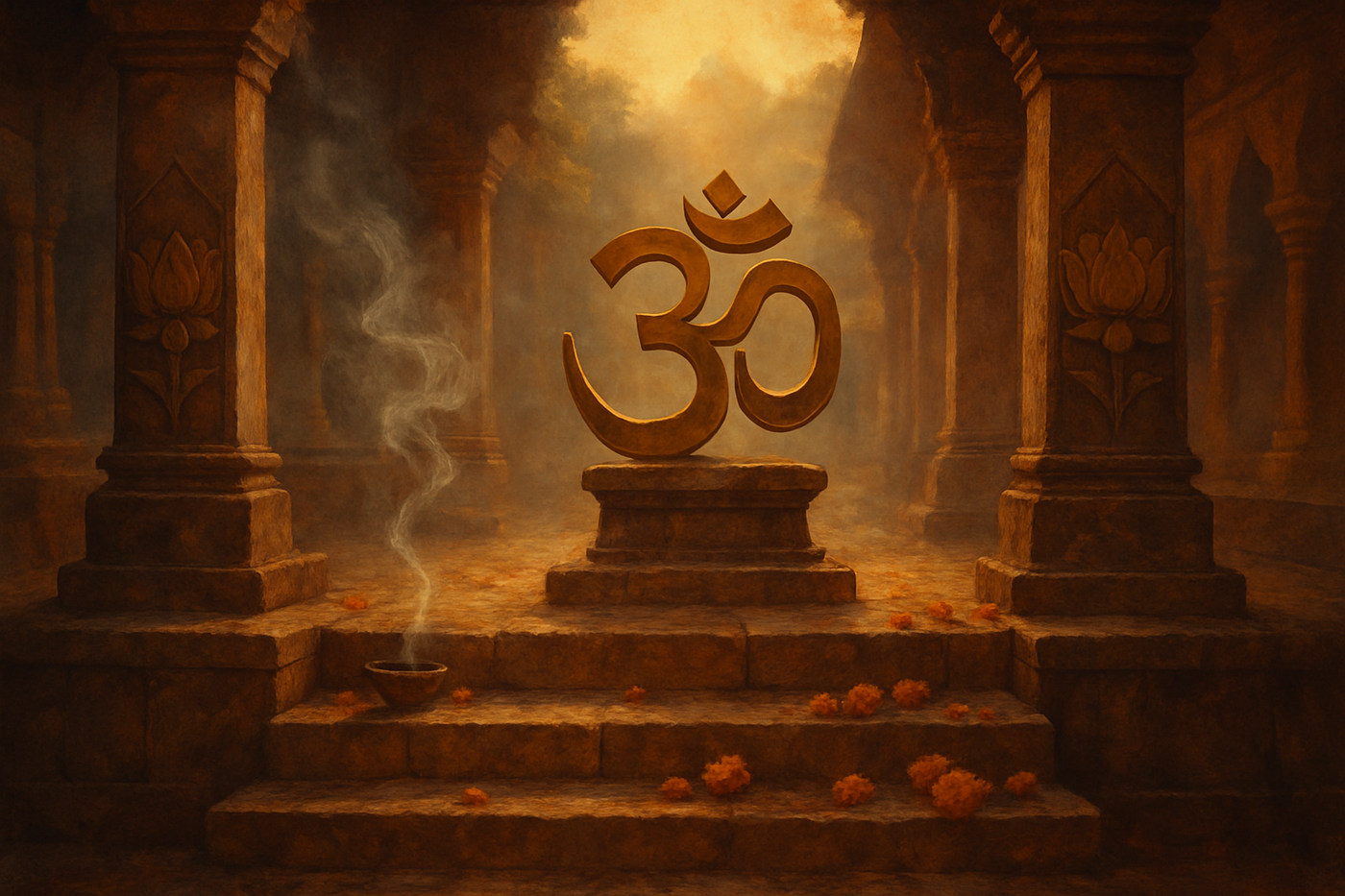
Hindu symbols are visual and sound representations of deities, cosmic principles, and states of consciousness, used in worship, art, and daily life for more than 3,000 years. Om represents the sound of creation and the four states of consciousness. The swastika, unconnected to its later hijacking by the Nazi party, means well-being and good fortune. The lotus stands for purity rising through muddy water and is linked to the goddesses Lakshmi and Saraswati. Other core symbols include the trishula, Shiva's trident, the shankha, Vishnu's conch shell, and the tilaka, the forehead mark that signals which sect a Hindu follows.
Picture a doorstep at dawn in Tamil Nadu, still damp from washing, where a woman bends down and draws a kolam in white rice flour, looping lines that fold back into themselves like a small prayer. In Varanasi a priest lifts a brass lamp in slow circles before an image of Shiva, and the trident behind him catches the light.
A grandmother in Jaipur presses sandalwood paste between her grandson's eyebrows before he leaves for an exam. None of this is decoration. Every mark and gesture is doing something: calling on protection, marking a threshold, reminding the person doing it of who they are trying to become. That is the real function of Hindu symbols, and it is why they have lasted this long.
In Hindu tradition, a symbol is rarely just an image. It is treated as a condensed form of a deity, a mantra, or a cosmic principle, something you can look at, wear, or trace with your hand to connect with a larger reality. The Sanskrit word for this kind of image is pratika, a representation that carries the essence of what it points to. This is different from a logo. A symbol like Om is believed to hold the vibration of the thing it names, not just refer to it from a distance.
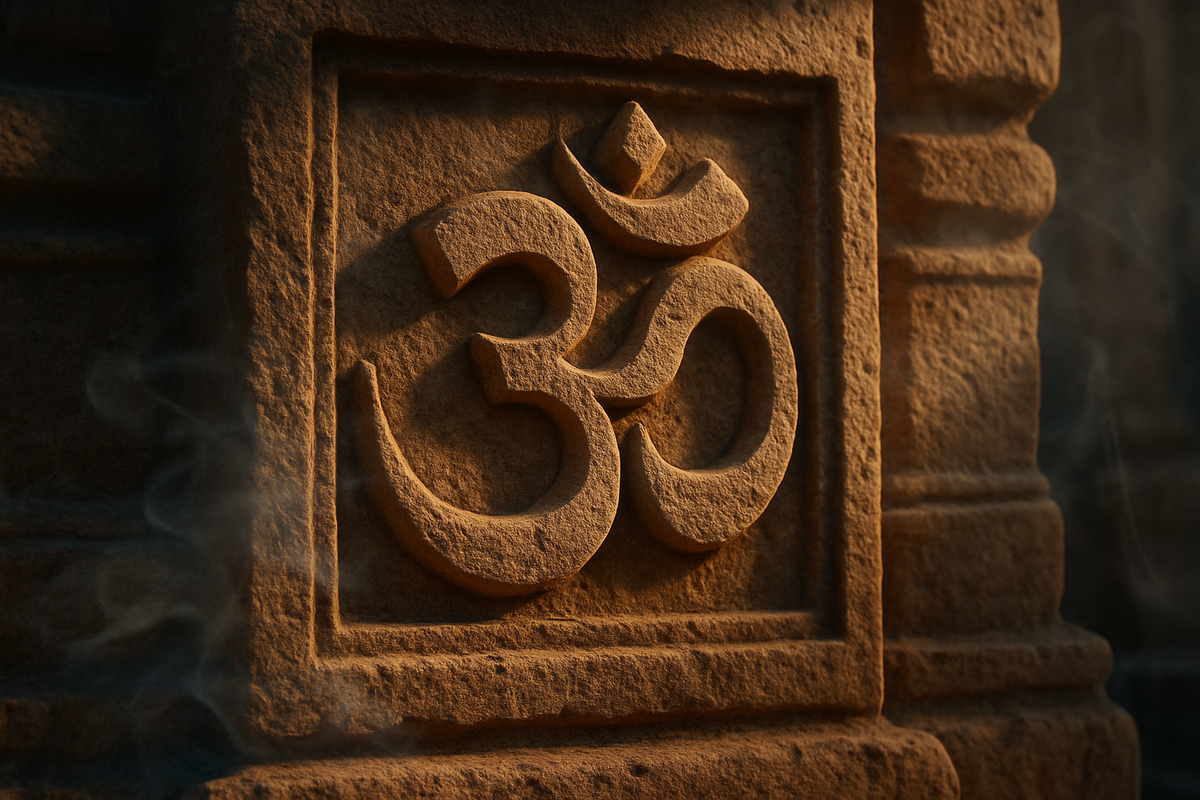
Om (also written Aum) is the most recognized Hindu symbol worldwide. The Mandukya Upanishad describes it as the sound that contains past, present and future, the vibration from which the universe unfolds. Its three curves and the crescent above them represent the waking state, the dreaming state, and deep sleep, with the dot standing for a fourth state beyond ordinary awareness, pure consciousness itself.
Chanting Om opens most Vedic rituals, yoga sessions and meditation practices. It is treated as a seed sound rather than a word with a dictionary meaning, something closer in spirit to how prayer beads are used across faiths to anchor the mind, as explored in this guide to prayer beads meaning across religions.
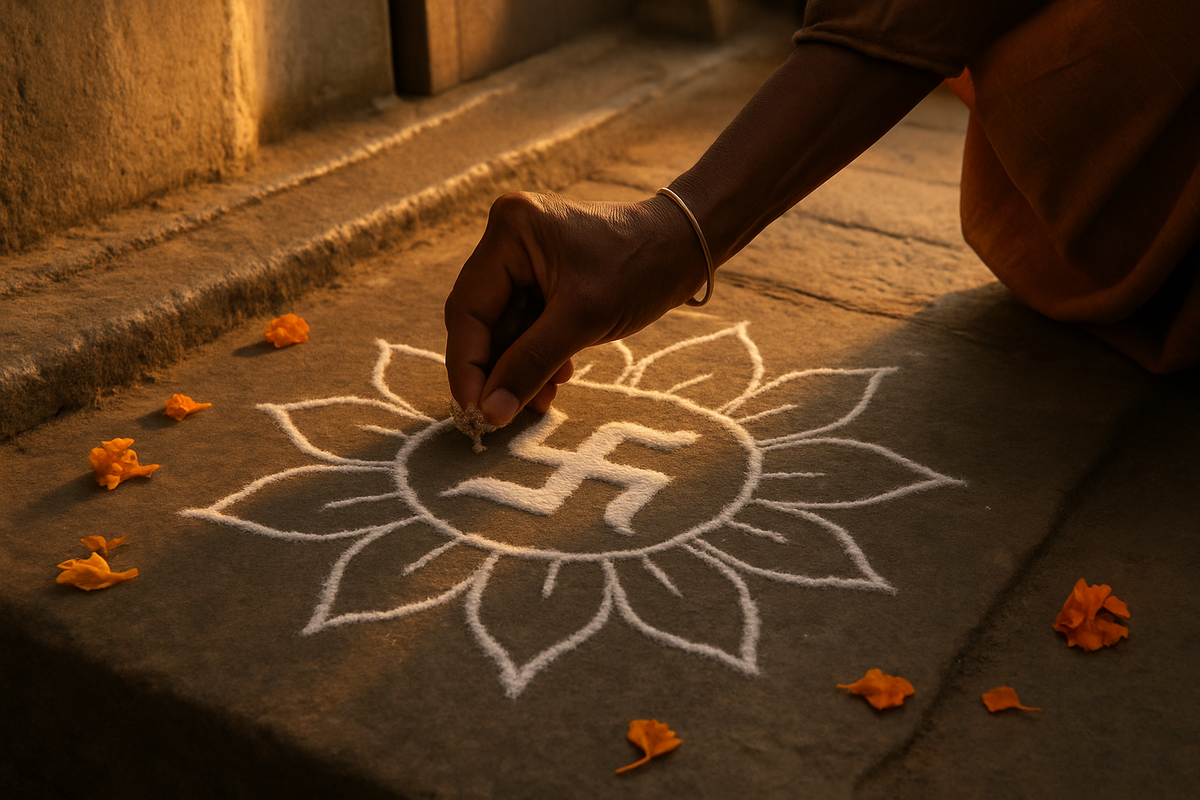
Long before the twentieth century, the swastika was carved into Indus Valley seals at Mohenjo-daro and Harappa, dated to around 2500 BCE. In Hindu use, the arms bending clockwise represent the sun's motion, the four directions, and general good fortune. It is drawn on wedding invitations, painted on new business ledgers during Diwali, and traced on doorframes to invite prosperity inside.
The symbol also appears in Buddhism and Jainism with similar positive meaning, marking the Buddha's footprints in some traditions and representing the Jain concept of the four possible states of rebirth in others. Its later reversal and adoption by the Nazi party in Germany has nothing to do with its original religious function. In India, the swastika is still drawn every day without any connection to that history.
The lotus grows rooted in murky pond water yet opens perfectly clean above the surface each morning. Hindus read this as a picture of the soul's journey: consciousness can rise untouched even while living inside a difficult world. Goddess Lakshmi is shown seated on a lotus, Saraswati holds one in her hand, and Brahma is depicted emerging from a lotus growing out of Vishnu's navel in the creation account told in the Puranas.
The lotus also maps onto the body in tantric anatomy, where the chakras are visualized as lotus flowers with a set number of petals at each energy center along the spine, from the four-petaled root chakra to the thousand-petaled crown.
Several Hindu symbols began as literal weapons carried by deities and became protective emblems on their own.
The mark on the forehead is one of the most visible Hindu symbols in daily life, but its shape changes meaning by sect. Vaishnavas often wear a U-shaped tilaka in white or yellow sandalwood paste with a central red line, called the urdhva pundra. Shaivites typically wear three horizontal white ash lines known as tripundra, sometimes with a central red dot. A simple bindi between the eyebrows marks the location of the ajna chakra, the third eye associated with intuition, and is worn by many women regardless of sect. Protective marks on the body appear elsewhere too, such as the meaning and colors of the evil eye across the Mediterranean and Middle East.
| Symbol | Core Meaning | Associated Deity or Concept |
|---|---|---|
| Om | Primordial sound of the universe | Brahman, the absolute reality |
| Swastika | Well-being, good fortune, the sun | General auspiciousness, Ganesha, Surya |
| Lotus | Purity rising above worldly mud | Lakshmi, Saraswati, Brahma |
| Trishula | Balance of creation, preservation, destruction | Shiva |
| Shankha | Victory, cosmic sound, protection | Vishnu |
| Tilaka | Sect identity, spiritual focus | Vishnu or Shiva depending on style |
Hindu symbolism is not one fixed system handed down uniformly. Vaishnavism, Shaivism and Shaktism each treat different symbols as central to worship. A Vaishnava household in Vrindavan might display the shankha and the tulsi plant prominently, while a Shaivite household in Tamil Nadu keeps a Shiva lingam and rudraksha beads on the home altar. Shaktas, who center worship on the Goddess, often use the Sri Yantra, a geometric diagram of interlocking triangles representing the union of masculine and feminine cosmic energy. Its exact origin is debated among scholars of tantra, though versions of the diagram appear in agamic texts many centuries old.
Folk and tribal Hinduism across states like Odisha and Chhattisgarh adds another layer, with local deities represented by simple stone markers, trees, or terracotta horses rather than the classical iconography found in temple sculpture. This regional variety is part of why Hindu symbolism has stayed alive rather than settling into one fixed meaning, the same way other traditions carry distinct regional readings, as seen in the different types of crosses and their meanings across Christian denominations.
In Hindu dream interpretation, particularly in folk traditions drawing on the Swapna Shastra texts, symbols carry specific messages:
These readings are folk interpretations rather than fixed doctrine, and different regional texts sometimes disagree on details.
Interest in these symbols has spread well beyond India, showing up in yoga studios, jewelry and tattoos. A few practical guidelines help keep that interest grounded and respectful:
Treated this way, these symbols work less like ornaments and more like the daily reminders and protective signs found across belief systems, from a Star of David worn for identity and protection to the sacred icons catalogued in this guide to Catholic symbols and their meanings.
Om is generally considered the most important Hindu symbol because it represents the sound of creation itself and opens most Vedic mantras and rituals. It is used across every major Hindu sect, unlike more specific symbols tied to a single deity.
Yes, the swastika is an ancient Hindu symbol of well-being and good fortune dating back to the Indus Valley Civilization, long before its unrelated use by the Nazi party in the twentieth century. It is still drawn on doorways, invitations and business ledgers across India today with its original meaning intact.
The lotus represents purity and spiritual awakening because it grows out of muddy water yet blooms clean above the surface. It is closely associated with the goddesses Lakshmi and Saraswati, as well as the creator god Brahma.
The forehead mark, called a tilaka or bindi, signals sect identity and marks the location of the third eye, the ajna chakra linked to intuition. The exact shape, whether a U-shaped Vaishnava mark or three horizontal Shaivite lines, tells others which tradition the wearer follows.
What the Star of Bethlehem really means: its biblical origins, spiritual symbolism, and place in Christian tradition today.
Discover the meaning behind the Latin cross, crucifix, Celtic cross and more — their history, symbolism, and how to choose one tha…
Discover what the lotus, dharma wheel, endless knot and other Buddhist symbols really mean, plus how different Buddhist traditions…