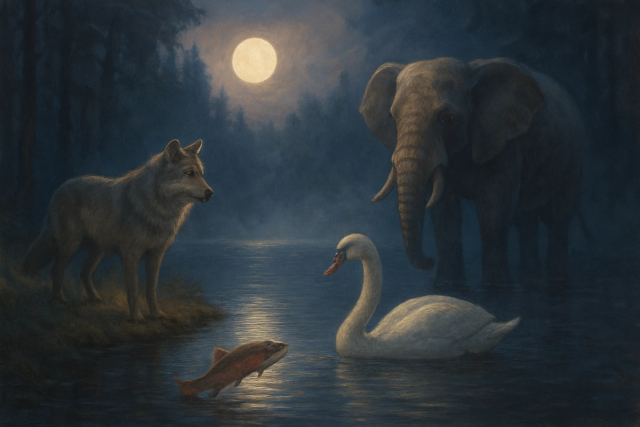
Animal Symbolism
10 Animals That Symbolize Integrity & Loyalty, Explained
See which animals symbolize integrity and loyalty, from wolves and elephants to dogs and salmon, and what their steady honesty can…
 KnowMastery
A raven appearing during Samhain is traditionally read as a death omen, a sign that the veil between the living and the dead has thinned enough for spirits to pass through. In Celtic folklore the bird was tied to the Morrigan, a goddess of war and fate who was said to take raven form to mark those about to die. At Samhain specifically, ravens are understood less as a warning of personal doom and more as confirmation that ancestors are near, that the dead are watching, and that the season's natural boundary between worlds has opened for a few short nights.
There is a particular stillness that settles over the land in late October. The light goes thin by four in the afternoon, the last apples drop from the trees, and somewhere above the bare branches a raven calls once, then goes quiet. People who have heard that sound on Samhain night say it stays with them, not because it is frightening exactly, but because it feels like being noticed by something old.
For centuries, the raven has carried that weight. It sits on battlefields and gallows in old paintings, it rides on the shoulders of gods, and it shows up in grief stories across continents, always near the edge of something ending. Samhain, the Celtic fire festival that marks the death of the old year, is the night that edge comes closest to us.
At its root, raven symbolism carries three overlapping ideas: death, prophecy, and the threshold between worlds. Unlike vultures or other scavenger birds that simply signal decay, the raven was historically seen as an intelligent witness to death rather than just a consumer of it. Battlefield folklore from medieval Britain and Ireland describes ravens gathering before a fight even began, as though they already knew the outcome.
Ravens are carrion birds, and that simple biological fact shaped thousands of years of symbolism. They were among the first creatures to appear near battle sites, plague villages, and deathbeds, so people began reading their presence backward, as a cause rather than an effect. A raven circling overhead was treated as a prediction, not just a scavenger doing its job.
Their coloring reinforced the association. Solid black with no markings, raven feathers were linked to night, void, and the unseen world in a way that lighter birds never were. Add to that their unsettling intelligence, ravens can solve puzzles, mimic sounds, and remember human faces for years, and it becomes easy to see why older generations treated them as something closer to messenger than animal.
Samhain falls on October 31st into November 1st, marking the midpoint between the autumn equinox and winter solstice on the old Celtic calendar. It was the night the harvest officially ended and the dark half of the year began. Celtic communities in Ireland, Scotland, and the Isle of Man held that the wall separating the living from the dead grew thin enough during these nights for spirits to cross in both directions.
Ravens fit naturally into that framework because they were already associated with death outside of Samhain. On a night when ancestors were expected to visit, a raven's call or its sudden appearance on a gatepost was not read as a random sighting. It was treated as proof that the crossing was happening, that something from the other side had taken notice of the living world.
In Irish mythology, the Morrigan is a goddess tied to war, sovereignty, and fate. She appears in the Ulster Cycle taking raven form above battlefields, and warriors who saw ravens circling before a fight believed she was marking who would not survive it. The hero Cu Chulainn, in one of the most famous scenes in Irish legend, dies standing upright, tied to a stone, and it is only when a raven lands on his shoulder that his enemies know for certain he is dead. That single image, a raven confirming death that nothing else could confirm, is the clearest statement of what the bird meant in Celtic belief.
In Norse tradition, Odin kept two ravens, Huginn (thought) and Muninn (memory), who flew across the nine worlds each day and returned to whisper what they had seen into his ears. They were not simply death omens here, they were agents of knowledge, but that knowledge was often tied to fate and mortality. Odin himself was associated with the dead through Valhalla, and his ravens were the link between the god of the slain and events happening in the world of the living.
English tradition carries its own raven omen, separate from Samhain but reinforcing the same instinct to read the bird as a guardian of fate. Legend holds that if the ravens ever leave the Tower of London, the kingdom will fall, a belief said to date back to the reign of Charles II in the 1600s. Keepers known as Ravenmasters still clip the birds' flight feathers today so the prophecy never gets tested. The raven-as-omen idea did not stay buried in ancient myth. It carried straight into modern British tradition almost unchanged.
Not every tradition reads the raven as a grim figure. Among Pacific Northwest peoples, including the Tlingit and Haida, Raven is a trickster and creator who stole the sun and placed it in the sky, shaping the world through mischief rather than destruction. This version of Raven is clever and self-serving rather than ominous, a reminder that the bird's meaning has always depended on the culture asking the question. The death association that dominates Samhain folklore is largely a European inheritance, not a universal one.
Ravens often get lumped together with crow symbolism and with owls, since all three are night-associated birds tied to mortality in Western folklore. The details, however, differ enough to matter if you are trying to read a specific sign.
| Bird | Traditional Omen | Cultural Association | Samhain Meaning |
|---|---|---|---|
| Raven | Death, prophecy, fate | Celtic Morrigan, Norse Odin | Confirmation that the veil has opened |
| Crow | Warning, change, collective fate | Widespread European folk belief | A heads up rather than a confirmation |
| Owl | Death, wisdom, the unseen | Many Indigenous American and African traditions | A guide through the dark half of the year |
For how owls fit into this same pattern, see owl symbolism and dream meanings. Owls tend to be read as guides through the dark half of the year rather than confirmations of a death already underway, which is a meaningfully different signal than a raven carries.
Dreaming of a raven in the weeks around Samhain tends to carry more weight than at other times of year, simply because the season already primes people to think about endings. A single raven in a dream is commonly read as a message about letting go of something, often a relationship, a job, or a version of yourself that has already died in practice but not yet in fact.
These dream interpretations borrow the same logic used for waking omens. A raven in a dream is rarely read as background noise. It tends to show up when something in your life is already ending, which is exactly the territory Samhain occupies.
Seeing a raven on or around October 31st does not require panic, and most folk traditions never treated it that way either. The older practice was to treat the sighting as information, not a sentence.
Modern Pagan and Wiccan practitioners who keep Samhain as a working practice also watch for other creatures appearing the same week, since the thin veil tends to bring out more than one kind of messenger. If a spider or a swan crosses your path in the same stretch of days, it is worth noting alongside the raven. Swan symbolism around transformation and the soul often pairs well with raven death omens in a single reading of the season.
No, most traditions treat it as a sign of transition rather than disaster. It generally points to an ending, often one you are already aware of, rather than predicting a new tragedy.
Ravens are larger, deeper voiced, and tied in Celtic and Norse myth directly to specific death figures like the Morrigan and Odin, which gives their appearance a more confirmed, final quality. Crows are more associated with early warning and collective change, so seeing one often feels less certain than seeing a raven.
Samhain marks the point in the Celtic calendar when the veil between the living and dead was believed to be thinnest, and ravens already carried death symbolism in Celtic folklore through figures like the Morrigan. The two ideas reinforced each other, so a raven sighting on that specific night carried more weight than it would on an ordinary day.
Dreaming of a raven around this time is usually tied to processing an ending or loss, often something you have not fully acknowledged while awake. A raven that watches rather than attacks in the dream is traditionally read as a guiding presence rather than a warning of harm.
See which animals symbolize integrity and loyalty, from wolves and elephants to dogs and salmon, and what their steady honesty can…
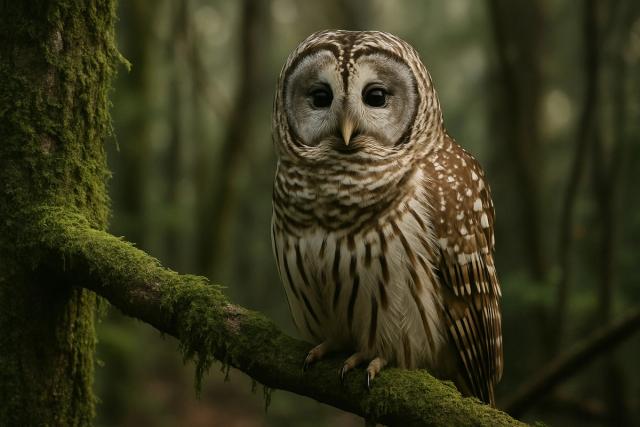
What does a barred owl's call really mean? Discover the spiritual symbolism behind its cry, daytime sightings, dreams, and cultura…
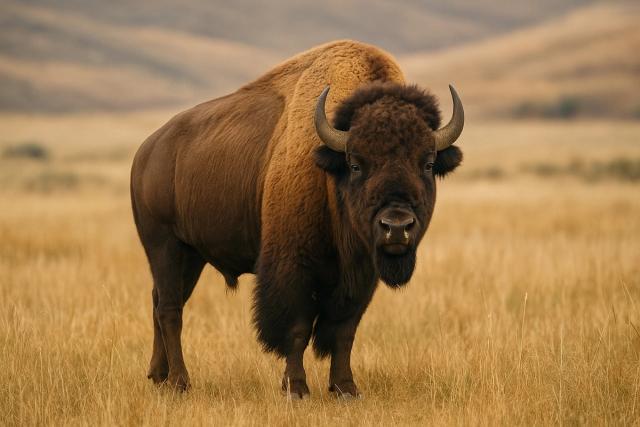
Bison symbolism meaning: what it represents spiritually, as a totem and spirit animal, in dreams, and in Native American tradition…