History
Plan 9 from Outer Space: From Worst Movie to Cult Classic
Why is Plan 9 from Outer Space called the worst movie ever made? Explore its plot, cast, Ed Wood's vision, and its rise to cult cl…
 KnowMastery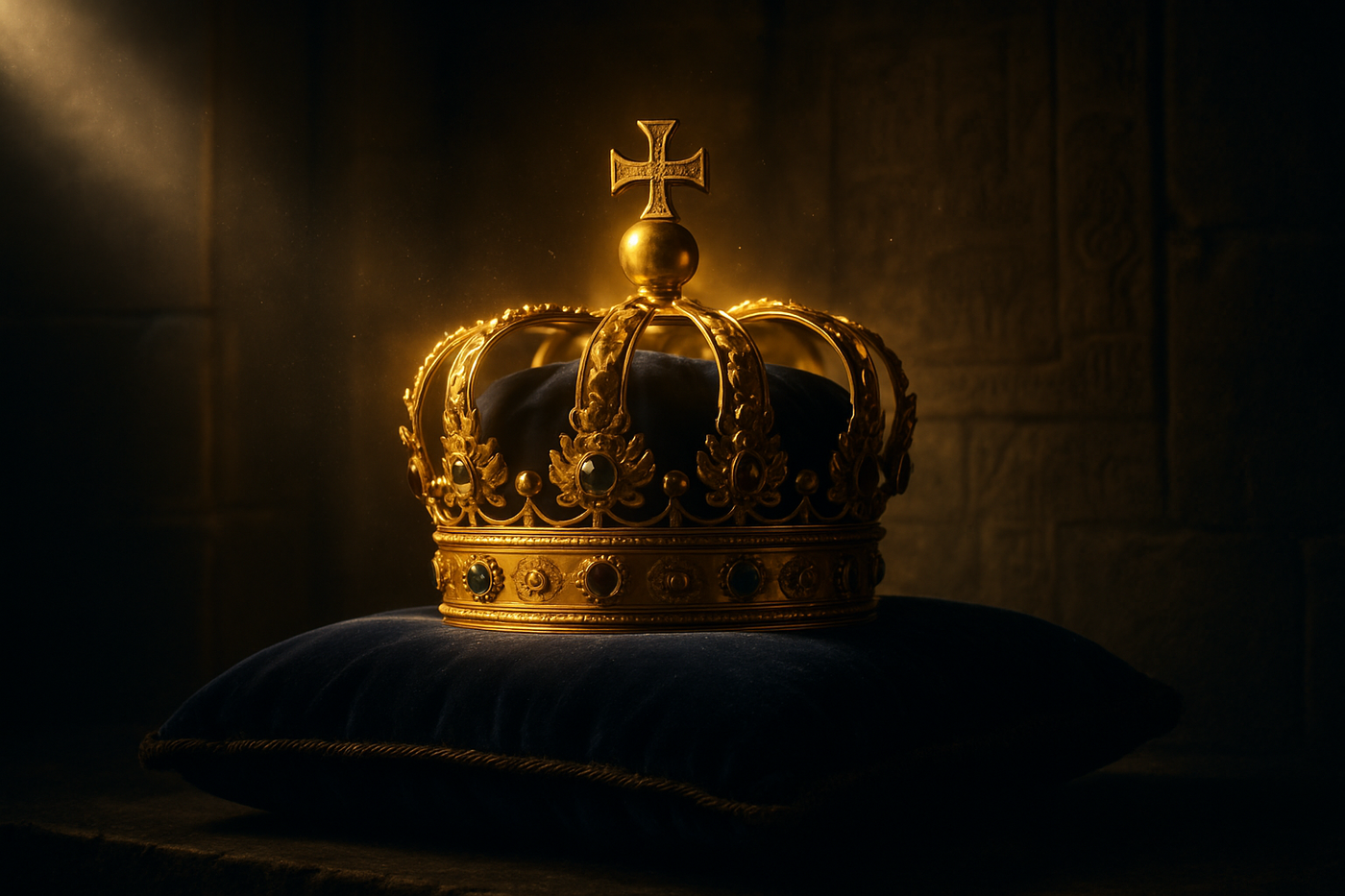
A crown is a ceremonial headpiece that symbolizes sovereignty and legitimate authority, visually marking its wearer as a ruler, deity, or champion chosen by bloodline, conquest, divine favor, or public merit. For more than 5,000 years, cultures across the world have used crowns to make invisible power visible, physically elevating the wearer's head while symbolically linking them to something greater than themselves - a god, an ancestral line, or a nation's collective will.
Quick Answer: A crown symbolizes sovereignty, divine right, and legitimate power - a visible, wearable claim that its wearer's authority comes from a source greater than personal ambition. Crowns date back over 5,000 years and appear in nearly every major civilization, from Egyptian pharaohs to Aztec emperors to modern beauty pageants. Materials, shapes, and colors vary by culture, but the core message - authority worn on the body's highest point - has remained remarkably constant.
There is something primal about placing an object on the highest point of the human body. The head holds the eyes, the voice, the mind - the seat of identity. To crown someone is to say: this person's thoughts and words now carry the weight of a kingdom, a god, or a people's collective will.
Think of the coronation of a young queen, hands trembling as an ancient circle of gold is lowered onto her head, centuries of ancestors watching through candlelight and stone. Or picture a Bronze Age chieftain, crowned in bronze and boar's tusk, believing the metal itself carried the strength of the earth into his skull. The crown was never just decoration. It was a contract between the wearer and something larger than themselves.
At its most basic, a crown symbolizes sovereignty - the right to rule granted by bloodline, conquest, divine appointment, or communal consent. But layered beneath that political meaning are older, deeper associations that appear again and again across unrelated civilizations:
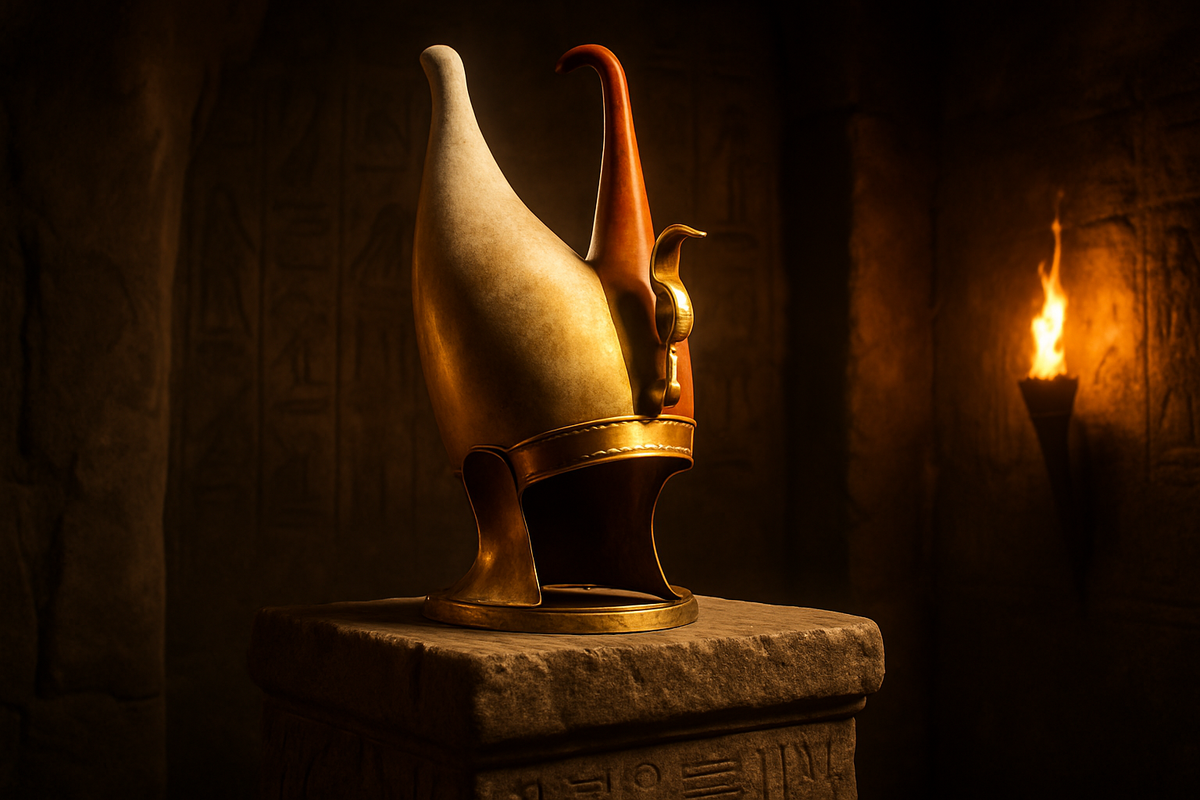
The Pschent, or Double Crown, united the white Hedjet of Upper Egypt with the red Deshret of Lower Egypt. Pharaohs wore it to declare mastery over a unified nation, and it was closely tied to Horus and Wadjet, the cobra goddess whose image often coiled at the front. The crown wasn't merely royal apparel - it was theology worn on the skull, proof that the pharaoh existed between the human and divine worlds.
Sumerian and Akkadian rulers wore layered horned crowns originally reserved for deities like Anu and Enlil. The Victory Stele of Naram-Sin dates to around 2250 BCE and shows him wearing the bull-horned helmet previously reserved for gods, making him, by tradition, the first Mesopotamian king depicted claiming this divine symbol for himself. This blending of human rulers with bull-horned, semi-divine imagery sits alongside a much wider tradition of hybrid gods and sacred beasts explored in our guide to mythical creatures, many of which share the same horned iconography of divine power.
Unlike the metal-heavy crowns of the Near East, the Greeks favored the laurel wreath, dedicated to Apollo and awarded at the Pythian Games. Romans adopted it for triumphant generals and eventually emperors, most famously Julius Caesar, who reportedly wore his laurel crown partly to disguise his balding head. The wreath represented merit and victory rather than inherited bloodline - a subtle but crucial difference from Egyptian or Mesopotamian crowns.
Charlemagne was crowned emperor by Pope Leo III on Christmas Day, 800 CE — recorded at the time as 'emperor of the Romans,' with the title 'Holy Roman Emperor' only coming into use in later centuries. The Holy Roman Emperor's later crown, the Reichskrone, featured an arched design symbolizing the vault of heaven, while England's Imperial State Crown carried the St Edward's Sapphire, said to have been worn by Edward the Confessor himself.
Coronations were religious ceremonies as much as political ones. Archbishops anointed monarchs with holy oil before the crown ever touched their head, echoing the biblical anointing of King David. This ritual reinforced the doctrine of the divine right of kings - the belief that royal authority came directly from God, not from the people.
The Chinese emperor's Mianguan featured a flat rectangular board with strings of beads hanging in front of the eyes, deliberately obscuring the ruler's vision. This wasn't a design flaw - it symbolized that a wise emperor should not be swayed by trivial sights, only by matters of true cosmic importance, aligning him with the Mandate of Heaven.
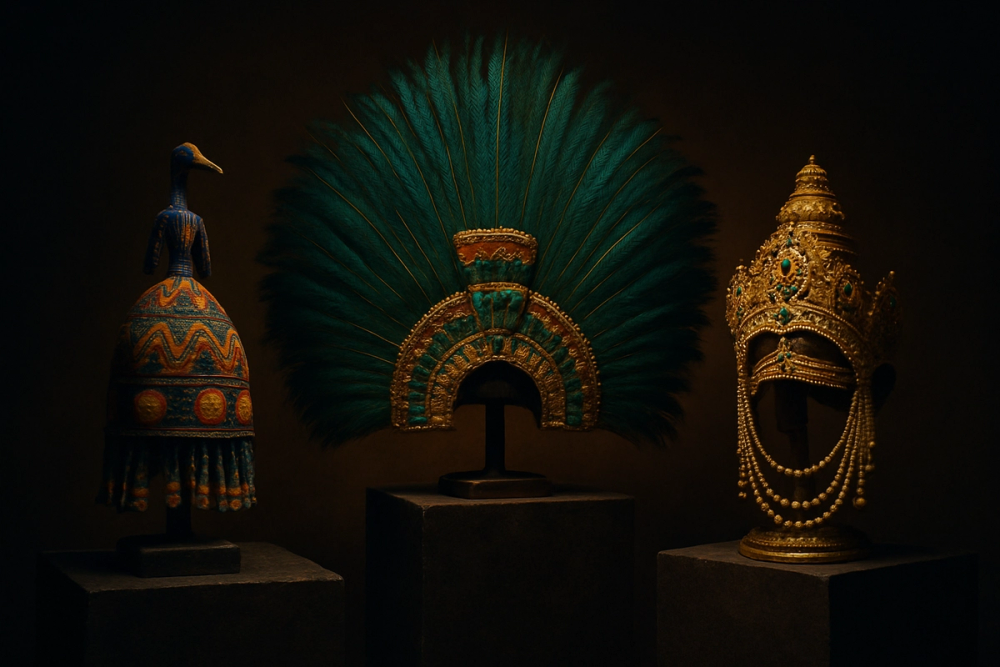
Among the Yoruba people of present-day Nigeria, the Adenla, or great crown, is covered in intricately beaded imagery and topped with a bird, representing spiritual insight. Yoruba tradition holds that the crown contains the ase - the sacred life force - of royal ancestors, meaning the crown itself is considered alive with ancestral spirit each time an oba (king) wears it.
In Mesoamerica, Aztec rulers such as Moctezuma II wore the penacho, a radiant headdress built from hundreds of quetzal and cotinga feathers, believed to channel the power of Quetzalcoatl and mark the wearer as an intermediary between gods and people. Far to the south, the Sapa Inca wore the mascapaicha, a fringed tassel of red vicuña wool hung across the forehead - so sacred that only the reigning Inca, considered a direct descendant of the sun god Inti, was permitted to wear it. When Atahualpa was captured by Spanish conquistadors in 1532, the loss of his mascapaicha symbolized the collapse of the entire imperial order it represented.
In Hindu tradition, the mukut is worn by both mortal rulers and deities - temple statues of Krishna, Vishnu, and Rama are adorned with elaborate gold mukuts studded with rubies and pearls, reflecting the belief that kingship on earth mirrors divine kingship in the heavens. Rajput maharajas wore the kalgi, a jeweled turban ornament with a heron feather plume, into coronations and battle alike, treating it as inseparable from personal honor.
Placed side by side, these traditions reveal how the same basic idea - a headpiece announcing power - took wildly different forms depending on climate, materials, and theology:
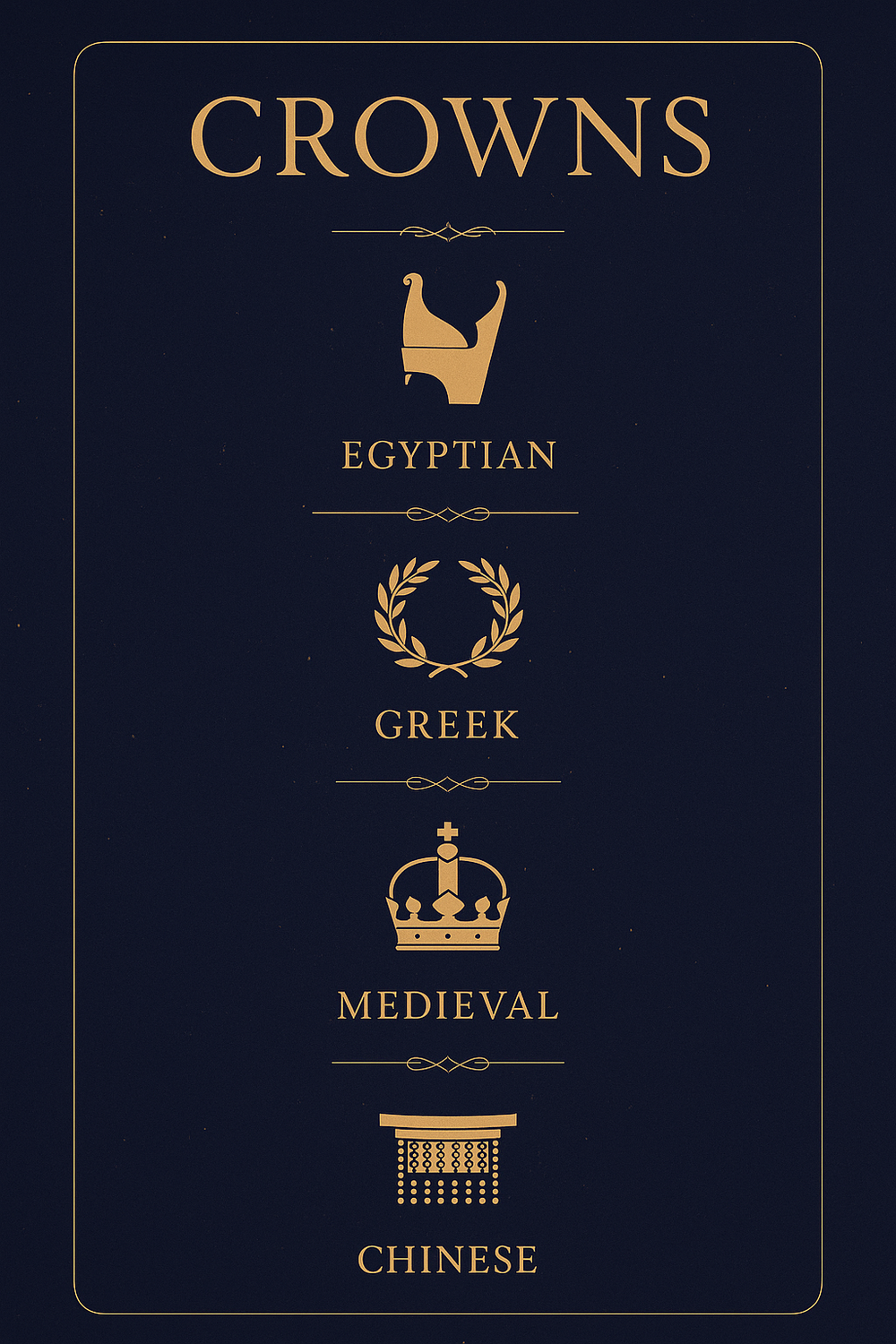
| Culture | Crown Type | Primary Symbolism |
|---|---|---|
| Ancient Egypt | Pschent (Double Crown) | Unity of Upper & Lower Egypt, divine kingship |
| Mesopotamia | Horned Crown | Shared status with the gods |
| Ancient Greece/Rome | Laurel Wreath | Victory, merit, achievement |
| Medieval Europe | Arched Metal Crown | Divine right, Christian kingship |
| Imperial China | Mianguan (Flat-topped Crown) | Cosmic order, the Mandate of Heaven |
| West Africa (Yoruba) | Beaded Crown (Adenla) | Ancestral spirit, royal ase (life force) |
| Aztec & Inca Empires | Penacho / Mascapaicha | Divine mandate, descent from the sun god |
| South Asia (Hindu/Rajput) | Mukut / Kalgi | Divine kingship mirrored from the gods, personal honor |
Gold's dominance in crown-making isn't just about wealth display - it carries deliberate symbolic weight. Because gold doesn't tarnish, rust, or corrode, ancient metallurgists and priests alike saw it as incorruptible, a fitting material for authority meant to be eternal and untouched by decay. Its color also mirrored the sun, tying earthly rulers to solar deities across Egyptian, Inca, and Mesopotamian traditions alike.
Other materials carried their own coded meanings. Silver, cooler and more reflective, was frequently associated with the moon and used in crowns tied to queens, priestesses, or lunar deities. Specific gemstones added further layers: rubies often symbolized passion or protection in battle, sapphires were linked to wisdom and heaven (as with England's St Edward's Sapphire), pearls suggested purity, and emeralds signified fertility or renewal. A crown's material palette was rarely accidental - it was a compact, wearable statement of the values a ruler wanted associated with their reign.
Beyond history, crowns carry rich symbolic weight in dream interpretation and spiritual practice:
In spiritual and New Age traditions, the crown is also linked to the crown chakra (Sahasrara), located at the top of the head, associated with enlightenment and connection to higher consciousness - a modern echo of ancient beliefs that the head is where divine power enters the body.
Crowns rarely appear on heads of state anymore outside ceremonial monarchies like the United Kingdom, but the symbol persists everywhere:
If you're drawn to the crown as a personal symbol rather than a historical artifact, consider what kind of authority you're actually seeking - authority over others, or authority over your own choices. Much like the enduring symbolism behind the history of engagement rings, another small wearable object loaded with outsized meaning, the crown's oldest message isn't about ruling a kingdom; it's about carrying responsibility with visible dignity, a lesson that outlasted every empire that ever minted one.
Crowns rarely stood alone. Royal courts paired them with elaborate charm bracelet traditions worn as personal talismans of status and protection, ceremonial makeup rituals, and specific scents reserved for the powerful, much like those detailed in the history of perfumes. Power, it turns out, was never expressed through a single object, but through a coordinated language of adornment from head to foot, with the crown always serving as the loudest statement in that language.
A crown is a closed or fully circular headpiece traditionally reserved for reigning monarchs, symbolizing complete sovereign authority. A tiara is typically a smaller, open-backed, semicircular piece worn by queens, princesses, or pageant winners for ceremonial or formal occasions rather than as a mark of ruling power. A diadem sits historically between the two - originally a simple cloth or metal band worn by ancient Greek and Persian rulers to signify royal status, later evolving into a decorative band-style headpiece without a crown's full enclosed structure.
Gold was chosen for crowns largely because it doesn't tarnish or corrode, making it a natural symbol of incorruptibility and eternal authority. Its warm color also linked earthly rulers to the sun and solar deities across many ancient civilizations, from Egypt to the Inca Empire, reinforcing the idea that royal power was inherited from the heavens.
In Christian tradition, crowns symbolize both earthly and spiritual authority - kings were anointed and crowned as God's appointed representatives, echoing the biblical anointing of King David. Crowns also appear symbolically in scripture as rewards for faithfulness, such as the "crown of life" and "crown of righteousness" promised to believers, representing eternal reward rather than political rule.
The Nahal Mishmar hoard, dated to around 3500 BCE and discovered in a cave in Israel, contains copper objects archaeologists conventionally call 'crowns' and often cite among the oldest known crown-like objects, though some scholars argue these pieces were actually altar fittings rather than headwear. These early pieces already show sophisticated symbolic design tying rulers to gods and cosmic order.
Pointed crowns frequently symbolize rays of the sun or divine radiance, a design tradition traced back to sun-associated deities in Egyptian and later Roman iconography, such as the radiate crown worn by Roman emperors depicting Sol Invictus. The spikes visually suggest that power emanates outward from the ruler like light.
Yes, ceremonial monarchies including the United Kingdom, Spain, Sweden, and several Middle Eastern kingdoms still use crowns during coronations or state occasions, though they rarely wear them daily. In the UK, the Imperial State Crown appears at the State Opening of Parliament and other high ceremonial events, continuing a tradition unbroken for centuries.
Why is Plan 9 from Outer Space called the worst movie ever made? Explore its plot, cast, Ed Wood's vision, and its rise to cult cl…
Where engagement rings began, why diamonds took over, and what the ring on your finger really means across history and culture.

12 key milestones in shoe history, from 40,000-year-old prehistoric footwear to Crocs and smart sneakers. See the full timeline an…