Animal Symbolism
Moth Symbolism: Spiritual Meaning & Significance
What do moths really symbolize? Explore the spiritual meaning of moths—transformation, intuition, and hidden light—across myth, dr…
 KnowMastery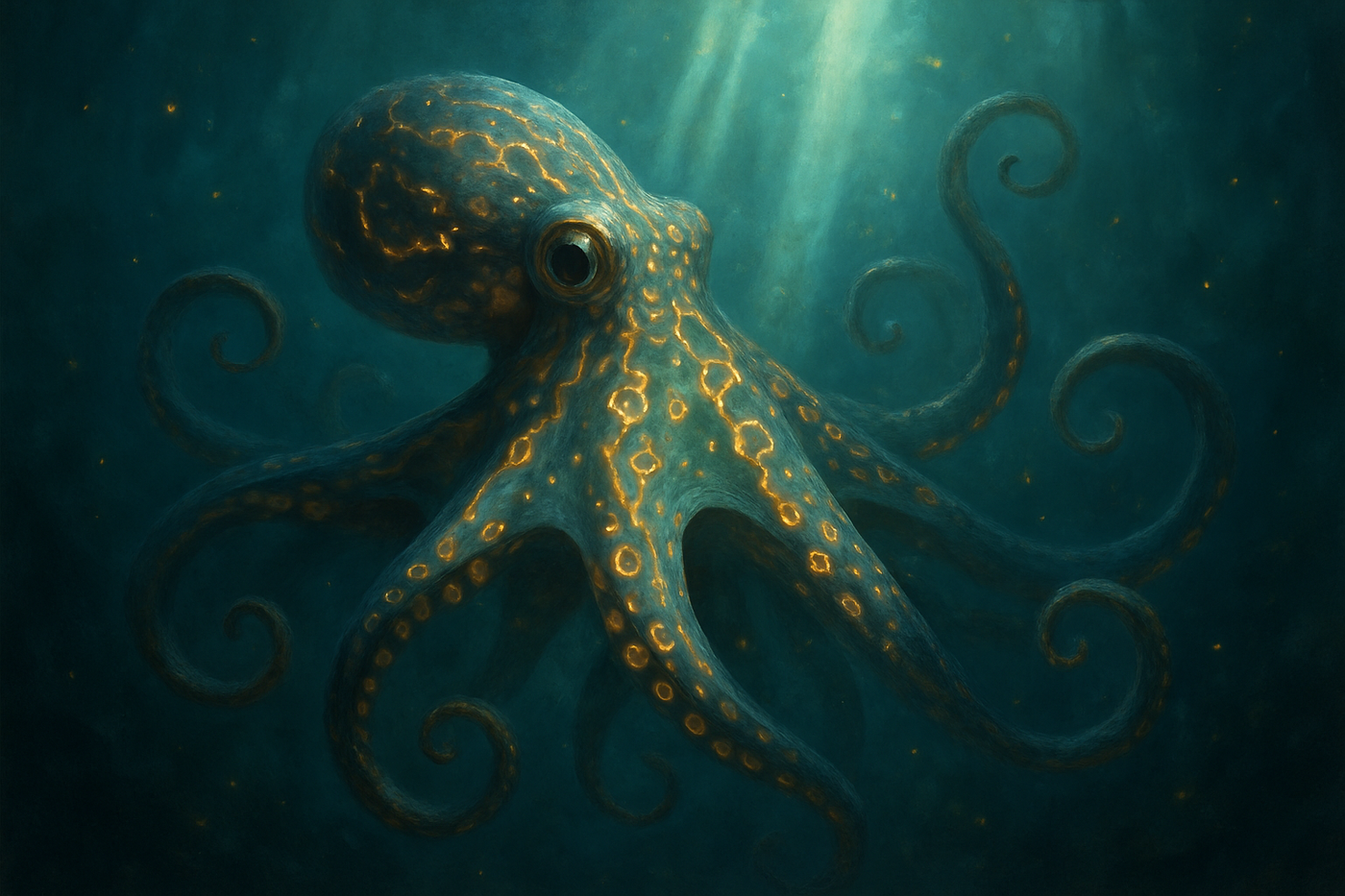
An octopus symbolizes adaptability, intelligence, mystery, and emotional depth. As a spiritual and totem animal, it represents the ability to reshape yourself to fit changing circumstances without losing your true identity, along with heightened intuition, resourcefulness, and the wisdom to retreat when direct confrontation isn't the answer. Its eight arms reinforce themes of multitasking and reach, while its ink-cloud escape reflects the strength found in strategic withdrawal.
You watch an octopus slip through a crack barely wider than its own eye, its body folding like liquid thought. It doesn't fight the shape of the world—it becomes it. There's a reason this creature has haunted sailors, inspired sacred art on Bronze Age Crete, and slipped into modern dream journals with equal ease. It moves between worlds: solid and fluid, hidden and revealed, alien and strangely familiar. That quiet unease you feel watching one isn't fear alone—it's recognition of a question most of us avoid: what would happen if you stopped resisting change and simply flowed?
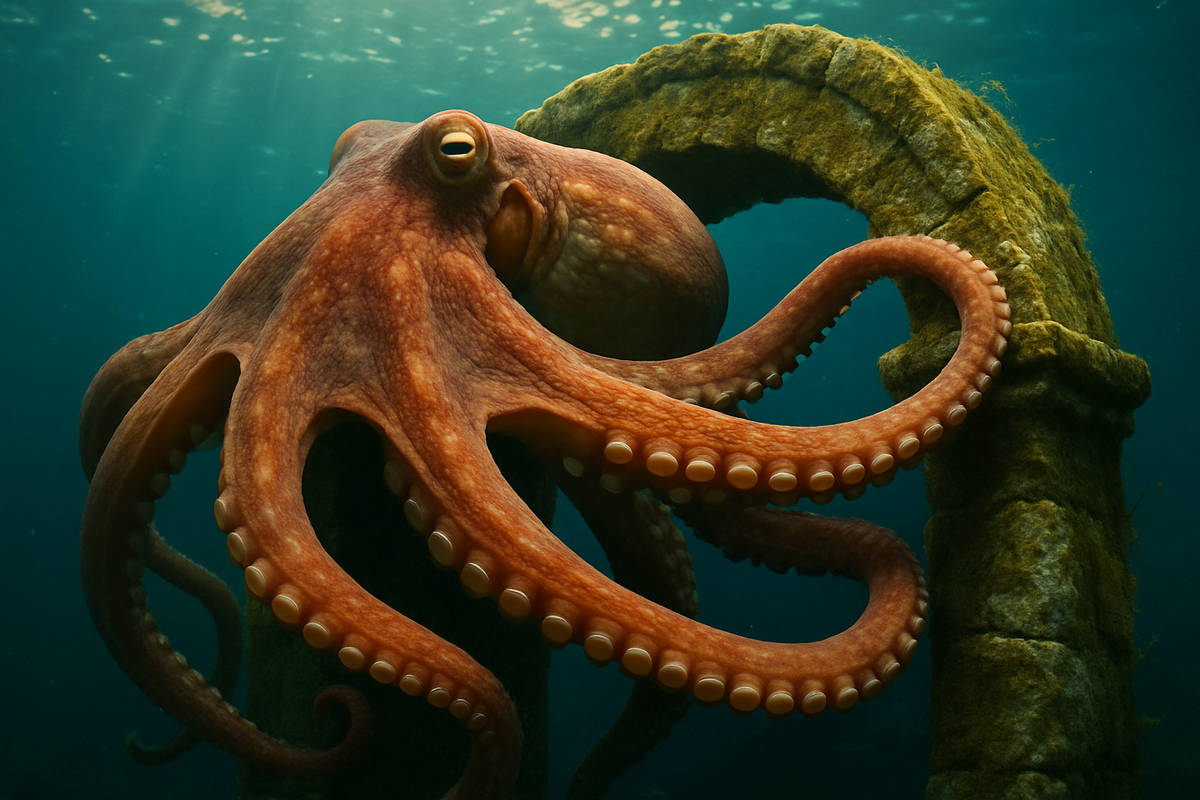
Before diving into myth and dream interpretation, it helps to see the octopus's symbolism laid out plainly. Each trait below maps to a real biological behavior, which is part of why the symbolism feels earned rather than arbitrary.
Spiritually, the octopus is often read as a messenger of fluid strength—the idea that softness and flexibility can outmatch rigidity. Where a scorpion teaches survival through defense, the octopus teaches survival through transformation. It doesn't need armor because it can become whatever the moment requires.
Many spiritual practitioners see the octopus as a guide for people moving through major life transitions—career changes, relationship endings, spiritual awakenings—because it embodies the ability to dissolve an old shape and reform into something new without dying in the process. It's also strongly associated with intuition and the third eye, since much of its "thinking" happens outside a centralized brain, hinting at wisdom that doesn't rely on pure logic.
Every powerful symbol has a shadow. The octopus can also represent manipulation, secrecy, or emotional evasiveness—someone who "has their tentacles in everything" but reveals little of their true self. When octopus symbolism appears alongside feelings of confusion or entrapment, it may be nudging you to examine where you're hiding rather than adapting, or controlling rather than connecting.
Few creatures have inspired such consistent reverence across unrelated civilizations, and the specifics reveal just how central this animal has been to human spiritual imagination. Much like the jellyfish, another marine being tied to transformation and the unconscious, the octopus has long served as a bridge between the ordinary world and the deep, unseen forces that shape it.
On Bronze Age Crete, around 1500 BCE, Minoan potters covered vases and jars with sweeping, tentacled octopus designs known today as the "Marine Style." Archaeologists believe these motifs weren't merely decorative—they reflected a worldview in which the sea was a living, intelligent force, and the octopus, with its otherworldly movement, served as a symbol of that deep, unknowable power.
The octopus (heʻe) is linked to Kanaloa, one of the four major Hawaiian akua, closely associated with the ocean, and in some traditions with the underworld and realm of darkness, though other accounts assign the underworld specifically to the god Milu. In one scholarly interpretation of the Kumulipo creation chant, the octopus is described as the sole survivor of a previous universe or age of existence, though other translators of the chant have read the verse differently.
In Japanese folklore, the octopus (tako) appears throughout ukiyo-e woodblock art, most famously in Hokusai's work, and in coastal legends where it is respected by ama pearl divers as both a resource and a spirit of the deep. Its intelligence and otherworldly form made it a natural subject for stories blurring the line between animal, spirit, and metaphor for desire and the unconscious.
Octopus (or 'devilfish') imagery appears in Haida and other Pacific Northwest Coast art, such as carved helmets and totem poles, reflecting the octopus's deep practical and cultural importance to coastal peoples, though its specific symbolic meaning is not well documented in reference sources.
If the octopus feels like your totem or spirit guide, you likely possess natural adaptability and a talent for reading situations others miss. People with octopus energy tend to:
This mirrors how those drawn to the spider spirit animal often weave complex plans, though the octopus totem favors flexible improvisation over careful, structured design. Both, along with the drifting jellyfish totem, remind us that strength doesn't always require a rigid backbone—sometimes it requires the willingness to bend.
| Context | Common Symbolic Meaning |
|---|---|
| Octopus in a dream | Overwhelm, hidden emotions, or the need to "handle" multiple life areas at once |
| Octopus tattoo | Adaptability, resilience, mystery, and personal transformation |
| Octopus as a totem or spirit animal | Intuitive intelligence, flexibility, comfort with ambiguity |
| Encountering one while diving or swimming | An invitation to trust intuition and move fluidly through a current challenge |
| Octopus changing color | Emotional masking, adaptability, or a call to reveal your true feelings |
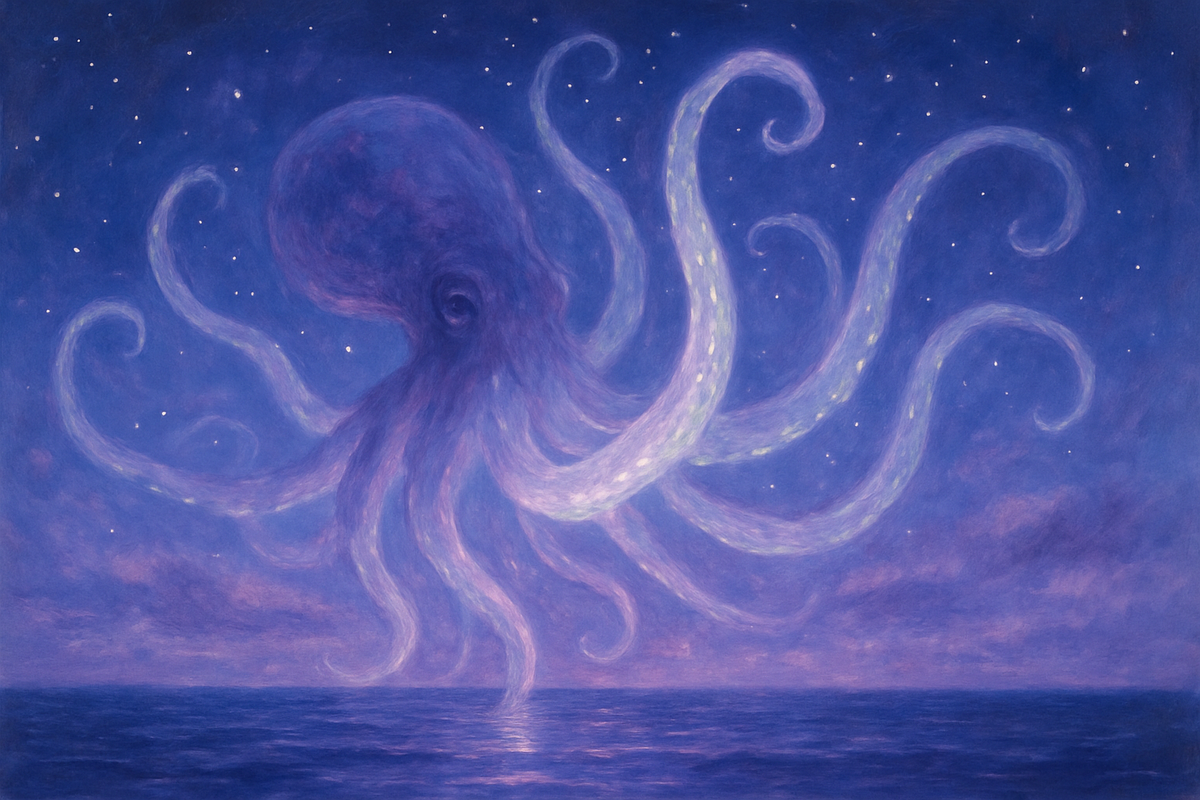
Dreaming of an octopus almost always points to something happening below the surface of your conscious awareness—unprocessed emotion, a situation with more moving parts than you've admitted, or a need to adapt quickly. This octopus dream meaning shifts depending on the animal's size, behavior, and how you feel toward it in the dream.
This scenario often reflects feeling overwhelmed by obligations, a relationship, or a situation with too many demands pulling at you simultaneously. It can also point to a fear of losing control or being emotionally "held" by something you can't fully see or name.
A relaxed octopus in a dream often signals that you're successfully navigating a complex phase of life—handling multiple responsibilities with more grace than you're giving yourself credit for. It can also suggest growing comfort with your own intuition.
Size amplifies intensity in dream symbolism. A giant octopus frequently represents a large-scale life change or an emotional issue that has grown bigger than you initially realized, much like encountering an oversized scorpion in a dream can signal an amplified warning about betrayal or self-protection.
Octopus tattoo meaning shifts noticeably depending on style, color, and placement, which is why this is one of the most-searched aspects of octopus symbolism. The number of visible arms matters too: a fully spread eight-arm design tends to emphasize reach, multitasking, and total adaptability, while a coiled or partially hidden octopus—arms tucked or wrapped around an object—leans more toward mystery, protection, or guarded emotion.
Color choice shapes meaning as well. A black octopus tattoo often symbolizes the shadow self, hidden strength, or a period of emotional depth and introspection, while a blue octopus leans toward calm intuition, emotional healing, and connection to the sea's tranquil, restorative side. Red or orange ink tends to signal passion, transformation through struggle, or a hard-won rebirth.
Style also changes the message. Japanese-style (irezumi) octopus tattoos, drawing on centuries of tako folklore, often carry themes of fate, desire, and the blurred line between human and spirit realms, frequently paired with waves or koi. Minimalist line-work octopus tattoos, by contrast, tend to emphasize simplicity and personal adaptability rather than mythology—popular with people marking a quiet, internal transformation rather than a dramatic one. Placement on the arm or shoulder often echoes the "reach" symbolism, while a back or ribcage piece tends to emphasize the octopus's hidden, protective, subconscious associations.
Symbols are most useful when they lead to action rather than just interpretation. If the octopus keeps appearing—in dreams, conversation, media, or nature—consider these practical steps:
Just as those exploring the owl as a symbol of wisdom are encouraged to trust quiet observation, the octopus asks you to trust felt intelligence—the kind that lives in instinct and adaptive action rather than pure analysis.
An octopus in a dream typically points to hidden emotions, multiple overlapping responsibilities, or a need to adapt quickly to a changing situation. The specific meaning shifts based on whether the octopus feels threatening, calm, or unusually large in the dream.
Yes, in most traditions the octopus is viewed positively, representing intelligence, adaptability, and resilience rather than danger. Its shadow meaning—manipulation or emotional evasiveness—only tends to apply when the symbolism appears alongside real feelings of confusion or deception in your life.
An octopus tattoo commonly symbolizes personal transformation, adaptability, and the ability to navigate difficult or unfamiliar circumstances with intelligence and grace. Many people choose it after a major life change to mark their own resilience and capacity to reshape themselves.
Color change reflects the octopus's mastery of adaptation, and spiritually it suggests the ability to adjust your outward presentation to fit different environments without losing your core identity. It can also serve as a gentle reminder to examine whether you're masking true feelings rather than expressing them.
The octopus is not directly named in the Bible, since it's a modern common name rather than a biblical-era term, though some interpreters loosely connect sea creatures of "the deep" in scripture to themes of chaos, mystery, and God's dominion over the unknown. In Christian symbolism more broadly, the octopus is sometimes read as a reminder of humility before creation's hidden complexity rather than as an official religious symbol.
In twin flame and spiritual-relationship frameworks, the octopus can represent the entangled, many-layered nature of a deeply connected bond—one where emotional threads reach into every part of both people's lives. It often appears as a sign to examine whether the connection is nurturing mutual growth or becoming enmeshed and overwhelming.
A black octopus is generally associated with the shadow self, hidden strength, and emotional depths not yet brought into the light, while a blue octopus leans toward calm intuition, emotional healing, and a peaceful connection to the subconscious. Both color associations build on the octopus's core symbolism of mystery, simply emphasizing different emotional tones.
The octopus is most commonly linked to Scorpio, since both are associated with the water element, hidden depths, transformation, and intuitive intensity. Cancer is sometimes mentioned as well, given its watery, emotionally attuned, home-protecting nature, though Scorpio remains the stronger and more frequently cited symbolic match.
What do moths really symbolize? Explore the spiritual meaning of moths—transformation, intuition, and hidden light—across myth, dr…
Discover what penguins symbolize spiritually — totem meaning, dream interpretation, love/loyalty, tattoos and Christian symbolism …
Discover what rabbit symbolism really means: fertility, luck, intuition, and folklore from Native American, Celtic, Chinese, and A…