Animal Symbolism
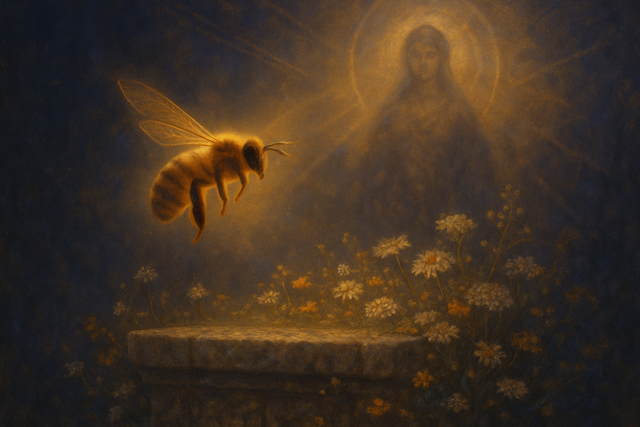
Bee Symbolism: Spiritual Meaning of Seeing a Bee
What does it mean when a bee visits you? Explore bee spiritual meaning, dreams, totem energy, and omens from cultures around the w…
 KnowMastery
 Ravens and crows belong to the same genus, Corvus, but they do not symbolize the same thing. Ravens are tied to death, prophecy, and solitary magic, linked to figures like Odin and the Morrigan. Crows are tied to collective omens, gossip, and warning, best known through the old folk rhyme "one for sorrow, two for joy." The split comes down to behavior: ravens are solitary birds read as messengers from gods or fate, while crows are social birds read as messengers from the group itself.
I remember the first time a raven landed close enough that I could hear its wingbeats, a heavy, dry sound like someone shaking out a leather coat. It did not scatter the way a crow would have. It just watched me, tilted its head, and made a low clicking noise before it left. That stillness is part of why ravens unsettle people in a way crows rarely do.
Crows show up in flocks, in parking lots, on power lines, arguing with each other over nothing in particular. Ravens tend to appear alone or in pairs, usually somewhere quieter. That single difference in behavior shaped thousands of years of myth, and it is why the two birds split so sharply when it comes to death, magic, and omens.
Before getting into myth, it helps to know what actually separates these birds, since the symbolism grew directly out of how people observed them in daily life.
| Feature | Raven | Crow |
|---|---|---|
| Size | Larger, up to 27 inches long | Smaller, around 17 to 21 inches |
| Call | Deep, croaking, guttural | Sharp, repetitive "caw" |
| Social habits | Solitary or in pairs | Highly social, large flocks |
| Tail shape in flight | Wedge-shaped | Fan-shaped |
| Lifespan | Up to 20+ years in the wild | Around 7 to 10 years in the wild |
| Common symbolic role | Death, prophecy, magic, the unknown | Omens, warning, collective fate |
Ravens live longer, range further, and rarely move in large crowds, which is part of why they got pulled into myths about solitary gods, death, and the edges of the known world. Crows, with their loud group behavior, became tied to omens that depend on counting and timing.
Across several unrelated traditions, ravens are not just linked to death, they are treated as creatures that move between the land of the living and whatever comes after.
In Norse belief, the god Odin kept two ravens, Huginn (thought) and Muninn (memory), who flew across the nine worlds each day and returned to whisper what they had seen into his ears. Odin was called Hrafnaguð, the raven god, and raven banners were carried by Viking warbands into battle as a sign that Odin favored them. The raven here is not feared exactly, it is respected as an extension of divine knowledge, something that sees what humans cannot.
In Irish mythology, the Morrigan, a goddess of war, fate, and death, is strongly associated with both ravens and crows, often appearing as a crow called Badb over battlefields to foretell or influence who would die. Warriors who saw a crow or raven circling before a fight read it as a direct sign from her. This is one of the clearest examples of the two birds blending in myth, since the Morrigan moves between raven and crow forms depending on the source text.
Ravens are not the only birds tied to death omens. In European folklore and owl symbolism traditions, the owl's silent night flight and human-like face made it a death messenger too. Owls are usually read as a warning tied to one specific person's death, while ravens are tied to fate and prophecy on a larger scale.
Crows carry a different flavor of meaning, built around their social behavior and their habit of showing up in specific numbers. The old British folk rhyme, still repeated today, assigns meaning by count: one crow for sorrow, two for joy, three for a girl, four for a boy, and so on. This counting tradition is the core of crow symbolism, and it has no real parallel in raven lore, since ravens are rarely seen in large enough groups to count this way.
Crows also show up heavily in fable and folklore as clever but flawed tricksters. Aesop's fable of the fox and the crow builds its entire plot around the bird's vanity. In farming communities across Europe and North America, crows were treated as pests that doubled as an early warning system, their alarm calls signaling a predator or stranger approaching before anyone could see it directly.
Where ravens are treated as oracles speaking for gods, crows are treated more like neighborhood gossips who happen to be right more often than you'd expect.
Both birds show up in witchcraft lore, but again with different roles. In medieval and early modern European witch trials, crows were frequently named as witches' familiars in court records, animals believed to carry out a witch's will or spy on neighbors. Their dark color and tendency to gather near death (crows scavenge on carrion) fed suspicion that they served dark magic rather than practiced it.
Ravens, by contrast, appear more often as the shapeshifted form of a powerful figure rather than a servant. The Morrigan transforms into a raven or crow herself. In Norse and later Scandinavian folk belief, sorcerers called seiðr practitioners were sometimes said to send their spirit out in raven form to travel and gather knowledge, echoing Odin's own birds. Crows serve magic in these stories. Ravens tend to embody it.
Two traditions outside Europe show how differently these birds have been read depending on where you stand.
None of these traditions treat the raven or crow as purely evil. Even where they are tied to death, they are read as messengers doing a job, not villains causing harm.
Dream interpretation generally follows the same split found in myth. A raven in a dream is usually read as a sign of a major transition, a message from the unconscious mind, or a warning tied to fate rather than daily annoyance. Seeing a raven speak or deliver something in a dream is often read as insight you are not yet facing directly in waking life.
A crow in a dream tends to point toward something closer to home: gossip, a warning about a specific situation, or an unresolved argument. Dreaming of a flock of crows is often read as a sign of overwhelming circumstances or too many voices pulling you in different directions, similar to how a hawk in a dream tends to point to focus and clarity by contrast, a sharpening rather than a scattering.
If an encounter with either bird stays with you, a few grounded steps work better than panic.
If there is one line that sums up the split, it is this: ravens speak for something larger than the group (fate, gods, the unknown), while crows speak for the group itself (its warnings, its gossip, its collective mood). One is the lone oracle, the other is the watchful crowd. Knowing which bird you actually encountered, and how it behaved, matters more than most quick interpretations suggest.
Not inherently. In Norse and Celtic tradition, ravens were respected as messengers tied to knowledge and fate rather than pure misfortune. Context matters more than the bird itself, including how many you saw and what was happening in your life at the time.
Folk tradition reads repeated crow visits as a sign to pay closer attention to the communication happening around you, since crows carry strong associations with social warning and gossip. There's also a simple practical explanation: crows have excellent memory for people and places, so a crow that visited once may just be checking a reliable food source again.
They overlap in several myths, most notably with the Irish goddess the Morrigan, who takes both forms. But most traditions treat them separately, with ravens tied to death, prophecy, and solitary magic, and crows tied to collective omens and everyday warnings.
A raven's call is deep and guttural, often described as a croak, while a crow's call is a sharper, higher "caw" repeated several times. This difference in sound is one of the easiest ways to tell the two birds apart even before you see them clearly.
What does it mean when a bee visits you? Explore bee spiritual meaning, dreams, totem energy, and omens from cultures around the w…
Black cats carry centuries of myth, from witches' familiars to Japanese luck charms. Discover their real spiritual meaning today.
Black cat meaning explained: luck, protection, dream symbolism, and spiritual signs across cultures, decoded simply.