
Jewelry & Fashion
What Is Platinum? Properties, Value & Care Guide
Discover what platinum really is, why it costs more than gold, and how to keep it brilliant for a lifetime of wear.
 KnowMastery
An anklet is a chain, beaded strand, or charm bracelet worn around the ankle to symbolize protection, status, sensuality, or personal freedom. Across history it has signaled marital status, warded off evil spirits, and displayed wealth, while today it's worn mostly for style, spiritual grounding, or self-expression — with meaning shifting by ankle, color, and material.
There's something quietly rebellious about a chain wrapped around a bare ankle. It sits low, close to the earth, catching light when you walk barefoot on sand or slip off your shoes under a table. Unlike a necklace or a ring, an anklet doesn't announce itself—it whispers.
For thousands of years, that whisper has carried weight. A jingling anklet on a bride in Rajasthan. A gold band on the leg of an Egyptian noblewoman buried beside her pharaoh. A beaded strand tied by a grandmother in Accra to ward off illness from a newborn. The ankle, it turns out, has always been sacred ground.
At its core, an anklet is a marker of identity worn at the body's most grounded point—the joint that connects us to the earth with every step. Because it sits so close to the feet, which many traditions consider spiritually humble or even impure, anklets have historically carried dual meanings: they could denote lowly servitude in one context and celebrated femininity in another.
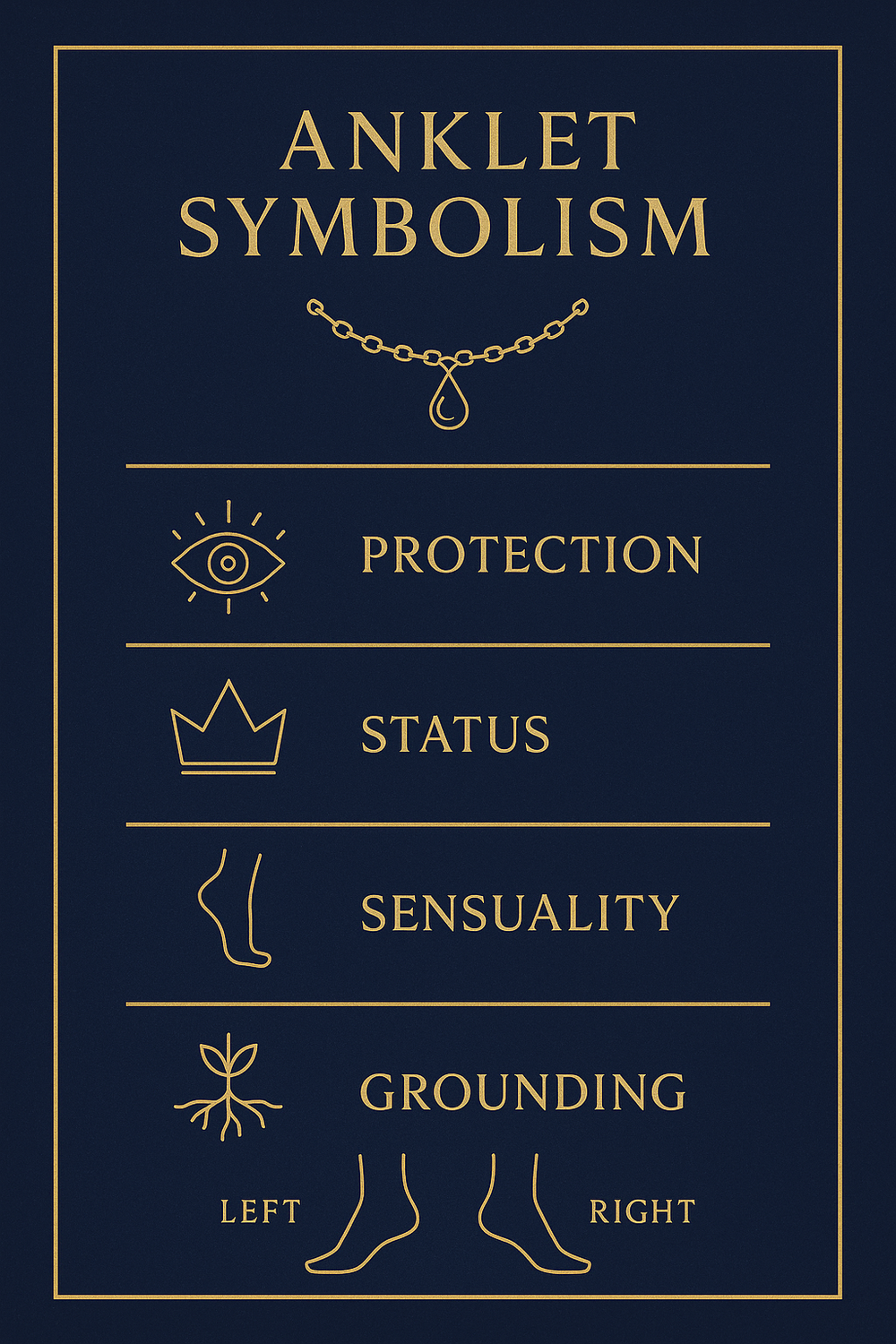
Across most traditions, three symbolic threads repeat:
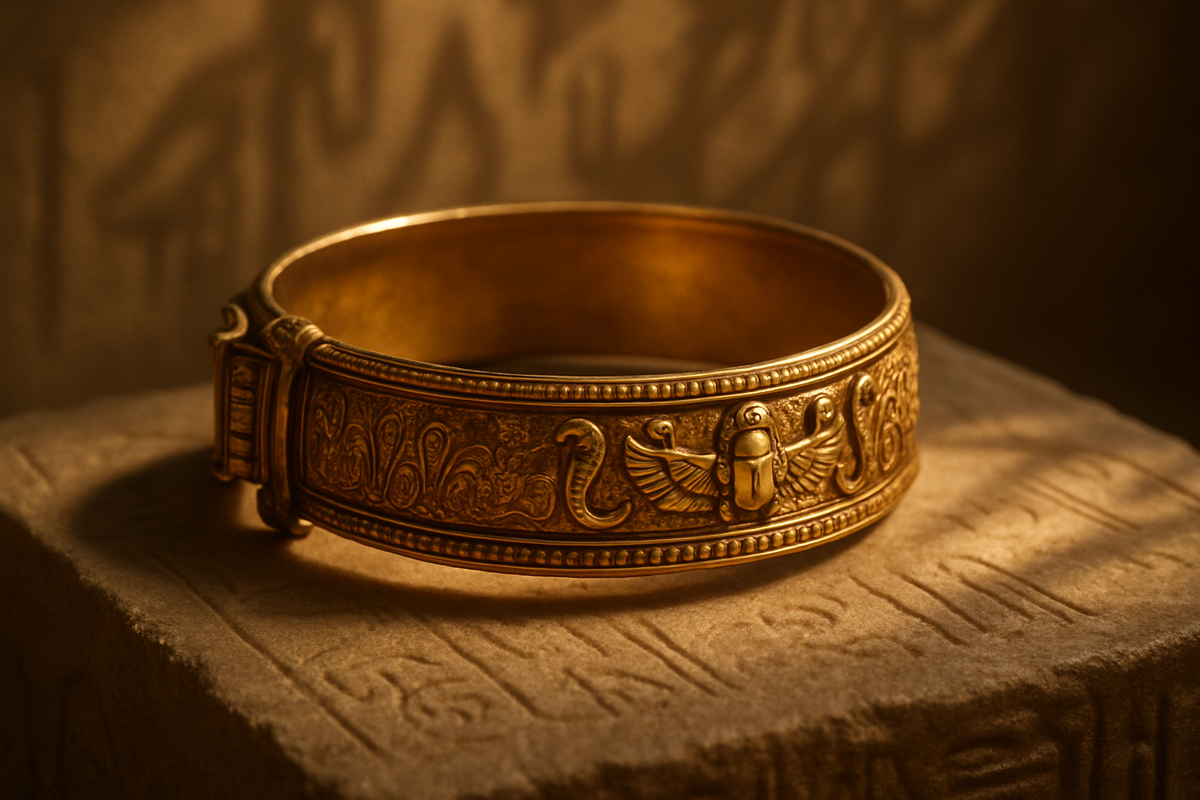
Physical anklets recovered from Egyptian burials date back to as early as predynastic times, around 4000 BCE, while the earliest tomb paintings that depict anklets — worn by dancers in Old Kingdom tombs such as those of Kagemni, Ti, and Akh-hotp — come from many centuries later. Archaeologists, including researchers whose finds are cataloged in the Metropolitan Museum of Art's Egyptian jewelry collection, have recovered gold anklets from Egyptian burial sites belonging to royal women such as Princess Khenmet and Sithathoriunet, though silver anklets from royal tombs are far less well documented, reflecting silver's greater rarity in ancient Egypt. In Egyptian belief, gold was associated with the sun god Ra and thought to be eternal and indestructible, symbolizing divine power and the promise of the afterlife — a belief that extended to gold jewelry, including anklets, worn by the living and the dead alike.

In South Asian culture, the anklet—known as payal or pajeb—remains one of the most ritually significant pieces of jewelry a woman wears. Indian payals have traditionally been made of silver rather than gold in many communities; one explanation documented in scholarship on traditional Indian jewelry, including Oppi Untracht's widely cited reference work on the subject, ties this to caste convention, with gold anklets historically reserved for Kshatriya (royal/warrior caste) wearers while other castes wore silver, though a popular belief also holds that gold was too pure to be worn on the foot. The sound served a practical and symbolic purpose: announcing a woman's presence respectfully as she moved through the household. In Ayurvedic and folk tradition, some believe that silver anklets create subtle vibrations that interact with acupressure points in the foot to balance the body's energy, though this is a traditional belief rather than a scientifically established effect.
In various West African traditions, including Yoruba and Akan cultures, beadwork — worn as waist beads, anklets, and other body ornaments — is used to mark rites of passage such as puberty, marriage, motherhood, and spiritual initiation. Specific bead colors and patterns could denote a girl's readiness for marriage or a woman's status within a lineage. In some communities, anklets tied around an infant's leg were believed to protect against convulsions and evil spirits, a practice still observed in parts of rural Ghana and Nigeria today.
Ottoman and Bedouin brides historically received anklets as part of their dowry, often paired with matching bangles—much like the coordinated sets discussed in our bangle size chart guide. Heavier anklets in these traditions doubled as portable wealth, easily liquidated in times of hardship, since a woman's jewelry was often the only asset legally hers alone. In some Bedouin communities, the weight and craftsmanship of an anklet also signaled which tribe or family a woman belonged to.
Anklets also appear in religious texts, most notably in Isaiah 3:16-18, where the prophet criticizes the "haughty" daughters of Zion for walking with "tinkling ornaments about their feet"—a passage often cited in "anklet meaning bible" discussions as evidence that ankle jewelry was linked to vanity and seduction in ancient Israelite society, even as it remained common, unremarkable adornment throughout the wider ancient Near East.
Beyond documented history, anklets carry layered spiritual associations in contemporary metaphysical practice, blending old folklore with modern energy-work philosophy.
Beyond metal and style, the color and material of an anklet's thread carries its own layer of folklore. These beliefs are cultural traditions rather than proven facts, but they remain widely practiced and searched-for today:
| Thread/Material | Folk Belief | Tradition of Origin |
|---|---|---|
| Black thread | Wards off the "evil eye" and jealousy-based misfortune, especially on infants | South Asian folk tradition |
| Red string | Offers protection and repels negative energy or spiritual harm | Kabbalah-linked Western folklore, also echoed in various Latin American and Mediterranean customs |
| Evil eye charm (blue/white) | Reflects harmful intent or "the evil eye" back toward its source | Turkish, Greek, and broader Mediterranean folklore |
| White/silver beads | Symbolizes purity, calm, or a new beginning | Various West African and South Asian communities |
None of these associations are scientifically verified—they're folk belief passed through generations, similar to superstitions around gemstones or the "evil eye" more broadly. Wearing one is generally considered a personal or cultural choice rather than a claim of fact.
Folklore around which ankle to wear jewelry on varies by region, similar to the finger-specific symbolism explored in our guide to ring meanings by finger or the placement-based symbolism behind a pinky ring. Below is a general breakdown of common associations:
| Ankle | Common Symbolic Meaning | Cultural Context |
|---|---|---|
| Left | Receiving energy, intuition, femininity | Western New Age tradition, some yogic teachings |
| Right | Giving energy, action, confidence | Western New Age tradition |
| Both | Balance, marital status (in some regions signals "married") | Parts of rural India, some Middle Eastern communities |
It's worth noting these left/right associations are largely modern Western interpretations layered onto older customs—historically, most cultures simply wore anklets on both legs as matched pairs, especially at weddings and coming-of-age ceremonies.
A viral piece of social-media folklore, popularized on TikTok and similar platforms, claims that an anklet worn on the left ankle means you're single and available, while one worn on the right ankle means you're in a relationship or "taken." Some versions of the trend reverse the sides entirely, which is itself a clue to how unreliable the claim is.
There is no historical, cultural, or documented basis for this specific left/taken-right/single (or vice versa) rule. It appears to be a recent internet invention rather than an inherited tradition, unlike genuinely old customs such as wearing anklets in matched pairs to signal marriage in parts of rural India. If you're wearing an anklet purely for style, placement doesn't communicate anything universally understood—context, local custom, and the wearer's own intention matter far more than which leg the chain happens to sit on.
That said, the myth persists because placement-based symbolism does have real precedent elsewhere in jewelry—think of how the pinky ring has accumulated its own set of placement myths over time. Anklets are simply the newest jewelry item to be swept into that pattern of folklore.
Dream interpretation traditions, from Jungian psychology to folk dream dictionaries, generally read anklets as symbols tied to freedom, restriction, or transition:

Contemporary anklets have largely shed their historical weight around marital status, becoming instead a canvas for personal style and subtle spirituality. Minimalist gold chains, dainty pearl drops, and stacked beaded anklets now sit alongside statement pieces reminiscent of Bohemian festival fashion. The metal choice itself carries meaning worth considering—much like the comparison in our silver vs. white gold breakdown, the finish you choose can shift an anklet's mood from edgy and grounded to warm and celebratory, and warmer tones like rose gold have their own romantic associations distinct from classic yellow gold.
| Material/Style | Modern Symbolic Association |
|---|---|
| Sterling silver | Grounding, calm, traditional femininity |
| Gold (including rose gold) | Confidence, celebration, luxury |
| Beaded/shell | Bohemian freedom, connection to nature, summer travel |
| Charm anklets (bells, evil eye) | Protection, folklore, spiritual intention |
| Chain with anklet-bracelet crossover | Modern minimalism, everyday self-expression |
If you're drawn to anklets for their symbolism rather than just their sparkle, a few intentional choices can make the piece feel more meaningful:
Historically, it could indicate marital status, wealth, or tribal identity, depending on the culture. Today, it's most often a personal style choice tied to confidence, femininity, or spiritual grounding rather than a formal social signal.
No—the idea that a left-ankle anklet means "single" and a right-ankle anklet means "taken" (or vice versa) is a modern social-media myth with no historical or cultural documentation behind it. If you're wearing an anklet, its placement doesn't reliably signal relationship status to anyone outside that particular internet trend.
There's no universal rule—many traditions historically wore matching anklets on both ankles. In modern Western folklore, the left ankle is sometimes linked to intuition and the right to confidence, but this is a loose, informal association rather than a fixed custom.
In South Asian tradition, a black thread anklet is commonly believed to ward off the "evil eye," especially on children, while red string anklets are tied to protection folklore rooted in Kabbalah-linked and Mediterranean customs. Both are widely practiced folk beliefs rather than scientifically verified effects.
In most cultures, anklets are simply decorative or symbolic jewelry and wearing one isn't considered disrespectful. However, in a few traditional or religious contexts an anklet can carry specific meaning—such as signaling marital status or caste in parts of rural India—so it's worth being culturally aware when wearing region-specific styles like a payal outside their original context.
No major tradition considers anklets inherently unlucky; in fact, most cultures view them as protective. Some older Western etiquette codes associated ankle jewelry with impropriety, but that stigma has largely faded in modern fashion.
Discover what platinum really is, why it costs more than gold, and how to keep it brilliant for a lifetime of wear.
Earrings are a kind of jewelry indispensable in any collection of similar objects and have been worn by both women and men for tho…
Rose gold vs yellow gold: compare color, karats, durability, cost, and meaning to find the right metal and shade for your skin ton…