Animal Symbolism
Black Cat Spiritual Meaning: Superstitions & Symbolism
Black cats carry centuries of myth, from witches' familiars to Japanese luck charms. Discover their real spiritual meaning today.
 KnowMastery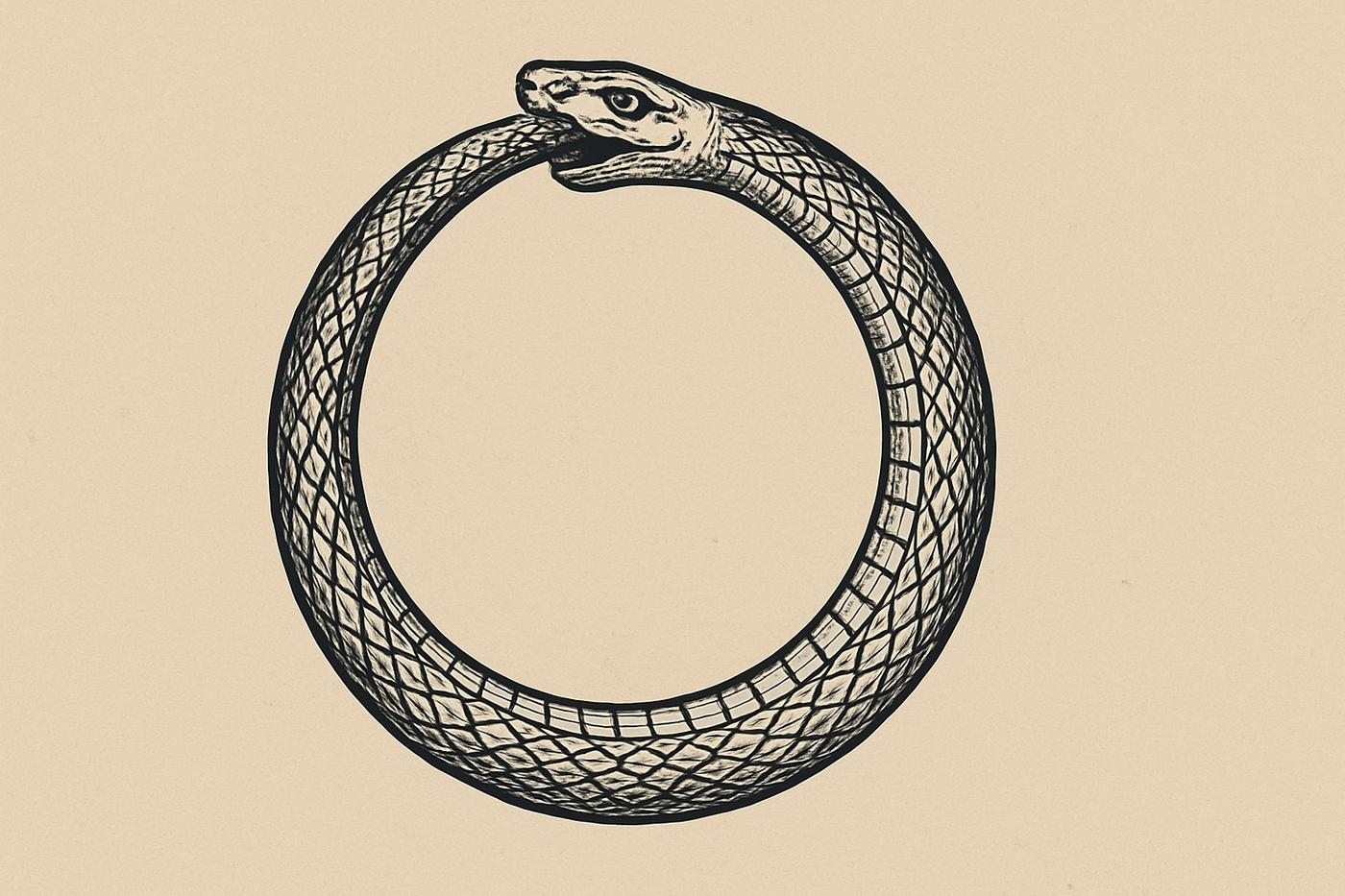
The ouroboros is a circular symbol of a serpent or dragon devouring its own tail, representing infinity, the eternal cycle of death and rebirth, and the unity of opposites contained within one unbroken form. The image is far older than most people realize — it appears in Egyptian tomb art, Greek philosophy, Gnostic and alchemical texts, and now modern tattoo studios, spanning more than 3,000 years of continuous use. This guide covers where the symbol came from, what it means in alchemy, psychology, love, and tattoo culture, how it shows up in pop culture and science, and how it compares to the infinity symbol.
But what does the snake eating its own tail really mean on a deeper level? And why has it endured across so many cultures, religions, and philosophies for over 3,000 years? Jump to any section below, or read straight through for the full picture.
At its core, the ouroboros represents more than just an endless loop — it reflects the way life devours itself and creates again, a self-sustaining universe folded into a single image. It carries four layered meanings that recur across every culture that has adopted it: the eternal cycle of life, death, and rebirth; the unity of opposites, where creation and destruction are treated as one continuous act rather than opposing forces; infinity and wholeness, since the circle has no true start or end; and spiritual transformation, often described as "inner alchemy" — the work of dissolving an old self to allow a new one to emerge.
In modern terms, it's the visual definition of "what goes around comes around." Nothing is ever fully lost; it's converted into fuel for the next cycle.
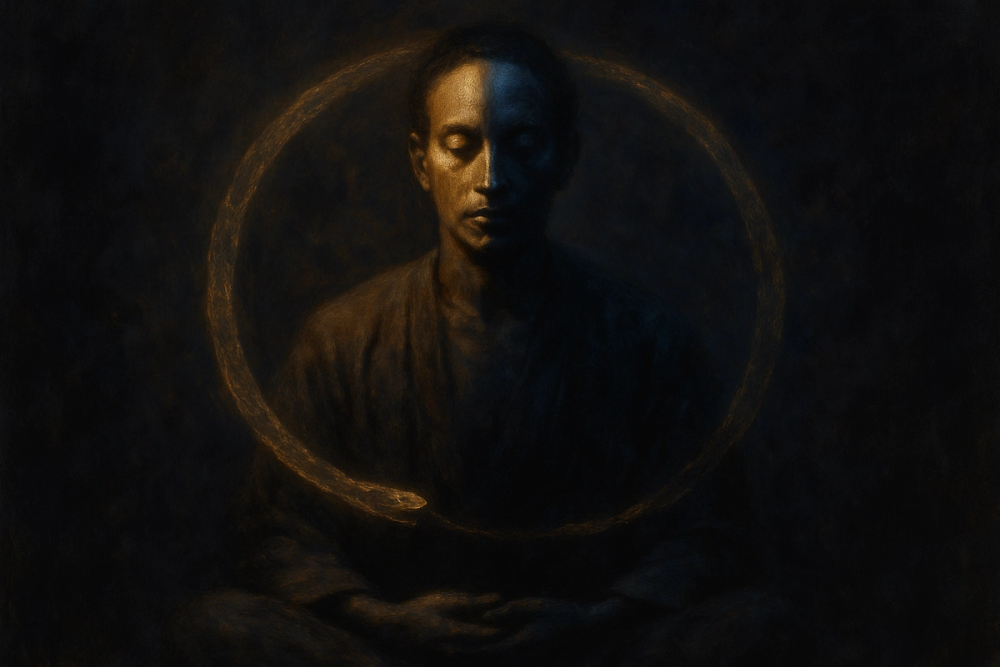
The name "ouroboros" comes from ancient Greek: oura (tail) and bora (eating) — literally, "tail-eater." But the symbol itself predates Greek culture by over a thousand years.
Across each culture, the message was the same: life renews itself, endlessly.
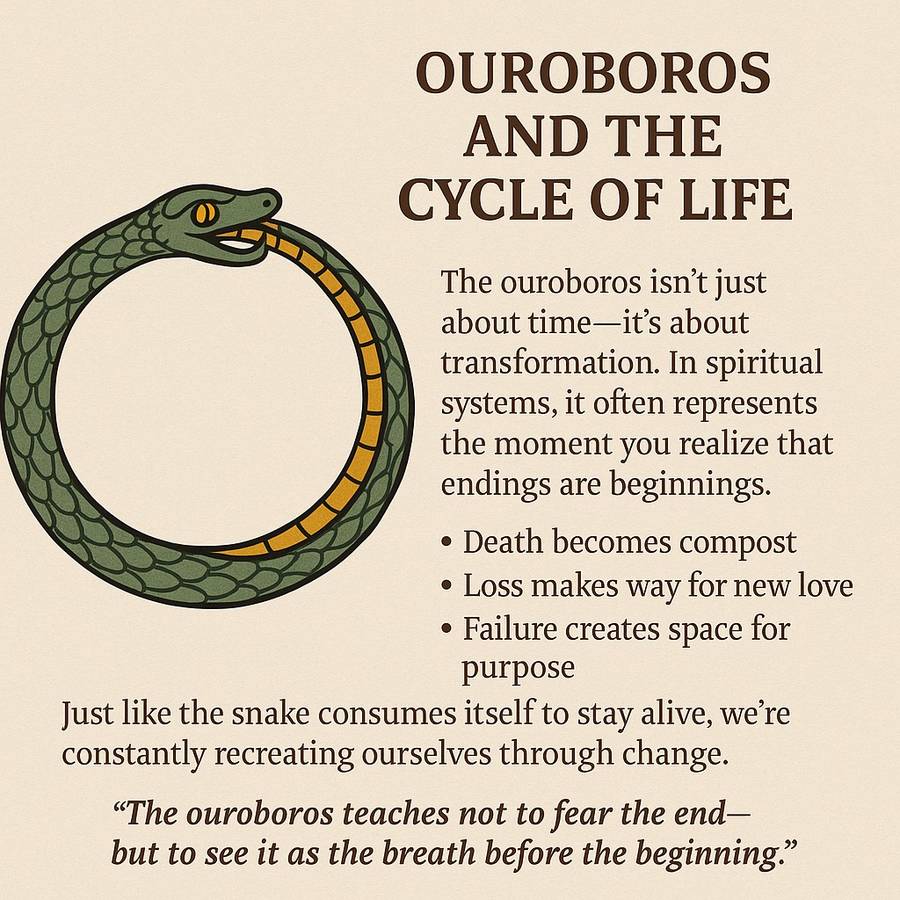
The ouroboros isn't just about time — it's about transformation. In spiritual systems, it often represents the moment you realize that endings are beginnings.
Death becomes compost. Loss makes way for new love. Failure creates space for purpose. Just like the snake consumes itself to stay alive, we're constantly recreating ourselves through transformation and rebirth — a theme echoed by other creatures long associated with death and renewal, such as the crow and the scorpion.
"The ouroboros teaches not to fear the end — but to see it as the breath before the beginning."
This is especially true in personal growth, shadow work, and healing. When you let go of old versions of yourself, you're not dying — you're evolving. That's the essence of the ouroboros: transformation within continuity.
Of all its uses, the ouroboros meaning in alchemy may be the most fascinating. Alchemists believed the ouroboros held the secret to the philosopher's stone — a state of spiritual perfection and unity.
One of the earliest and most cited images of the ouroboros appears in the Chrysopoeia of Cleopatra, a 2nd-to-3rd-century Greek alchemical text attributed to Cleopatra the Alchemist. There, the snake encircles the words:
"The All is One."
In alchemical tradition, this symbol stood for the union of opposites: fire and water, masculine and feminine, life and death. It was about merging everything into a single, eternal truth. The ouroboros became a visual mantra for the transformative process — both in metal and in spirit.
Today, the ouroboros meaning in alchemy still resonates with anyone walking a path of self-transformation, spiritual practice, or even psychological healing.
Can a snake eating its own tail symbolize love? Surprisingly — yes. The ouroboros meaning in love centers around the idea of relationships as ever-evolving cycles of growth, death, and renewal.
In deep, soul-based relationships, you're constantly shedding layers of self and rediscovering one another. You don't "complete" someone — you mirror their transformation. This is the ouroboros at its core: two people growing, falling apart, and choosing to come back together — stronger each time. It's a theme shared by other love and renewal symbols, like swans, known for lifelong bonds, and the hummingbird, a symbol of joy returning after loss.
That's why you'll often see the ouroboros used in wedding rings or matching tattoos. It represents not perfection, but eternal commitment to renewal — love that evolves, adapts, and doesn't fear the end of old dynamics.
At a glance, the ouroboros and the infinity sign might seem interchangeable. But their meanings — while related — have subtle differences worth noting.
| Ouroboros | Infinity Symbol (∞) |
|---|---|
| A living creature—snake or dragon—devouring its own tail | An abstract, mathematical figure-eight shape |
| Represents cyclical transformation: death feeding rebirth | Represents a continuous, unbroken quantity or flow |
| Rooted in mythology, alchemy, and spiritual traditions | Rooted in mathematics and modern design |
| Implies a story: destruction becomes creation | Implies a static, timeless state |
While the infinity symbol expresses a continuous state, the ouroboros infinity meaning speaks to cycles within the infinite — where destruction is not the opposite of creation, but part of it.
Infinity is a concept. Ouroboros is a story.
The ouroboros appears in many ancient cultures, often reimagined but rooted in the same idea — the world renewing itself through itself.
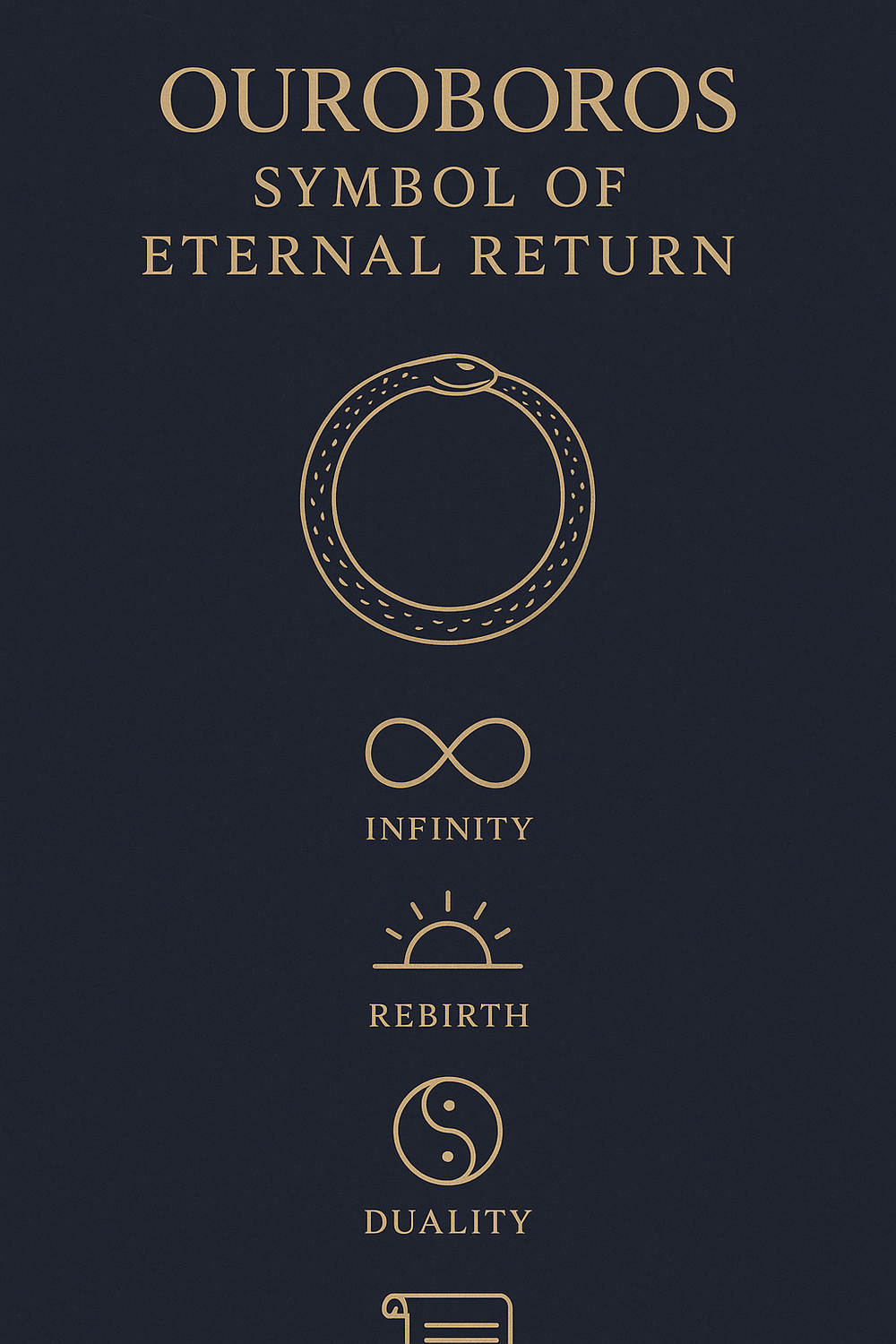
Across time and cultures, the core message repeats: what dies is not gone — it becomes.
Swiss psychologist Carl Jung saw the ouroboros as a powerful archetype of the individuation process — where the conscious and unconscious mind spiral into unity. In his writings on alchemy, notably Psychology and Alchemy (1944), Jung discussed the ouroboros as a symbol appearing repeatedly in alchemical texts to represent the self-devouring, self-generating nature of psychic transformation.
He believed the image represented a person's journey to become whole: embracing shadow, confronting cycles of pain, and integrating all parts of the self — a process closely tied to the kind of quiet wisdom associated with the owl in many symbolic traditions.
From a psychological perspective, the ouroboros is not just cosmic — it's personal. It's about owning your evolution, even the messy, cyclical parts.
Beyond mythology and psychology, the ouroboros has become a fixture of modern storytelling, science, and design — often used as shorthand for cycles, balance, or forbidden knowledge.
In the anime and manga series Fullmetal Alchemist, the ouroboros is used as the mark of the series' homunculus antagonists, tattooed onto their bodies as a symbol of their unnatural, cyclical existence — a modern echo of the alchemical "union of opposites" theme discussed above. The show deliberately borrows real alchemical symbolism, including the ouroboros, to reinforce its themes of equivalent exchange and the consequences of tampering with life and death.
The symbol also has a famous place in the history of science. German chemist August Kekulé claimed that he discovered the ring-shaped structure of the benzene molecule in 1865 after daydreaming of a snake seizing its own tail — a story that, true or embellished, is still taught in chemistry classes today as an example of insight arriving through imagery rather than pure logic. This is why "ouroboros meaning chemistry" is a search people actually make: the symbol is genuinely tied to one of organic chemistry's foundational discoveries.
You'll also spot the ouroboros in video games, fantasy novels, and corporate and brand logos, almost always signaling the same idea in shorthand: something ancient, cyclical, self-sustaining, or dangerous to disturb. Its instant visual recognizability — a circle formed from a single creature — makes it a favorite for designers who want to imply depth without lengthy explanation.
The ouroboros is one of the most requested circular tattoo designs, and its meaning in ink stays close to its ancient roots: cycles, transformation, and resilience. People choose an ouroboros tattoo to mark a major turning point — recovering from illness, ending a relationship, overcoming addiction, or simply closing one chapter of life to begin another.
Design variations matter here. A snake ouroboros tends to lean into themes of quiet, internal transformation and healing, while a dragon ouroboros is often chosen for its association with power, protection, and mastery over change. Some designs keep the tail-eating loop minimal and linear; others incorporate scales, flames, flowers, or phases of the moon inside the circle to personalize the meaning further.
Placement also carries intention. Wrist and forearm placements are popular for a visible, everyday reminder of personal growth. A circular ouroboros wrapped around the upper arm or ankle plays into the natural "loop" of the design, while larger back or spine pieces allow for more intricate detail, often combining the ouroboros with other death-and-rebirth imagery.
Ultimately, an ouroboros tattoo is a wearable reminder that no ending is truly final — it's a way of carrying the eternal cycle of life, death, and renewal on your own skin.
The ouroboros meaning centers around eternal cycles — life, death, rebirth — as well as wholeness, infinity, and spiritual transformation. It's a symbol of the idea that endings feed new beginnings rather than simply stopping them.
No — the ouroboros is not inherently evil or satanic in its historical or traditional use. It originated in ancient Egyptian religious art, Greek philosophy, and Gnostic and alchemical texts as a symbol of unity, eternity, and spiritual transformation, not malevolence.
Its association with "dark" or occult imagery in some modern pop culture and horror media comes from a broader, more recent trend of using serpent and dragon imagery to signal mystery or danger, not from the symbol's actual meaning in the traditions that created it.
The ouroboros meaning in love represents evolving relationships — ones that grow, break, renew, and deepen. It's a symbol of lasting, regenerative love rather than a static, "perfect" bond.
In alchemy, the ouroboros represents the union of opposites and the process of turning lead (the base self) into gold (the higher self). It's the core symbol of transformation used across alchemical texts, most famously in the Chrysopoeia of Cleopatra.
The core meaning of an ouroboros tattoo — cycles, transformation, and resilience — doesn't change based on gender; it's a personal symbol tied to whatever ending or rebirth the wearer has lived through. Softer linework, florals, or moon phases inside the loop are common stylistic choices for a more delicate look, while bolder scales, flames, or a dragon form suit a heavier, more graphic style, but neither is "for" one gender over another.
As for placement, the wrist and forearm are the most popular spots because they're visible daily reminders, while the upper arm, ankle, or spine allow the circular design to wrap naturally around the body.
Not quite. While both represent continuity, the ouroboros infinity meaning adds life, transformation, and spiritual renewal to the concept of eternity, whereas the infinity symbol (∞) is a purely mathematical, static shape.
The earliest known depiction of the ouroboros comes from ancient Egypt, appearing in funerary texts and on King Tutankhamun's tomb around the 14th century BCE. The symbol was later adopted and adapted by the Greeks, Gnostics, and alchemists, who each added their own layers of meaning.
The ouroboros itself is not directly named in the Bible, though serpent symbolism appears prominently in texts like Genesis. It does appear explicitly in Gnostic and Hermetic religious writings, where it was used as an image of divine unity and the all-encompassing nature of God.
Black cats carry centuries of myth, from witches' familiars to Japanese luck charms. Discover their real spiritual meaning today.
Black cat meaning explained: luck, protection, dream symbolism, and spiritual signs across cultures, decoded simply.
Cicada symbolism explained: rebirth, patience, and voice, with dream meanings, cultural history, and ways to work with the sign.